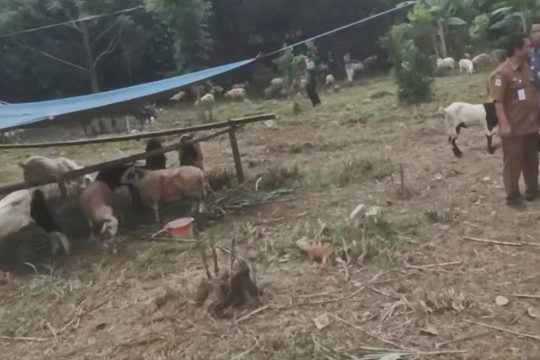
CIKARANG – The controversy over the distribution of sacrificial animals from companies in the Bekasi Regency industrial area has begun to attract attention. The distribution on Tuesday (26/5/2026) was centered in Burangkeng, Setu District, rather than at the Bekasi Regent’s Office government center in Cikarang Pusat.
This is despite a Circular Letter from the Acting Regent of Bekasi, Number 400.8.1/3018/Kesra/2026, concerning the implementation of Eid al-Adha sacrifices, which clearly designates the People’s Welfare Section (Kesra) as the coordinator and committee for distributing sacrificial animals. The Environmental Agency (DLH) has instead actively collected and distributed sacrificial animal donations from several companies.
Based on a letter dated April 30, 2026, signed by the Acting Regent of Bekasi, Asep Surya Atmaja, companies, state-owned enterprises (BUMN), and regional-owned enterprises (BUMD) are requested to distribute sacrificial animals through the Bekasi Regency Government, coordinated by the Kesra Section of the Bekasi Regency Regional Secretariat.
In that letter, the names of Kesra Section officers—Hapiz, Affan, and Bagus—are even listed as contact persons, complete with phone numbers, for data collection and distribution of sacrificial animals.
However, in practice, several companies have been found to be handing over sacrificial animal donations through the Bekasi Regency DLH. This situation raises questions about the legal basis for the DLH to carry out functions that have been administratively assigned to the Kesra Section.
The Director of Research and Data at the Indonesian Governance Forum (FORTALA) assessed that the DLH’s involvement in distributing sacrificial animals not only deviates from its main duties and functions but also has the potential to create a conflict of interest.
“If there is already an official regent’s letter appointing Kesra as the coordinator and distributor, then all regional apparatuses should respect that mechanism. When another technical agency collects or distributes donations from companies, the public has the right to question the motives and interests,” said Hendry.
The DLH is a regional apparatus that has direct contact with many companies, especially regarding environmental supervision, waste management, and various permits related to industrial activities.
This situation is feared to create a perception that sacrificial animal donations are no longer purely a religious social activity but could become a means of building closeness between companies and the agency that supervises them.
Hendry assessed that this practice needs to be explained openly to the public.
“The question is simple: why are companies handing over sacrificial animals through the DLH if there is already an official mechanism through the Kesra Section, as stated in the Acting Regent’s circular letter? This must be explained to avoid creating a perception of a disproportionate relationship between companies and the supervisory agency,” said Hendry.
According to him, the aspect of transparency is very important so that there is no suspicion that social assistance is being used as an instrument to build certain relationships with officials or regional apparatuses.
“In terms of government ethics, any assistance from a party supervised by an agency must be managed carefully. There should be no impression of special closeness that could affect the independence of supervision. This concerns bureaucratic integrity,” he emphasized.
Hendry also requested the Bekasi Regency Inspectorate to investigate the mechanism for collecting and distributing sacrificial animals by the DLH, including ensuring whether this activity has received an official assignment from the regional head.
“If there is a legal basis or official assignment, inform the public. But if there is none, then it needs to be evaluated because it has the potential to cause administrative and governmental ethics problems,” he said.
Until this news was published, there has been no official explanation from the Bekasi Regency DLH regarding the legal basis for their authority to collect and distribute sacrificial animal donations from companies in the industrial area.
Amid demands for clean and transparent governance, the public is now waiting for an explanation: why is a task that has been assigned to the coordination of the Kesra Section being carried out by the Environmental Agency?
Bekasi Regency
Burangkeng
Setu District
Bekasi Regent’s Office government center
Cikarang Pusat
Related news

Court Hearing on Alleged Fraud Involving Dirus TB, Legal Representative: This Case Becomes Civil

Taiwan Travel Fair in Jakarta Showcases the Romantic Charm of Taiwan’s Tourism

Leaked Prices for 18 Square Meter Subsidized Homes, Installments of IDR 600,000 per Month

PT Sinergi Patriot Expands Gas Network, Targets 20 Thousand New Customers