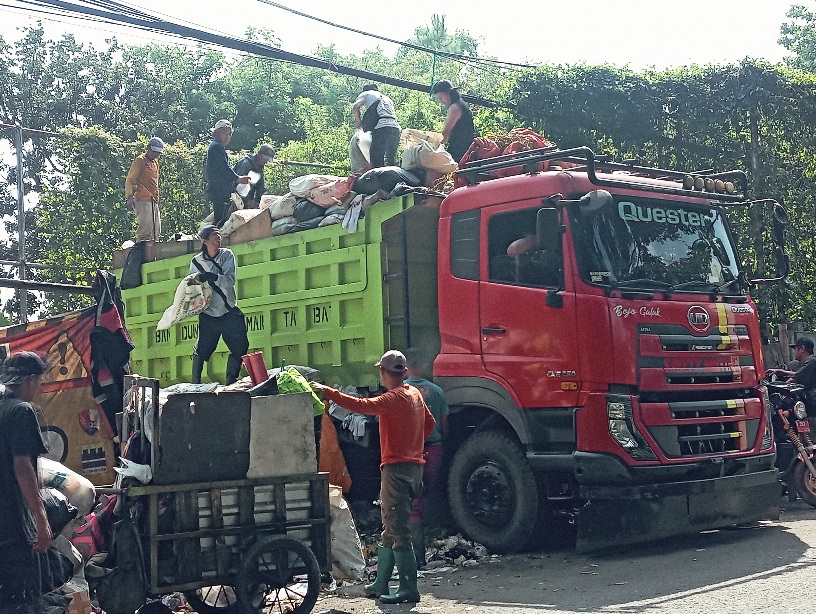
The waste crisis has once again drawn sharp criticism. An environmental observer and chairman of the Java Forest Rescue Forum, Eka Santosa, assessed that the Provincial Government has not seriously addressed the waste issue and the increasingly massive forest conversion occurring in various regions.
Eka stated that the waste problem seems to be stagnating despite having persisted for years. He noted that no concrete steps have yet been taken to truly resolve the fundamental issues of waste management, especially after the Leuwi Gajah landfill tragedy in 2005, which became one of Indonesia’s largest environmental disasters.
“Since that incident, the West Java Provincial Government took over responsibility for regional waste management. But in practice, the waste problem continues to recur and is even becoming more alarming,” said Eka on Thursday (14/5/2026).
Eka also agreed with environmental law expert Nanang Solihin, who stated that the public has the right to file a class action lawsuit against local governments regarding poor environmental management.
Eka highlighted the condition of the Sarimukti Final Disposal Site, which he considered unsuitable as a waste disposal location from the start.
“That area was originally a forest area that was then cleared to be used as a temporary disposal site, not a modern facility with an integrated management system,” he said.
On the other hand, Eka questioned the existence of the Legok Nangka facility, which has yet to function optimally. This project was built with a budget of trillions of rupiah and was touted as the main solution for regional waste management.
“Why is such a large facility left idle when the waste emergency is still ongoing?” said Eka.
Eka revealed that waste production in Bandung Raya reaches around 50 thousand tons per day. However, only about 30 percent of that amount is managed. This condition is seen as evidence of the weak waste management system implemented by local governments.
Eka also mentioned the existence of the Regional Waste Management Agency, which should be at the forefront of handling regional waste.
“The existence of this institution has not shown significant results in solving waste problems on the ground,” he said.
Eka believes the main solution to the waste problem should start upstream, namely reducing waste directly at its source. He has repeatedly conveyed this idea to the government, but it has not received serious attention.
In addition to the waste issue, Eka also highlighted the rampant conversion of forests and plantation land in West Java into residential areas and other non-conservation zones. This condition is considered one of the causes of increased landslides and floods in several regions.
“Many forest areas are cut down and replaced with other plants under the pretext of food security, even though their use is not in accordance with the designated area. As a result, ecosystem balance is disrupted and environmental carrying capacity continues to decline,” said Eka.
Therefore, Eka urged the Governor of West Java to prioritize handling environmental issues, especially waste management and forest area conservation. As chairman of the Java Forest Rescue Forum, Eka also called on law enforcement officials to take firm action against environmental violations in West Java, including the waste problem in Bandung Raya.
Amid these criticisms, Eka appreciated the attention of the new Minister of Environment, Jumhur Hidayat, to environmental conditions in West Java. Eka hopes the ministry will be more active in going directly to the field to see increasingly complex environmental problems.
Meanwhile, the chairman of PHRI West Java, Dodi Ahmad Sofiandi, stated that the waste problem is entirely the government’s responsibility.
“The self-management policy promoted by the Ministry of Environment needs to be implemented seriously with adequate facility support,” said Dodi.
Dodi cited Bandung City, which has 30 sub-districts and ideally should have an independent waste management system in each area. He believes the management concept used in the TMII area could serve as an example, as it is considered effective and does not require large costs.
Additionally, Dodi questioned why Legok Nangka has not been utilized to accommodate residual waste from the community while the waste emergency is still ongoing. He believes the facility could serve as a temporary solution to reduce the waste burden in Band