Why were paired EVMs used only in Bhangar across all of Bengal in the election?
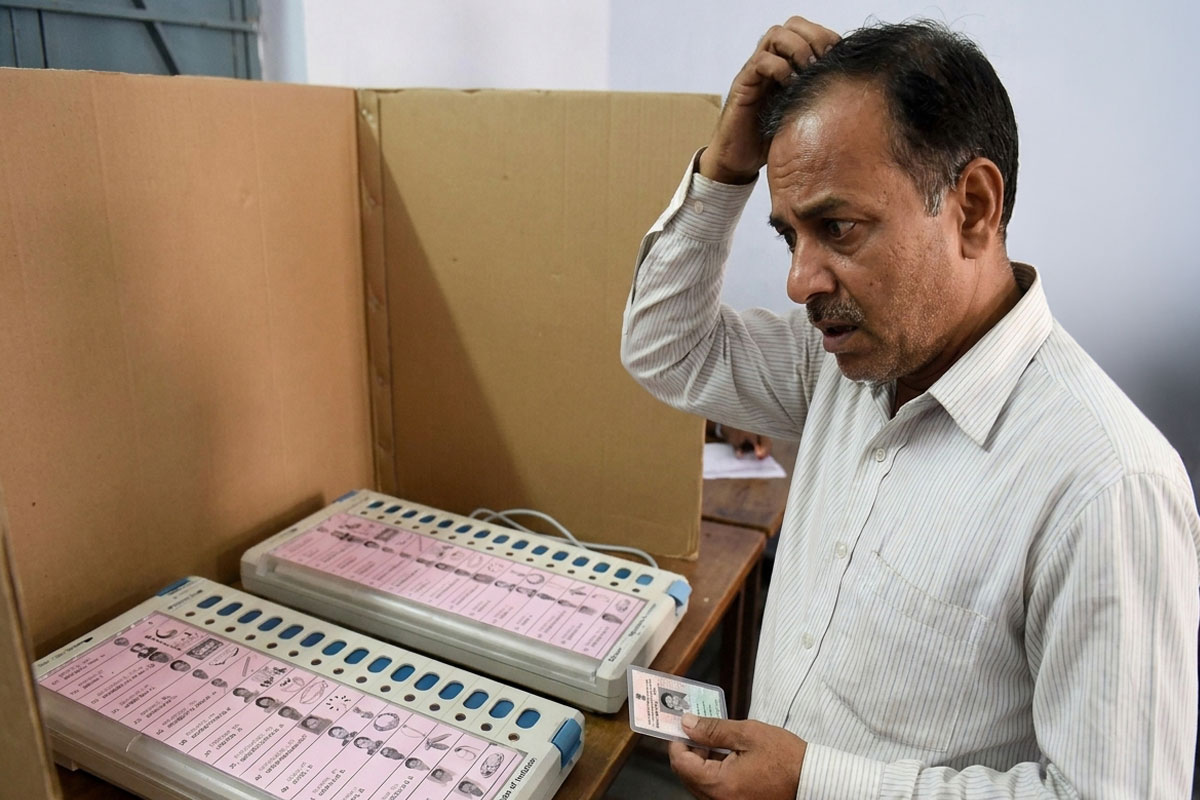
Typically, only one EVM is seen at a polling booth. However, in the upcoming elections, residents of Bhangar are set to witness an unprecedented event. Every booth in Bhangar will have paired EVMs. Across Bengal, Bhangar is the only place where two EVMs will be placed side-by-side in every booth. The Election Commission has made this extraordinary arrangement. But why such an exceptional step? This question naturally arises.
More on this topic
An EVM has a maximum of 16 buttons. 15 buttons contain candidates’ names. The last button is for ‘NOTA’. Therefore, any assembly constituency should ideally have a maximum of 15 candidates. However, this time in Bhangar, 7 candidates from political parties are contesting. Additionally, 12 independent candidates are in the fray. The total number of candidates is 19. Consequently, voting with a single EVM is not possible.
An EVM has a maximum of 16 buttons. 15 buttons contain candidates’ names. The last button is for ‘NOTA’. This means a voter who does not wish to support any candidate can vote using the ‘NOTA’ button. Therefore, any assembly constituency should ideally have a maximum of 15 candidates. However, this time in Bhangar, 7 candidates from political parties are contesting. Additionally, 12 independent candidates are in the fray. The total number of candidates is 19. Consequently, the total number of candidates from all political parties and independents exceeds the maximum number of buttons on a single EVM. As a result, conducting the vote with one EVM is not feasible. This is the reason behind the Election Commission’s decision to place two EVMs side-by-side.
It is worth noting that the number of candidates was also quite high in Coochbehar South and Karandighi. In those cases, the use of paired EVMs might have been necessary. However, after withdrawals and scrutiny, the number of candidates decreased. Currently, the number of candidates there is 15. Therefore, there is no longer a need for paired EVMs. Among Bengal’s 294 assembly constituencies, Bhangar is the only one with 19 candidates. This is why the Commission has taken this exceptional decision. Past statistics indicate that Bengal did not witness the use of such paired EVMs during the last 2021 assembly elections. However, paired EVMs were used in Kolkata South and Jadavpur during the 2024 Lok Sabha elections.
Bhangar
Bhangar is a town in West Bengal, India, located near Kolkata. Historically, it was part of the Sundarbans mangrove forest region and developed as an agricultural and trading center. Today, it is known for its local markets and as a growing suburban area.
Bengal
Bengal is a historical and culturally rich region in South Asia, now divided between Bangladesh and the Indian state of West Bengal. It was a major center of ancient kingdoms, medieval Islamic sultanates, and the British Raj, and is globally renowned for its contributions to literature, art (especially the Bengal Renaissance), and revolutionary movements.
Coochbehar South
Cooch Behar South is a district in the northeastern Indian state of West Bengal, historically part of the ancient Koch Kingdom and later the princely state of Cooch Behar. The region is known for its rich cultural heritage, including the famous **Cooch Behar Palace**, a model of classical European architecture built by Maharaja Nripendra Narayan in the late 19th century. Today, it remains a significant cultural and administrative center, reflecting a blend of indigenous traditions and colonial influence.
Karandighi
Karandighi is a village located in the North Dinajpur district of West Bengal, India. It is historically significant as the site of the **Battle of Karandighi** in 1945, where Indian National Army (INA) forces, led by Netaji Subhas Chandra Bose, fought against the British Raj. Today, it is primarily known as a rural agricultural area with a memorial commemorating its role in India’s independence movement.
Kolkata South
Kolkata South refers to the historic southern districts of Kolkata, India, which contain many of the city’s oldest and most significant cultural landmarks. This area was the heart of the British East India Company’s settlement and later the capital of British India until 1911, home to iconic sites like the Victoria Memorial and St. Paul’s Cathedral. Today, it remains a vibrant center of heritage, colonial architecture, and Bengali culture.
Jadavpur
Jadavpur is a vibrant neighborhood in southern Kolkata, India, historically significant as the site of the 1905 anti-partition movement during India’s struggle for independence. Today, it is best known for the prestigious Jadavpur University, a leading public university established in 1955 that grew from the earlier Bengal Technical Institute. The area remains a major hub for education, arts, and progressive political and cultural activism.