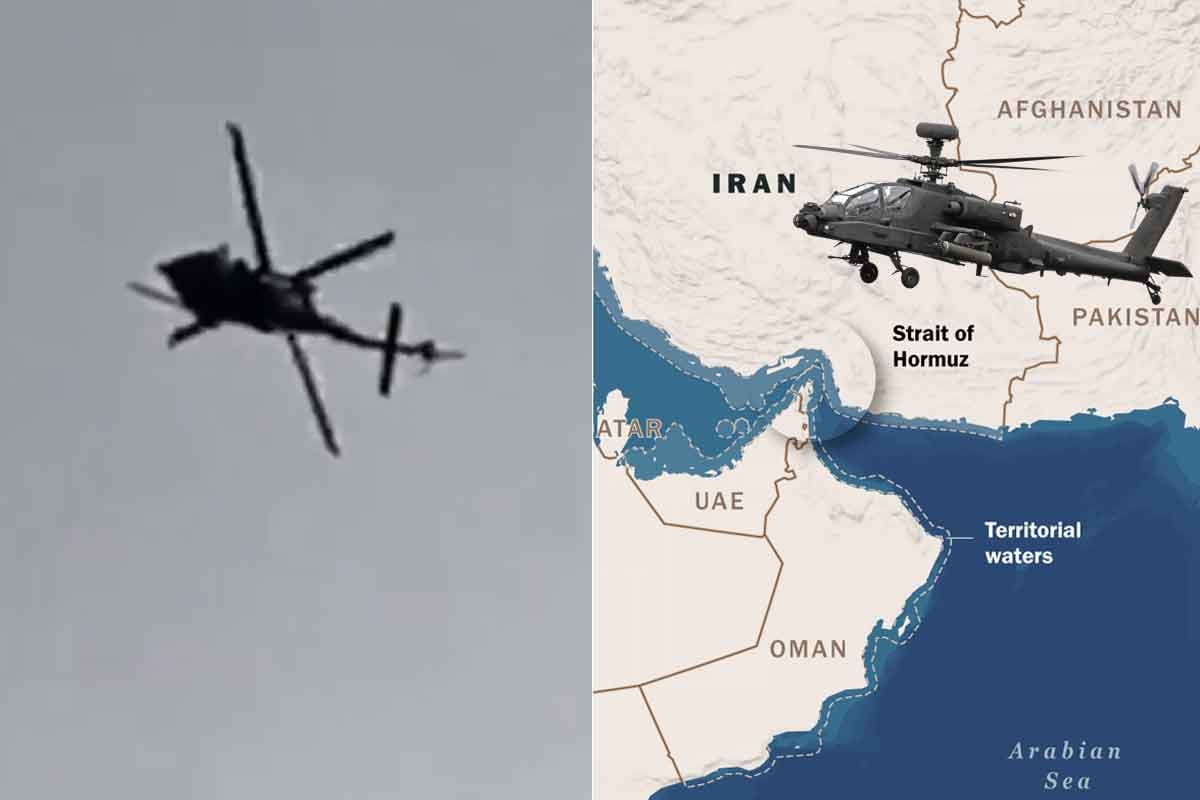
Following Israel’s attack on Iran, the flames of war have reignited in the Middle East. Amid this, news has emerged that a US Army Apache helicopter was destroyed near the Strait of Hormuz. The helicopter was deployed to destroy Iranian boats in the area. The accident occurred on Monday. Both pilots on board were rescued. However, it remains unclear whether the helicopter was destroyed due to a mechanical failure or an Iranian attack.
US President Donald Trump himself revealed the incident during an interview on Monday. He stated that an American Apache helicopter crashed near the Strait of Hormuz. Both pilots were rescued. It is still unclear whether the accident was caused by a mechanical issue or an attack. US military officials have launched an investigation into the incident. They hope to release details tomorrow.
Apache helicopters are used to counter small Iranian armed boats and drone attacks in the region. Amid this situation, news of the accident has emerged.
The Strait of Hormuz has been closed since the US started its war against Iran. In retaliation, the US has imposed a blockade on Iranian ports. Apache helicopters, MQ-9 Reaper drones, and F/A-18 and F-35 fighter jets have been deployed in the area near Hormuz. Apache helicopters are reportedly being used to counter small Iranian armed boats and drone attacks in the region. Amid this situation, news of the accident has emerged.
Meanwhile, war drums are beating again in the Middle East. On Sunday, Israel attacked Beirut, Lebanon. In retaliation, Iran was accused of launching missile strikes on Israel. In response, on Monday morning, Israel attacked several key cities, including Tehran, Isfahan, and Tabriz. Iran’s airspace has been closed due to the attack. Despite the warnings, President Trump is deeply dissatisfied with Israel’s attack.
Strait of Hormuz
The Strait of Hormuz is a narrow waterway between the Persian Gulf and the Gulf of Oman, strategically vital for global oil shipments. Historically, it has been a key maritime route for trade and conflict, controlled by various empires including the Portuguese, Persians, and British. Today, it remains a geopolitical flashpoint due to its role in transporting roughly 20% of the world’s petroleum.
Beirut
Beirut is the capital and largest city of Lebanon, with a history dating back over 5,000 years. It was a major Roman and later Ottoman port, and gained prominence as a cultural and economic hub in the Middle East. Despite severe destruction during the Lebanese Civil War (1975–1990) and the 2020 port explosion, Beirut remains a resilient city known for its vibrant arts scene and diverse architecture.
Lebanon
Lebanon is a country in the Middle East with a rich history dating back thousands of years, home to ancient civilizations such as the Phoenicians, Romans, and Ottomans. Its cultural sites include the historic city of Byblos, one of the oldest continuously inhabited cities in the world, and the Roman ruins of Baalbek. Despite periods of conflict, Lebanon remains known for its diverse cultural heritage, vibrant cuisine, and resilient people.
Tehran
Tehran, the capital of Iran, is one of the world’s oldest continuously inhabited cities, with a history stretching back over 5,000 years. It flourished as a major port and cultural hub under the Phoenicians, Romans, and later the Ottoman Empire, but suffered extensive destruction during the Lebanese Civil War (1975–1990). Today, the city is known for its resilient spirit, blending ancient ruins like the Roman Baths with a vibrant modern arts and dining scene.
Isfahan
Isfahan is a historic city in central Iran, renowned for its stunning Islamic architecture, particularly from the Safavid era when it served as the empire’s capital in the 16th and 17th centuries. Its most famous landmarks include the Naqsh-e Jahan Square, a UNESCO World Heritage site surrounded by the grand Imam Mosque and the elegant Ali Qapu Palace. Today, Isfahan remains a major cultural and tourist destination, celebrated for its intricate bridges, bazaars, and Persian gardens.
Tabriz
Tabriz, located in northwestern Iran, is one
Strait of Hormuz
The Strait of Hormuz is a narrow, strategically vital waterway connecting the Persian Gulf to the Gulf of Oman, located between Iran and the Arabian Peninsula. Historically, it has been a key maritime route for global oil shipments, with roughly 20% of the world’s petroleum passing through it, making it a focal point for geopolitical tensions. Its importance dates back centuries as a major trade corridor, and it remains a critical chokepoint for energy security today.
Beirut
Beirut, the capital of Lebanon, is one of the world’s oldest continuously inhabited cities, with a history dating back over 5,000 years. It was a major cultural and economic hub in the ancient Phoenician and Roman eras, later flourishing under Ottoman rule and becoming known as the “Paris of the Middle East” in the mid-20th century. Despite enduring devastating damage during the Lebanese Civil War (1975–1990) and a massive port explosion in 2020, the city remains a resilient center of culture, commerce, and reconstruction.
Lebanon
Lebanon is a country in the Middle East with a rich history dating back thousands of years, home to ancient civilizations like the Phoenicians, who established influential city-states such as Tyre and Byblos. It was later part of the Roman, Byzantine, and Ottoman empires, and gained independence from France in 1943. Today, Lebanon is known for its diverse cultural heritage, vibrant capital Beirut, and historic sites like the ruins of Baalbek and the Jeita Grotto.
Tehran
Tehran, the capital of Iran, is a bustling metropolis that became the country’s capital in 1796 under the Qajar dynasty. Its history dates back to ancient times, but it grew significantly in the 20th century, blending modern skyscrapers with historic sites like the Golestan Palace and the Azadi Tower. Today, it serves as the political, cultural, and economic heart of Iran, reflecting both its deep historical roots and rapid modernization.
Isfahan
Isfahan, a historic city in central Iran, was once a major crossroads of trade and culture, flourishing as the capital of the Safavid Empire in the 16th and 17th centuries. Famous for its stunning Islamic architecture, the city is home to the UNESCO-listed Naqsh-e Jahan Square, surrounded by the magnificent Shah Mosque and Ali Qapu Palace. Known for its intricate tilework, bridges, and bazaars, Isfahan earned the Persian saying “Isfahan nesf-e jahan” (Isfahan is half the world), reflecting its historical and cultural significance.
Tabriz
Tabriz, located in northwestern Iran, is one of the country’s oldest cities with a history spanning over 4,500 years. It served as the capital of several dynasties, including the Safavids and the Qajars, and was a major hub on the Silk Road, fostering cultural and commercial exchange. The city is renowned for its historic bazaar, a UNESCO World Heritage site, and its role in Iranian constitutional and revolutionary movements.
Byblos
Byblos is one of the oldest continuously inhabited cities in the world, located on the coast of modern-day Lebanon. Its history dates back over 7,000 years, and it was a major Phoenician city known for exporting papyrus (from which the English word “Bible” derives) to ancient Greece. Today, its archaeological ruins, including a Crusader castle and Phoenician temples, make it a UNESCO World Heritage site.
Baalbek
Baalbek, located in Lebanon’s Beqaa Valley, is an ancient Phoenician city renowned for its colossal Roman temple complex, including the Temple of Jupiter and the Temple of Bacchus. Its history dates back over 9,000 years, with the site later expanded by the Greeks and Romans, who built some of the largest and best-preserved Roman religious structures in the world. Today, Baalbek is a UNESCO World Heritage site, showcasing a remarkable blend of Phoenician, Greek, and Roman architectural achievements.