-
The future of the country is being gambled with in Patna. The lives of children who study at coaching institutes for better education are being toyed with. These coaching institutes are fighting among themselves, shedding each other’s blood. They have turned violence into a weapon instead of education.
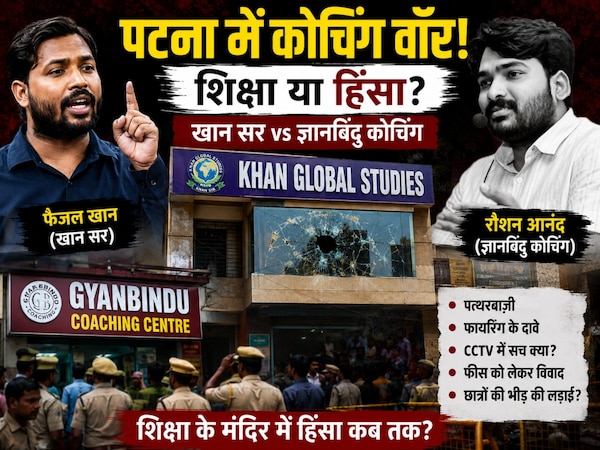
On Tuesday night, a coaching center run by Faizal Khan in Patna was attacked. He alleged that the attack was carried out by a coaching center named Gyanbindu. First, the guard of Khan Global Studies coaching center was beaten. Then, some people attacked his coaching center with stones. The guard was injured in this attack.
This coaching war involved stone-pelting, bloodshed, and arrests. In institutions where pens, books, and knowledge should be discussed, stones are being thrown. How horrifying is this? Those who should educate children and teach them non-violence are engaging in violence. Those who should focus on building children’s futures are risking their lives.
Dr. A.P.J. Abdul Kalam said that teaching is a noble profession that builds a person’s character, ability, and future. But the focus of teachers at some coaching institutes is on creating a mob rather than turning children into better citizens.
When we raised questions against this mindset in DNA, some YouTube teachers running coaching centers became outraged. Social media lynchings of the media began. Faizal Khan also contributed to this ideological lynching by making videos. A troll army was deployed against us, using a specific number: 157. We will also explain the meaning of troll army 157.
When Faizal Khan got news of the stone-pelting, he arrived at his coaching center. There, he saw the marks of the stone-pelting. When the media questioned him, he claimed that there had been several rounds of firing at his coaching center as well.
Teacher Faizal Khan said he saw the firing with his own eyes. He told the police the same thing. When the police asked him for CCTV footage from outside his coaching center, he refused to provide it. Faizal Khan said the camera was broken. The police checked footage from other CCTV cameras in the lane, which only showed stone-pelting. No one was seen firing anywhere. The police dismissed Faizal Khan’s claim of firing.
When morning came, Faizal Khan felt he might have said too much, as usual. He had given extra information about the attack. So in the morning, he said that only after the police investigation would he know the truth. Now understand how Faizal Khan, who made big claims about firing at night, backtracked on his own claims in the morning.
Faizal Khan sir claimed at night that he saw firing with his own eyes. He said that not just one or two, but 8-10 rounds of firing took place in front of him. But as morning came, he started saying that he too would only know the truth after the police investigation, or that the guard would tell the truth once he recovered.
Whether the attack on Faizal Khan’s coaching was with stones or bullets, whatever happened should not have happened. It is reprehensible and dangerous. Whoever did this must face strict action. But when the learned Faizal Khan himself was claiming to have seen the firing with his own eyes, he should have remembered that he is a teacher.
Sarvepalli Radhakrishnan said, “A teacher is not one who only teaches facts, but one who inspires the search for truth.” But after this attack, both the facts and truth of teacher Faizal Khan are questionable. This should not be.
Similarly, it should not happen that where knowledge is discussed and education is given, stones are thrown, there are talks of firing, or guards are seen walking around with rifles. Think, what is a teacher’s job? To teach, to impart knowledge to children. But armed guards are being placed outside coaching centers, and vandalism is happening. What is the need for this?
If this stone-pelting had happened during the day and a student had been hit by a stone, what would
Patna
Patna, the capital of Bihar, India, is one of the world’s oldest continuously inhabited cities, historically known as Pataliputra. It served as the capital of major ancient Indian empires, including the Maurya and Gupta dynasties, and was a center of power, learning, and culture. Today, it remains a significant cultural and political hub, blending its rich ancient heritage with modern development.Khan Global Studies
Khan Global Studies is an educational platform and research initiative that focuses on providing accessible learning resources in global studies, history, and related fields. It aims to bridge cultural and academic gaps by offering courses and materials that explore world civilizations, international relations, and contemporary global issues. While specific historical details about the organization itself are limited, it represents a modern effort to democratize knowledge and foster cross-cultural understanding through digital education.Gyanbindu
Gyanbindu is a significant cultural site in Nepal, known for its ancient pond and temple located in the heart of Kathmandu. According to local legend, the pond was created by the mythological serpent king Karkotak and is believed to have mystical healing properties. The site holds deep religious importance for both Hindus and Buddhists, who visit to perform rituals and seek blessings.Dr. A.P.J. Abdul Kalam
Dr. A.P.J. Abdul Kalam was an Indian aerospace scientist and the 11th President of India, serving from 2002 to 2007. Known as the “Missile Man of India” for his pivotal role in developing ballistic missile and space rocket technology, he also contributed to the country’s civilian space program. His legacy endures as a beloved leader, educator, and author who inspired millions, especially youth, with his vision for a developed India.Sarvepalli Radhakrishnan
Sarvepalli Radhakrishnan (1888–1975) was an Indian philosopher and statesman who served as the first Vice President and second President of India. A renowned scholar of comparative religion and philosophy, he played a key role in introducing Indian thought to the Western world. His birthday, September 5, is celebrated as Teacher’s Day in India in honor of his contributions to education.