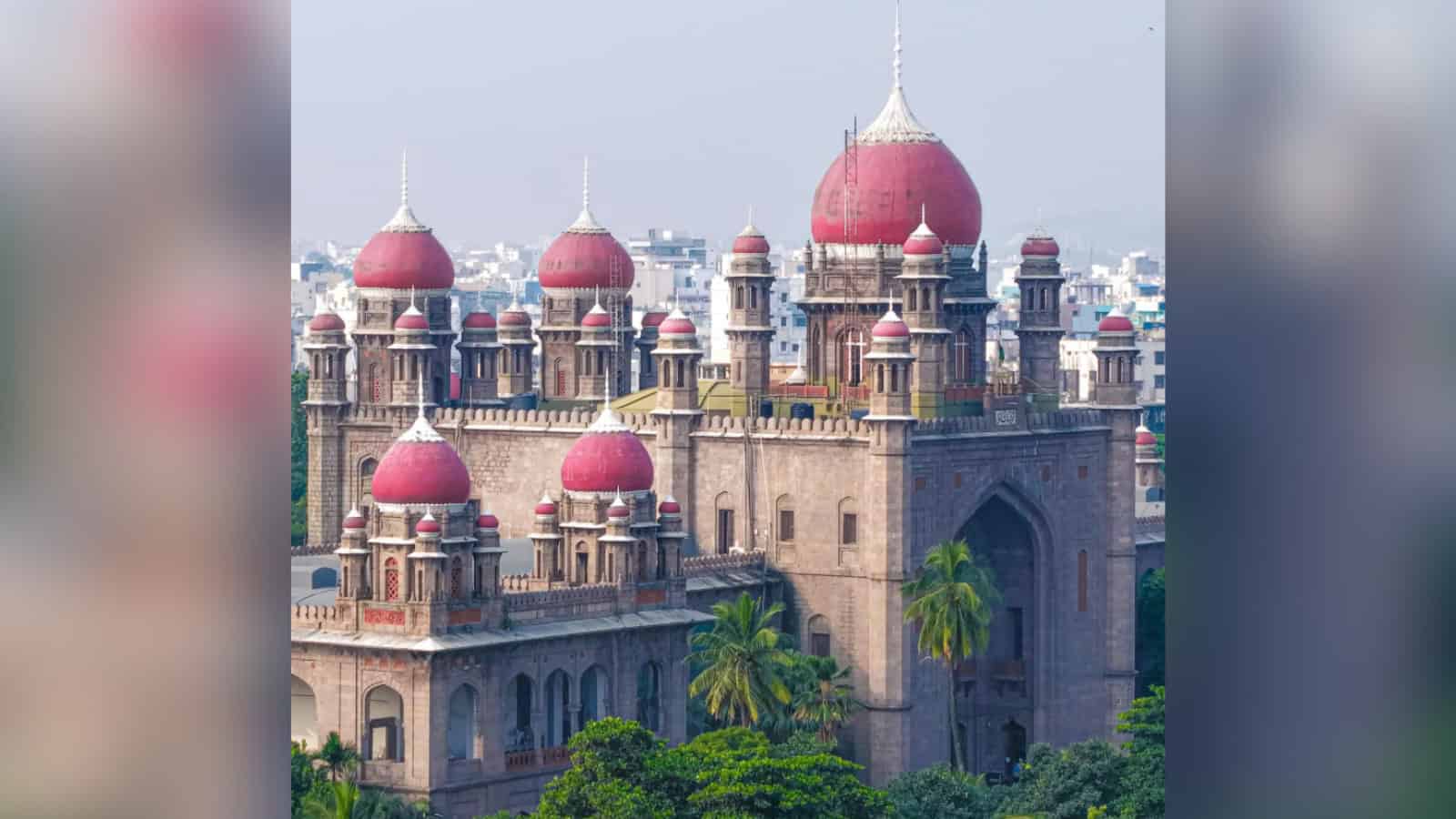
Hyderabad: The Telangana High Court on Monday observed that preventing drinking water pollution is a collective responsibility of all government departments, calling it a critical public health issue that cannot be left to a single agency.
A bench of Chief Justice Aparesh Kumar Singh and Justice GM Mohiuddin stressed the need to ensure that water supplied to the public is free from contamination, noting that pollution extends beyond bacterial presence to include hazardous metals.
The court was hearing a public interest litigation (PIL) taken up based on a letter prompted by a newspaper report on the deteriorating state of the city’s water bodies.
All departments must act, court tells GHMC, others
The bench observed that other departments could not remain indifferent by claiming the issue fell solely within the jurisdiction of the Hyderabad Metropolitan Water Supply and Sewerage Board (HMWSSB). It directed all concerned departments, including the Greater Hyderabad Municipal Corporation (GHMC), to file detailed counter-affidavits.
The court also appointed senior advocate K Vivek Reddy as amicus curiae to assist it in the matter, taking note of the gravity of the situation.
State counsel told the High Court that the water board oversaw supply from both reservoirs and informed the bench that a counter-affidavit had already been filed on behalf of the Pollution Control Board. Counsel for the water board argued that sewage did not mix with the lakes and that water treatment plants were in place.
The bench, however, questioned how untreated sewage was being released into the lakes if that were the case.
Stating that no department could distance itself from the issue by claiming it was unrelated to water supply, the court passed the directions and adjourned the hearing to July 2.
Telangana High Court
The Telangana High Court, located in Hyderabad, was established on January 1, 2019, following the bifurcation of the combined Andhra Pradesh High Court after the state of Telangana was formed in 2014. It serves as the highest judicial body for the state of Telangana, handling civil and criminal appeals. The court operates from the historic Justice City complex in Hyderabad, symbolizing the legal heritage of the region.
Hyderabad Metropolitan Water Supply and Sewerage Board
The Hyderabad Metropolitan Water Supply and Sewerage Board (HMWSSB) is the government agency responsible for providing water supply and sewerage services to the Hyderabad metropolitan area in India. Established in 1989 under the Hyderabad Metropolitan Water Supply and Sewerage Act, it was created to consolidate and manage the city’s water infrastructure, which historically relied on sources like the Musi River and the Himayat Sagar and Osman Sagar reservoirs built in the early 20th century. Today, the board oversees a vast network that includes treatment plants, pipelines, and projects like the Krishna Water Supply Scheme to meet the growing demands of the expanding city.
Greater Hyderabad Municipal Corporation
The Greater Hyderabad Municipal Corporation (GHMC) is the civic body responsible for administering India’s Hyderabad city and its surrounding suburbs. It was formed in 2007 by merging the original Municipal Corporation of Hyderabad with 12 surrounding municipalities and several villages, significantly expanding its jurisdiction. Today, it is one of the largest municipal corporations in India, overseeing urban planning, infrastructure, and public services for a rapidly growing metropolitan population.
<h3 class="text-lg font-semibold mb
Telangana High Court
The Telangana High Court, located in Hyderabad, was established on January 1, 2019, following the bifurcation of Andhra Pradesh and the formation of Telangana state. It succeeded the former Andhra Pradesh High Court, which had operated since 1954, and now serves as the highest judicial body for the state of Telangana. The court is housed in a historic building that blends colonial and modern architectural styles, reflecting its role in the region’s legal heritage.
Hyderabad Metropolitan Water Supply and Sewerage Board
The Hyderabad Metropolitan Water Supply and Sewerage Board (HMWSSB) is a government agency responsible for providing water supply and sewerage services to the Hyderabad metropolitan area in Telangana, India. Established in 1989 under the Hyderabad Metropolitan Water Supply and Sewerage Act, it was formed to manage the growing city’s water needs, drawing from sources like the Krishna and Godavari rivers. The board oversees the distribution of treated water and wastewater management, playing a crucial role in supporting Hyderabad’s urban development and public health.
Greater Hyderabad Municipal Corporation
The Greater Hyderabad Municipal Corporation (GHMC) is the civic body responsible for governing the Indian city of Hyderabad, Telangana. Formed in 2007 by merging the original Municipal Corporation of Hyderabad with 12 surrounding municipalities and several village panchayats, it significantly expanded the city’s administrative boundaries. Today, GHMC oversees the infrastructure, sanitation, and urban planning for one of India’s largest metropolitan areas.
Musi River
The Musi River flows through the city of Hyderabad, India, and has historically been a vital water source for the region, supporting the Golconda kingdom and later the Qutb Shahi dynasty. Its banks are home to iconic landmarks like the Charminar and the Salar Jung Museum, reflecting the area’s rich cultural heritage. However, rapid urbanization and pollution have severely degraded the river, leading to ongoing restoration efforts to revive its ecological and historical significance.
Himayat Sagar
Himayat Sagar is a reservoir located near Hyderabad, India, built in 1927 during the reign of the Nizam of Hyderabad to address the city’s water needs. The dam was constructed across the Musi River and named after Prince Himayat Ali Khan, the second son of the seventh Nizam. It remains a vital water source for the region and is often paired with the nearby Osman Sagar.
Osman Sagar
Osman Sagar, also known as Gandipet Lake, is an artificial reservoir located near Hyderabad, India. It was built in 1920 during the reign of the last Nizam of Hyderabad, Osman Ali Khan, to address the city’s drinking water needs and to prevent flooding after a major plague outbreak. The lake and its surrounding park have since become a popular recreational destination.
Krishna Water Supply Scheme
The Krishna Water Supply Scheme is a major drinking water project in the Indian state of Maharashtra, designed to provide water from the Krishna River to the drought-prone regions of Solapur and surrounding areas. Its history dates back to the early 20th century, with construction beginning in the 1920s and completion in the 1930s, making it one of the oldest and largest water supply systems in Asia. The scheme continues to serve millions of people, addressing chronic water scarcity through a network of canals, tunnels, and pipelines.
Justice City complex
The Justice City complex, also known as the Palace of Justice, is a major judicial center located in Bucharest, Romania. Its construction began in the late 19th century and was completed in 1895, designed by architect Ion Mincu in a neoclassical style. Today, it houses the Bucharest Tribunal and other courts, serving as a symbol of the country’s legal system and architectural heritage.