The northern lights are coming to India, but Hyderabad will miss them.
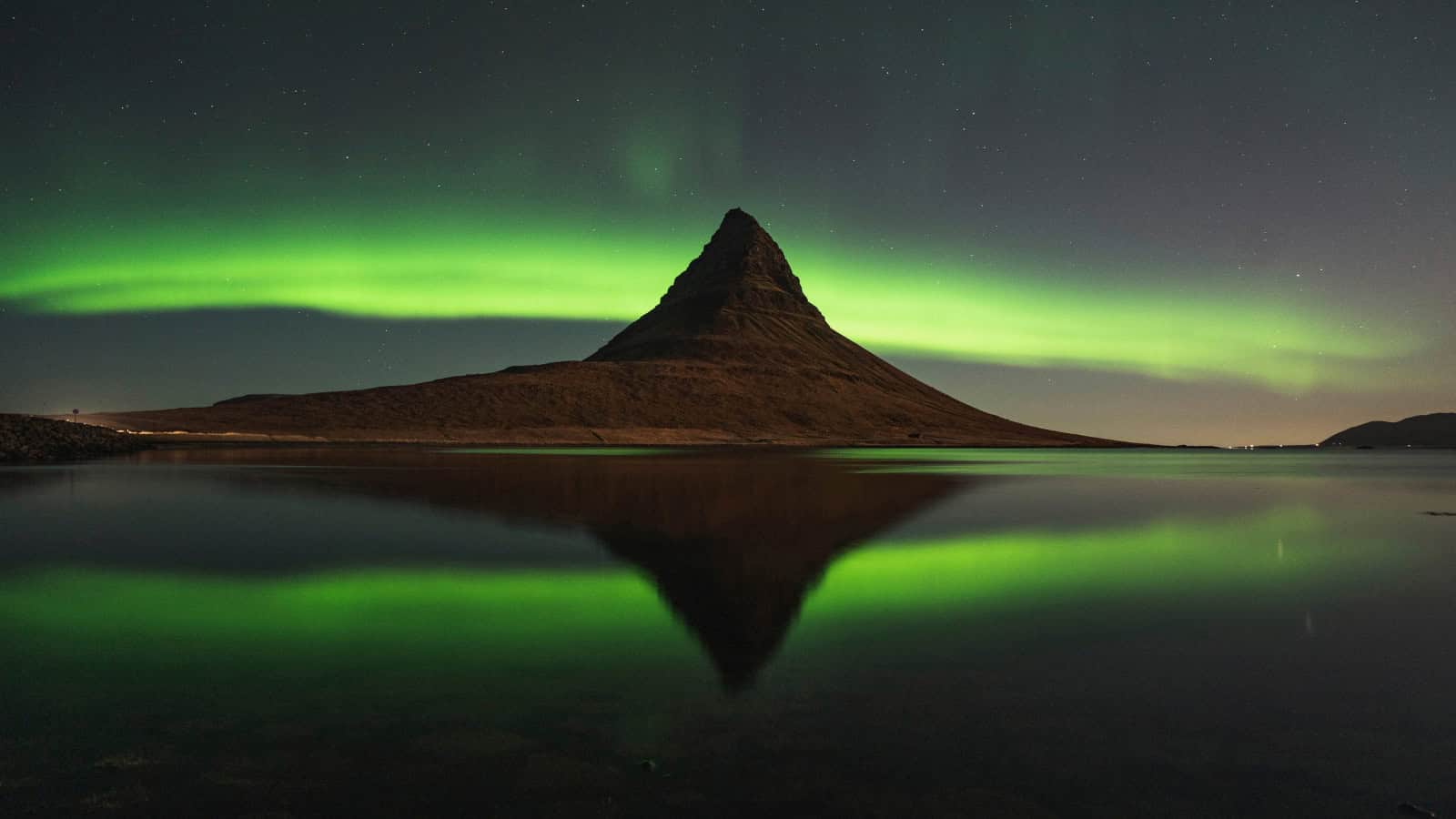
Aurora Borealis over Kirkjufell mountain in Iceland at night, reflecting on calm water.
A billion-tonne cloud of magnetised plasma is hurtling toward Earth at 1,400 kilometres per second, and it will produce one of the rarest light shows the night sky has to offer.
But Hyderabad will not see the northern lights.
The Sun erupted on June 6, hurling the cloud into space. It has been travelling for two days. It arrives on Tuesday, June 8, and the Space Weather Prediction Centre has issued a G3 (“strong”) geomagnetic storm watch, with brief G4 (“severe”) periods possible. The storm peaks between 11:30 PM IST and 2:30 AM IST on Tuesday, June 9.
Auroras, the curtains of green, red and purple light that ripple across the sky when charged solar particles collide with gases in the upper atmosphere, could be visible from parts of India. Hyderabad is not one of those parts, and neither is any other city where most Indians live.
There is exactly one place in India where one can watch it.
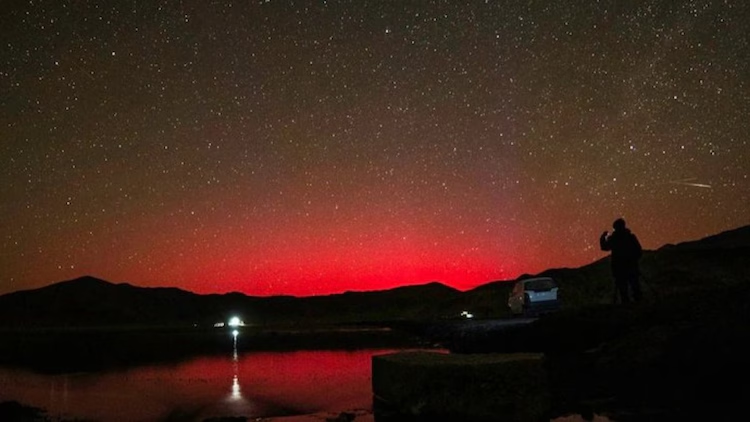
Hanle, in Ladakh, 4,500 metres above sea level, sits at the edge of the auroral oval, the ring of charged light that encircles the poles during a major storm. On January 19 this year, all-sky cameras at the Indian Astronomical Observatory there watched the sky turn red. Scientists at the Indian Institute of Astrophysics confirmed it. An aurora, burning silently above the Himalayan cold desert.
On Monday night, Hanle has a genuine shot at a repeat. High-altitude locations nearby – the Nubra Valley, Pangong Tso, parts of the higher reaches of the Himalayas – carry slimmer but real possibilities. A faint red or pink glow on the northern horizon, visible only to a long-exposure camera and a person patient enough to wait for it.
That is as far south as it goes.
Delhi is cloudless but useless, and the city’s own light has made it blind to this for years. Hyderabad, Mumbai, Kolkata and other areas are under the monsoon.
The rest of the world
Internationally, tonight is a serious event. Scandinavia and nearby regions are near-certain to see displays, the kind that fills the whole northern sky without needing a camera. Northern Germany and parts of Poland are well placed. So is Iceland.
In North America, Minneapolis, Seattle and much of the northern United States sit squarely in the auroral zone.
In the Southern hemisphere, Tasmania, New Zealand’s South Island and the southern tips of Argentina and Chile could see the aurora australis if the storm holds through their night hours.
Live data is available at swpc.noaa.gov, updated by the minute.
For those in Ladakh tonight, face north after midnight, find the darkest ground available, give your eyes 20 minutes to adjust and use a long-exposure camera, as it will see what the naked eye cannot.
Kirkjufell mountain
Kirkjufell, located on Iceland’s Snæfellsnes Peninsula, is one of the country’s most iconic and photographed mountains, known for its distinctive church-like shape. Its history is deeply rooted in Icelandic folklore, with local legends claiming it is a troll or a cursed creature turned to stone. The mountain also gained international fame as a filming location for the “Game of Thrones” television series.
Hanle
Hanle is a remote village in the Indian union territory of Ladakh, known for its breathtaking high-altitude desert landscape and the 17th-century Hanle Monastery, a significant center of Tibetan Buddhism. Historically, it served as an important stop
Kirkjufell mountain
Kirkjufell, located on Iceland’s Snæfellsnes Peninsula, is one of the country’s most photographed mountains, known for its distinctive church-like shape. Its history is rooted in volcanic activity, and it was formed during the Ice Age through glacial erosion of ancient lava flows. The mountain also gained international fame as a filming location for the “Game of Thrones” series, where it appeared as the “arrowhead mountain” north of the Wall.
Hanle
Hanle, located in the remote Ladakh region of India, is a high-altitude village known for the 17th-century Hanle Monastery, a significant Buddhist site of the Drukpa Kagyu sect. The area is also home to the Indian Astronomical Observatory, one of the world’s highest observatories, which has contributed to major discoveries like the detection of exoplanets. Its stark, arid landscape and clear skies make it a unique blend of ancient spirituality and modern science.
Indian Astronomical Observatory
The Indian Astronomical Observatory, located in Hanle, Ladakh, at an altitude of 4,500 meters, is one of the world’s highest sites for optical, infrared, and gamma-ray astronomy. Established in the early 2000s by the Indian Institute of Astrophysics, it houses the 2-meter Himalayan Chandra Telescope, which is remotely operated from Bengaluru. Its pristine, high-altitude desert environment offers exceptional clarity for studying celestial objects.
Hanle Monastery
Hanle Monastery, located in the remote Changthang region of Ladakh, India, is a 17th-century Buddhist monastery founded by the revered scholar and translator Lochen Rinchen Zangpo. It is known for its striking white-and-gold architecture set against the stark Himalayan landscape and holds deep religious significance as a center for the Drukpa Kagyu school of Tibetan Buddhism. Today, it also attracts visitors for its proximity to the Hanle Observatory, a high-altitude astronomical site.
Nubra Valley
Nubra Valley is a breathtaking high-altitude desert region in Ladakh, India, known for its stark landscapes, sand dunes, and the Shyok and Nubra rivers. Historically, it was a key stop on the ancient Silk Road trade route, facilitating commerce between Tibet, Central Asia, and India. The valley is also home to the famous Diskit Monastery and the unique double-humped Bactrian camels, remnants of its historical trade connections.
Pangong Tso
Pangong Tso is a stunning, high-altitude lake situated in the Himalayas, straddling the border between India and China. Known for its mesmerizing ability to change colors from deep blue to emerald green, the lake has historically been a key geographical landmark, though its location has also made it a point of contention in border disputes between the two nations. Despite its remote and often politically sensitive setting, it has gained worldwide fame as a breathtaking natural wonder and a popular filming location.
Himalayas
The Himalayas are a vast mountain range in Asia, stretching across five countries and home to the world’s highest peaks, including Mount Everest. Formed millions of years ago by the collision of the Indian and Eurasian tectonic plates, the range has long been a sacred site in Hinduism, Buddhism, and other traditions, inspiring spiritual pilgrimage and exploration. Today, it remains a major destination for mountaineering and trekking, while its glaciers and rivers sustain millions of people across the continent.
Snæfellsnes Peninsula
The Snæfellsnes Peninsula is a stunning region in western Iceland, often called “Iceland in Miniature” due to its diverse landscapes of glaciers, volcanoes, lava fields, and coastal cliffs. Its most iconic feature is Snæfellsjökull, a glacier-capped stratovolcano made famous by Jules Verne’s novel *Journey to the Center of the Earth*, which is said to be the entrance to the Earth’s core. The area has a rich history of Viking settlement and fishing villages, with sites like the black church at Búðir dating back to the 19th century.