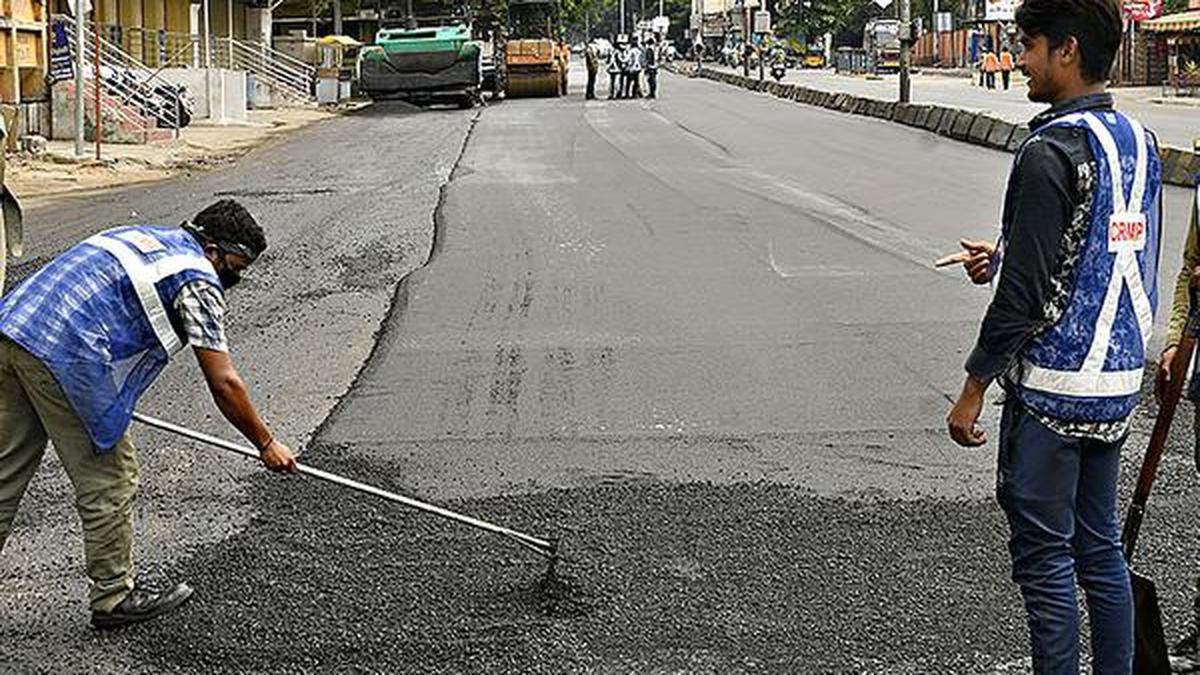

Full Depth Reclamation (FDR), an eco-friendly and cost-effective technology, will be used in laying the blacktop roads as part of the Comprehensive Road Maintenance Programme (CRMP) in its second phase.
The state government sanctioned ₹3,145 crore for the second phase of CRMP, for maintenance of 1,045 kilometres of road length in the CURE area for the coming five years. Of this, ₹2,230 crore has been allocated for road length covered in the first phase, for a length of 744.22 kilometres. Both BT and CC roads in this lot will be laid using conventional method.
A total of ₹208 crore has been allocated for additional CC roads that were not covered in first phase, also in conventional method, for a length of 64.49 kilometres.
These apart, an additional length of 236.3 kilometres of BT road will be laid using FDR technology, for which ₹707 crore has been earmarked.
FDR technology does not involve new materials in laying the road, but uses the debris of the existing road after chemical treatment. The Greater Hyderabad Municipal Corporation (GHMC) had earlier conducted two pilots using the technology, one on the Secretariat Road and the other at Moula-Ali, with the agency doing both free of cost.
Both the roads have lasted for more than eight years without any problem, proving that the technology could cut the road maintenance costs phenomenally, while being eco-friendly.
Road laying process involves a layer of cement on the existing BT road, over which a chemical compound will be sprayed. Later the road will be pulverised up to certain depth, compacted and stabilised to create a strong base, over which a fresh layer of BT will be applied.
These roads are better than white-topped roads in quality, they consume less time in laying, and last longer, experts say.
Government has empowered the GHMC Commissioner to call for tenders for all the three corporations within the Outer Ring Road, namely, GHMC, Cyberabad Municipal Corporation and Malkajgiri Municipal Corporation.
CRMP was first mooted in 2020, when the corporation became the target of public criticism for the road quality in the city. Through this programme, maintenance of major thoroughfares in the city was handed over to private agencies, with strict time frames and quality standards. The programme proved to be a huge success, with all the roads in the programme re-carpeted at least once during the five years. While the first cycle of the programme finished at the start of 2025, the government had delayed the orders for the next phase by over a year.