Ukraine launched its largest-ever attack on Russia with over 500 drones, targeting several regions including Moscow. At least four people were killed in the attack.
Ukraine carried out its largest drone attack on Russia. The overnight strikes targeted multiple areas of Russia, including Moscow. According to Russian officials, more than 500 drones were used in the attack.
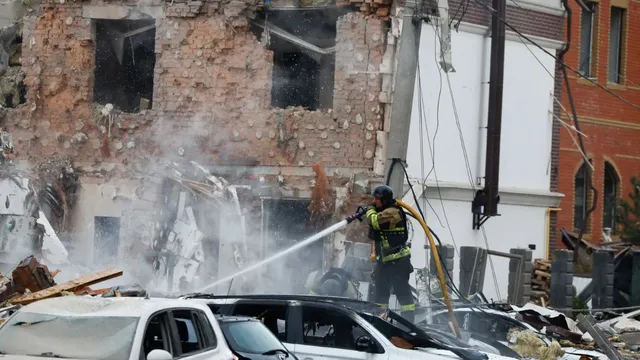
Officials described this as the biggest attack on the Russian capital region in over a year. At least four people were killed and several others were injured. Residential buildings and infrastructure were also damaged in various areas.
Russia destroyed 556 drones
Russia’s Defense Ministry reported that its air defense systems intercepted and destroyed 556 Ukrainian drones across more than a dozen regions during the overnight attack. Explosions and emergency rescue operations were reported around Moscow and western Russia.
According to local officials, at least four people lost their lives in these attacks. Three of the deaths occurred in the Moscow region, and one person died in the Belgorod region near the Ukrainian border.
Moscow region Governor Andrei Vorobyov stated that at least three people were killed in the attacks. According to Vorobyov, a woman died when a drone struck a private residential house, while another person was trapped under debris for hours during rescue operations.
Attacks began early in the morning
In separate incidents related to the attacks, two people were reported killed. Vorobyov wrote on Telegram, “A woman died when a UAV fell on a private house. Another person is trapped under debris.” He further stated that the attacks began early in the morning, forcing Russian air defense units to operate continuously.
He said, “Since 3 a.m., air defense forces have been responding to a massive UAV attack on the capital region.” He also reported that at least four people were injured during the attack, and several infrastructure facilities were targeted.
Although Moscow and surrounding areas have been targeted by Ukrainian drones before, attacks directly impacting the Russian capital have been relatively rare.
Zelensky had issued a warning
Russian officials did not immediately provide full details of the infrastructure damage, but they indicated that residential areas and strategic sites were the main targets of the attack. These latest strikes came just days after Ukrainian President Volodymyr Zelensky vowed to intensify retaliatory actions following a major Russian attack on Kyiv that killed 24 people.
Zelensky warned that Moscow would face consequences for the continued attacks on Ukrainian cities and civilians. In recent days, airstrikes between Moscow and Kyiv have escalated after a prisoner exchange was completed and a three-day temporary ceasefire broke down. That ceasefire ended this week.
Moscow
Moscow, the capital of Russia, is a historic and cultural hub first mentioned in chronicles in 1147. It grew from a small medieval settlement into the center of the Grand Duchy of Moscow, eventually becoming the capital of the Tsardom of Russia and later the Soviet Union. Today, it is known for iconic landmarks like the Kremlin and Red Square, reflecting its rich political and architectural heritage.
Belgorod region
The Belgorod region, located in southwestern Russia near the border with Ukraine, has a rich history as a key defensive frontier since the 16th century, when the Belgorod fortress was established to protect Moscow from Crimean Tatar raids. During World War II, the area was heavily contested and occupied by Nazi forces, with the famous Battle of Kursk (including the tank battle at Prokhorovka) taking place nearby. Today, the region is known for its agricultural production, particularly grain and sunflower oil, and as a center of Russian military activity.
<h3 class="text-lg font-sem
Moscow
Moscow is the capital and largest city of Russia, with a history dating back to its founding in 1147 by Prince Yuri Dolgorukiy. It served as the center of the Grand Duchy of Moscow and later the Tsardom of Russia, playing a pivotal role in the country’s unification and expansion. Today, Moscow is known for its iconic landmarks such as the Kremlin and Red Square, reflecting its rich cultural and political heritage.
Belgorod region
The Belgorod region, located in southwestern Russia near the border with Ukraine, has a rich history as a frontier territory. It was first established as a defensive line in the 16th century to protect the Russian state from Crimean Tatar raids, and later became a key agricultural and industrial hub. During World War II, the region was heavily fought over, and the city of Belgorod was liberated in 1943, an event commemorated with a lasting memorial.
Kremlin
The Kremlin is a historic fortified complex located in the heart of Moscow, Russia, serving as the official residence of the President. Its origins date back to the 12th century, and it has been expanded and rebuilt over centuries, most notably under Ivan the Great in the 15th century. Today, it is a UNESCO World Heritage site, renowned for its iconic cathedrals, palaces, and the famous Red Square adjacent to it.
Red Square
Red Square is a historic plaza in Moscow, Russia, that has served as a central gathering place for political, military, and cultural events since the 15th century. Its name likely derives from the Russian word “krasny,” meaning both “red” and “beautiful,” and it is flanked by iconic landmarks such as the Kremlin, Saint Basil’s Cathedral, and Lenin’s Mausoleum. Throughout history, it has been the site of coronations, parades, and public demonstrations, symbolizing Russian power and identity.
Belgorod fortress
The Belgorod fortress was a key defensive structure in the 16th–17th centuries, built to protect the southern borders of the Russian Tsardom from Crimean Tatar and Nogai raids. It served as a central stronghold of the Belgorod Line, a vast network of fortifications, and played a crucial role in securing and colonizing the region. Today, the original fortress no longer stands, but its legacy is preserved through museums and historical reenactments in the city of Belgorod.
Battle of Kursk
The Battle of Kursk, fought between July and August 1943 on the Eastern Front of World War II, was the largest tank battle in history. It marked a decisive turning point, as the Soviet Red Army successfully repelled the German offensive, permanently seizing the strategic initiative from Nazi Germany. The battle is renowned for the massive armored clash at Prokhorovka and for solidifying Soviet defensive tactics and industrial production as key factors in their eventual victory.
Prokhorovka
Prokhorovka is a rural locality in Russia’s Belgorod Oblast, best known for the massive tank battle that took place there on July 12, 1943, during World War II. This engagement was a key part of the Battle of Kursk and is often cited as the largest tank battle in history, involving hundreds of Soviet and German armored vehicles. Today, the site features a memorial complex and museum dedicated to the battle and its role in the war’s Eastern Front.