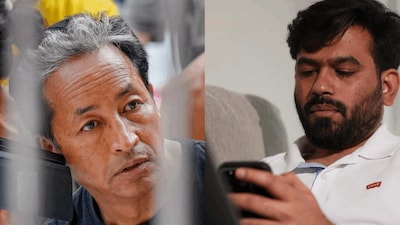
The remarks come as political satire outfit Cockroach Janta Party (CJP) gears up for its first on-ground gathering at Jantar Mantar in the national capital
Climate activist Sonam Wangchuk on Saturday announced that he would go on a 42-day hunger strike if Cockroach Janta Party (CJP) founder Abhijeet Dipke or other members of the group were arrested during the scheduled demonstration at Jantar Mantar in New Delhi.
The statement comes as political satire outfit gears up for its first on-ground gathering at Jantar Mantar in the national capital, which is scheduled to begin at 9 A.M.
In a video message posted on social media, Wangchuk said: “Tomorrow, June 6, I will be coming to Delhi from Ladakh to meet all of you, and I will see you at Jantar Mantar. However, if for any reason they are arrested tomorrow, then I will be compelled to take a step that I do not wish to take. I will begin an indefinite hunger strike from tomorrow itself, and this time it will last six weeks, or 42 days. I am prepared to do that. The question is: what will you do?”
CJP founder Abhijeet Dipke — a 30-year-old political communication strategist and content creator — received permission from Delhi Police to hold a peaceful sit-in protest at Jantar Mantar. The group has now asked supporters to assemble at the protest site, sources said.
Ahead of the demonstration, security has been ramped up across parts of the national capital, with police deploying additional personnel at Jantar Mantar, Indira Gandhi International (IGI) Airport, and other sensitive spots.
Dipke — who arrived from the United States on Saturday — urged his supporters to lead the movement with “love and peace”. In a post on social media, he wrote: “Landed. Looking forward to meeting you all at Jantar Mantar. Do not forget to carry a book and our Tiranga! Offer flowers to policemen as a gesture of compassion and gratitude. We have to lead this movement with love and peace!”
On Friday, the group’s spokespersons, Saurav Das and Ashutosh Ranka, conveyed a list of guidelines “to ensure the movement remains peaceful, disciplined, and respectful of public order”.
The Do’s and Don’ts included carrying the tricolour and a book, recording the proceedings of the demonstration and reporting miscreants to the police.
The group also asked supporters to apply sunscreen, stay hydrated, and bring a cap, to shield themselves against the heat.
Why The CJP Is Protesting?
CJP founder Abhijeet Dipke proposed a “peaceful sit-in protest” to demand the resignation of Union Education Minister Dharmendra Pradhan as he criticised the Centre, alleging that the education system had “failed over one crore students”.
The party also flagged concerns surrounding the recent NEET paper leak case and irregularities in CBSE examinations, along with its OSM portal-related issues.
Jantar Mantar
Jantar Mantar is a collection of astronomical instruments built in the early 18th century by Maharaja Jai Singh II in Jaipur, India. It was designed to observe celestial movements with remarkable precision, using massive stone structures that function as sundials, calendars, and observatories. Recognized as a UNESCO World Heritage Site, it remains one of the most significant historical observatories in the world.
New Delhi
New Delhi is the capital of India, designed and built by British architect Edwin Lutyens in the early 20th century to serve as the seat of British imperial power. Officially inaugurated in 1931, it replaced Calcutta as the capital and features grand boulevards, government buildings, and landmarks like India Gate and the Rashtrapati Bhavan. Today, it stands as a vibrant metropolis that blends colonial heritage with modern Indian culture and politics.
Ladakh
Ladakh, often called “Little Tibet,” is a high-altitude region in northern India known for its stark, breathtaking landscapes and rich Buddhist culture. Its history is deeply tied to the ancient Silk Road trade routes, which brought a blend of Tibetan, Indian, and Central Asian influences, and it was once an independent kingdom before being incorporated into India. Today, Ladakh is famous for its dramatic monasteries, such as Hemis and Thiksey, and its vibrant festivals that preserve centuries-old traditions.
Indira Gandhi International (IGI) Airport
Indira Gandhi International Airport (IGI), located in New Delhi, India, is the country’s busiest and largest aviation hub. Originally opened as Palam Airport in 1930, it was renamed in 1986 after former Prime Minister Indira Gandhi and has since undergone major expansions, including the addition of Terminal 3 in 2010. Today, it serves as a key gateway for international and domestic travelers, connecting India to destinations worldwide.
United States
The United States, founded in 1776 with the Declaration of Independence, is a large and diverse nation in North America shaped by waves of immigration and its evolution from 13 British colonies into a global superpower. Its cultural sites, such as the Statue of Liberty and the Grand Canyon, reflect a complex history of indigenous peoples, European colonization, the struggle for civil rights, and ongoing innovation. Today, the U.S. is known for its influential popular culture, political system, and economic strength.
Tiranga
Tiranga is the Hindi word for the Indian national flag, which features three horizontal stripes of saffron, white, and green, with a navy blue Ashoka Chakra in the center. Adopted on July 22, 1947, just before India gained independence from British rule, the flag symbolizes courage, peace, and prosperity. The design was inspired by the Swaraj flag created in 1921, and it represents the unity and diversity of the Indian nation.
NEET
“NEET” is not a place or cultural site, but an acronym that stands for “Not in Education, Employment, or Training.” It originated in the United Kingdom in the late 1990s to describe young people who are disengaged from both the workforce and formal education, often due to economic challenges, mental health issues, or social barriers. The term has since been adopted globally to highlight a demographic facing significant socioeconomic difficulties.
CBSE
The Central Board of Secondary Education (CBSE) is a national-level board of education in India for public and private schools, established in 1962. It standardized the curriculum across affiliated schools, initially focusing on central government institutions, and has since grown to oversee over 26,000 schools in India and abroad. CBSE is known for its structured syllabus and annual board examinations for classes 10 and 12.