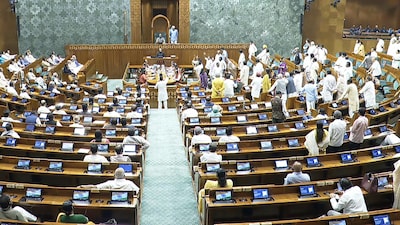
The NDA could find itself closer than ever to the parliamentary strength it enjoyed during its peak years, before the 2024 Lok Sabha polls.
For nearly two years after the 2024 Lok Sabha election, the BJP-led NDA faced one significant parliamentary limitation despite returning to power: it has lacked the numbers required for major constitutional changes without support from outside parties. That arithmetic may now be changing rapidly.
The reported rebellion by 20 Trinamool Congress MPs, the formal collapse of the Congress-DMK alliance, and the earlier shift of seven AAP Rajya Sabha MPs towards the NDA have together created a political situation that would have seemed improbable just months ago.
The question now is whether the ruling alliance is gradually moving towards the kind of dominant parliamentary position that allows governments to pursue much larger structural changes.
The Impact Of TMC Split
At least 20 of the TMC’s 28 Lok Sabha MPs have reportedly written to the Speaker indicating their desire to support the NDA. The rebel group claims it has crossed the crucial two-thirds threshold required under the anti-defection law to seek recognition as a separate bloc.
Under the Tenth Schedule, a split backed by at least two-thirds of a legislature party can avoid immediate disqualification proceedings. For TMC’s 28-member Lok Sabha contingent, the magic figure is 19. The rebels claim support from 20 MPs, putting them above that threshold. If the Speaker ultimately recognizes such a breakaway formation, the impact extends far beyond Bengal politics.
TMC has been one of the largest opposition parties in Parliament and one of the most vocal anti-BJP forces. A bloc of 20 MPs moving into the NDA camp or even providing stable outside support would represent one of the largest parliamentary shifts of the Modi era.
The Parliament Maths
The Lok Sabha currently has 543 elected members. For ordinary legislation, a simple majority is enough. For a Constitutional Amendment Bill under Article 368, however, the government needs support from at least two-thirds of members present and voting, along with a majority of the total membership of the House.
In practical political calculations, parties often use the benchmark of roughly 362 MPs – two-thirds of the full House strength – as the indicator of whether a government can comfortably push constitutional changes without depending on unpredictable outside support.
Step One: The TMC Revolt
The biggest immediate factor is the rebellion within the Trinamool Congress.
Reports indicate that around 20 of TMC’s 28 Lok Sabha MPs have written to the Speaker expressing their willingness to support the NDA.
If those 20 MPs formally shift their support to the government, the NDA’s tally rises from 293 to 313.
The alliance would still remain 47 seats short of the two-thirds mark, but the distance would have narrowed substantially.
This is why the developments in West Bengal are being watched so closely in New Delhi.
The implications extend far beyond state politics.
Step Two: What Happens If The DMK Extends Issue-Based Support?
The second major variable is the DMK.
The DMK’s break with Congress has dramatically altered the opposition landscape.
The party has 22 MPs in the Lok Sabha. There is currently no indication that the DMK is considering joining the NDA. However, parliamentary politics often works through issue-based alignments rather than formal alliances.
If the DMK decides to support the government on select legislation, particularly constitutional or institutional reforms, another 22 votes could effectively become available.
That would take the tally to:
<h3 class="text-lg font-semibold mb-2 text
Lok Sabha
The Lok Sabha is the lower house of India’s bicameral Parliament, representing the people of India through directly elected members. Established under the Constitution of India in 1952, it plays a central role in lawmaking, budget approval, and holding the government accountable. The term “Lok Sabha” translates to “House of the People” in Hindi, reflecting its democratic purpose.
Rajya Sabha
The Rajya Sabha, or the Council of States, is the upper house of India’s bicameral Parliament, established in 1952 under the Constitution of India. It represents the states and union territories, with members elected by state legislatures and appointed by the President, and it serves as a revising chamber for legislation. The Rajya Sabha plays a crucial role in India’s federal structure, ensuring regional interests are considered in the legislative process.
Bengal
Bengal is a historical region in South Asia, now divided between the Indian state of West Bengal and the country of Bangladesh. It was once a powerful and wealthy region under the Bengal Sultanate and later the British Empire, known for its rich culture, literature, and the Bengal Renaissance. Today, it is celebrated for its distinct language, cuisine, and artistic traditions, including the works of Nobel laureate Rabindranath Tagore.
West Bengal
West Bengal, a state in eastern India, has a rich history as the center of British colonial power from 1772 to 1911, when Calcutta (now Kolkata) served as the capital of British India. Known for its vibrant cultural heritage, it is the birthplace of the Bengali Renaissance and iconic figures like poet Rabindranath Tagore. Today, it is celebrated for its diverse traditions, including the Durga Puja festival, and its unique blend of art, literature, and cuisine.
New Delhi
New Delhi is the capital of India, officially inaugurated in 1931 as the administrative heart of British India, designed by British architects Edwin Lutyens and Herbert Baker. It replaced Calcutta as the capital and features grand boulevards and iconic structures like the India Gate and Rashtrapati Bhavan. Today, it serves as the seat of the Indian government, blending its colonial history with a vibrant modern identity.
Tenth Schedule
The “Tenth Schedule” refers to the Anti-Defection Law in India, added to the Constitution in 1985 through the 52nd Amendment. Its purpose is to prevent political defections by disqualifying legislators who voluntarily give up party membership or vote against party directives. The schedule was introduced to combat political instability caused by frequent party-switching, though it has been subject to debate over its impact on internal party dissent.
Article 368
Article 368 refers to the provision in the Indian Constitution that outlines the procedure for amending the constitution itself. It grants Parliament the power to amend any part of the constitution by a two-thirds majority in both houses, followed by ratification by at least half of the state legislatures for certain amendments. This article has been pivotal in shaping India’s constitutional evolution, including landmark changes like the addition of fundamental duties and the abolition of privy purses.
Modi era
“Modi era” refers to the period of Indian politics under Prime Minister Narendra Modi, who took office in 2014. His leadership has been marked by economic reforms, digital initiatives, and a strong focus on Hindu nationalism, as well as controversial policies like the 2016 demonetization and the revocation of Jammu and Kashmir’s special status. This era has significantly reshaped India’s political and social landscape, sparking both widespread support and intense debate.