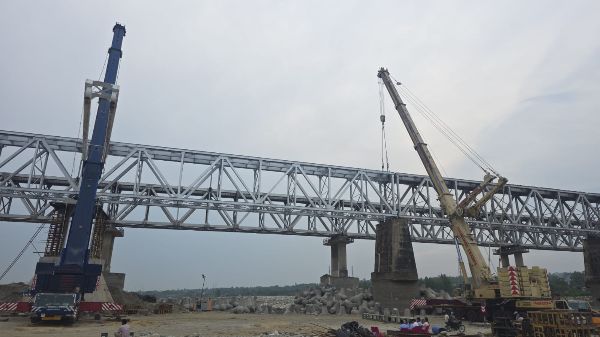
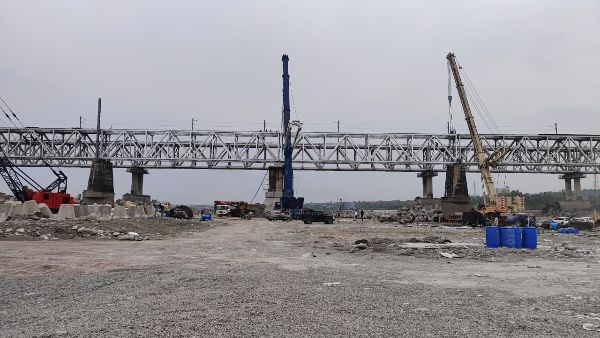
An outstanding example of railway engineering: Jammu division’s damaged bridge number 17 restored in record time.
New Delhi
Northern Railway has successfully completed the restoration of Bridge No. 17. This bridge is a crucial railway bridge over the Ravi River between Kathua (Jammu and Kashmir) and Madhopur (Punjab) sections in the Jammu division.
The bridge was severely damaged during the devastating floods and heavy rains in 2025. Initially, it was estimated that restoring this damaged bridge, which used a non-standard girder design with a 45-meter span, could take about two years. However, thanks to innovative engineering solutions, meticulous planning, and continuous efforts by a dedicated team of railway engineers, the restoration work has been completed in approximately eight months.
With the successful restoration of Bridge No. 17, all five major railway bridges damaged during the unprecedented floods in Jammu and Kashmir and Himachal Pradesh have now been fully restored. The restoration of this important bridge will significantly improve the efficiency and punctuality of train operations in the Jammu division as well as across the entire Northern Railway. This achievement reflects the commitment, technical expertise, and coordinated efforts of railway officials and staff who worked tirelessly to restore rail connectivity in the region as quickly as possible.
Northern Railway remains committed to providing safe, efficient, and reliable rail services to its passengers.
Bridge No. 17
Bridge No. 17, also known as the “Bridge of Spies,” is a historic iron bridge in Potsdam, Germany, that connected East and West Berlin during the Cold War. It gained global fame as the site where captured spies were exchanged between the United States and the Soviet Union, including the 1962 swap of U-2 pilot Francis Gary Powers for Soviet intelligence officer Rudolf Abel. Originally built in the early 20th century, the bridge now symbolizes a key chapter in espionage and Cold War history.
Ravi River
The Ravi River is one of the five major rivers of the Punjab region, flowing through India and Pakistan. Historically, it was known as the Iravati in the ancient Sanskrit text, the Rigveda, and formed part of the fertile Indus Valley Civilization. The river also gave its name to the ancient city of Lahore (originally called Lavapuri), and its waters have been a source of irrigation and conflict, particularly during the partition of India in 1947.
Kathua
Kathua is a city in the Jammu region of Jammu and Kashmir, India, known as the “Gateway of Jammu and Kashmir” due to its strategic location near the border with Himachal Pradesh and Punjab. It has historical significance as part of the ancient princely state of Jammu and Kashmir, and it houses the famous Mata Bhadrakali Temple, which dates back centuries. Today, Kathua serves as an important commercial and cultural hub, blending its rich heritage with modern development.
Madhopur
Madhopur is a historic village in the Indian state of Punjab, best known for the Shahid Ganj Gurudwara, which commemorates the martyrdom of Sikhs during the 18th-century conflicts. The site holds religious significance for Sikhs, as it marks where many devotees were killed while protecting their faith. Today, it remains an important pilgrimage destination, reflecting the region’s deep spiritual and historical heritage.
Jammu
Jammu is a city in northern India that serves as the winter capital of the union territory of Jammu and Kashmir. Historically, it was the capital of the Dogra dynasty, which ruled the region from the 19th century until India’s independence in 1947. Known as the “City of Temples,” Jammu is famous for its numerous Hindu shrines, including the revered Vaishno Devi temple located in the nearby Trikuta Mountains.
Punjab
Punjab is a historic region in South Asia, divided between India and Pakistan, known as the “Land of Five Rivers.” It was the cradle of the Indus Valley Civilization and later became the heartland of the Sikh religion, with the Golden Temple in Amritsar as its spiritual center. The region has a rich history of empires, including the Mughals and the British, and is famous today for its vibrant culture, agriculture, and cuisine.
Jammu and Kashmir
Jammu and Kashmir is a region in the northern part of the Indian subcontinent, known for its stunning Himalayan landscapes and rich cultural heritage. Historically, it was a princely state under British rule before acceding to India in 1947, leading to ongoing disputes with Pakistan and China. The region is renowned for its diverse traditions, including Kashmiri Sufi music, intricate handicrafts, and the iconic Dal Lake in Srinagar.
Himachal Pradesh
Himachal Pradesh, located in the northern Himalayas of India, is a scenic state known for its mountain landscapes, hill stations, and spiritual sites. Historically, it was part of the ancient Trigarta kingdom and later ruled by various Rajput dynasties before becoming part of British India. After India’s independence, it was established as a state in 1971, and today it is a popular destination for tourism and pilgrimage.