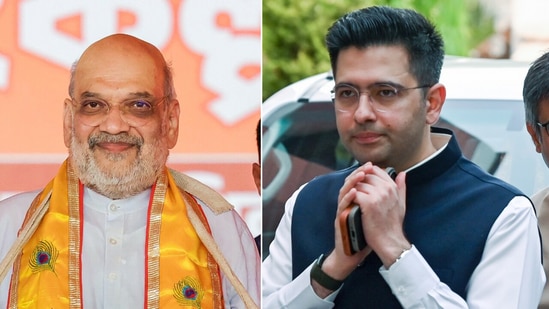
BJP’s decision to accommodate disgruntled AAP MPs was taken around the time Amit Shah visited Punjab for a rally in Moga on March 14.

The dramatic exit of seven Aam Aadmi Party (AAP) MPs may have unfolded in a single day, but the groundwork, it appears, was laid weeks earlier.

Home minister Amit Shah's Moga rally set the stage for Raghav Chadha-led AAP exodus
Home minister Amit Shah’s Moga rally set the stage for Raghav Chadha-led AAP exodus

What seemed sudden on Friday is now being seen as part of a longer political build-up that traces back to Punjab — and crucially, to a visit by the Union home minister.

The Bharatiya Janata Party’s decision to accommodate disgruntled AAP MPs was taken around the time Amit Shah visited Punjab for a rally in Moga on March 14. The so-called Badlav Rally is now being viewed as a key moment in the sequence that led to the defections.

AAP’s internal churn before exits

According to people familiar with the matter, the roots of the current crisis can be traced back to 2024, when two parallel developments began to shape the situation — preparations for the Delhi elections gathered pace, and discontent started brewing among some AAP leaders over the functioning of the party’s Punjab government.

However, the cracks became evident earlier this month, when on April 2, the party moved to remove Raghav Chadha as its deputy leader in the Rajya Sabha, citing his inability to raise key issues and accusing him of focusing on “soft issues.”

BJP national president Nitin Nabin, second right, meets Rajya Sabha members Raghav Chadha, right, Sandeep Pathak, left, and Ashok Mittal at the party's headquarters, in New Delhi on Friday.
BJP national president Nitin Nabin, second right, meets Rajya Sabha members Raghav Chadha, right, Sandeep Pathak, left, and Ashok Mittal at the party’s headquarters, in New Delhi on Friday.

Ashok Mittal was brought in as a partial replacement, but that recalibration did little to steady the situation — with Mittal himself among those who switched sides on Friday.

While the BJP formally inducted Chadha along with Sandeep Pathak and Ashok Mittal in the presence of party chief Nitin Nabin, questions remain over whether the move will translate into electoral gains in Punjab.

‘Ginger, garlic, cumin… can’t become vegetable’

Political reactions from the state suggest that the BJP’s strategy may not necessarily pay off. “The thing about Punjab voters is that they are a different lot. They don’t like ‘gaddars’ (traitors). I have a feeling that this may end up helping AAP,” said a Congress MP from the state.

The leader also pointed out that none of the seven MPs carried a strong grassroots base that the BJP could leverage.

Punjab chief minister Bhagwant Mann also mounted a strong counterattack, dismissing the political weight of the defectors.

“Ginger, garlic, cumin, fenugreek powder, red chili, black pepper, and coriander—these 7 things together make the vegetable taste great, but on their own, they can’t become a ‘vegetable.'”

He didn’t stop there. “Let me be clear—none of them is capable of becoming even a village sarpanch on their own merit,” he said earlier during a press conference.

“The party is bigger than any individual. These 6-7 people who have left do not comprise Punjab. They were not mass leaders,” Mann added.

BJP ‘trying to break’ AAP, says Punjab CM

Escalating the attack on the BJP, Mann said, “The BJP’s lack of political ground has pushed it towards such tactics even as visible improvements in schools, hospitals, roads, and employment have unsettled


Moga

Moga is a city in the Indian state of Punjab, historically significant as part of the Malwa region. It was a key center during the Indian independence movement, notably associated with the 1921 massacre at the nearby village of Nankana Sahib. Today, Moga is known for its agricultural economy and as a hub for dairy and textile industries.

Punjab

Punjab is a historical and cultural region straddling India and Pakistan, known as the “Land of Five Rivers.” It has a rich history shaped by the Indus Valley Civilization, the Vedic era, and the rise of Sikhism under Guru Nanak in the 15th century, later becoming central to the Sikh Empire under Maharaja Ranjit Singh. Today, it is renowned for its vibrant festivals, hearty cuisine, and significant sites like the Golden Temple in Amritsar.

Delhi

Delhi, the capital of India, is a historic city that has been continuously inhabited for over two millennia, serving as the capital of several ancient empires, including the Mughals. It is renowned for its rich cultural heritage, featuring landmarks like the Red Fort, Qutub Minar, and Humayun’s Tomb, which reflect its layered history. Today, Delhi is a bustling metropolis that blends its ancient past with modern development, making it a vibrant center of politics, culture, and commerce.

Rajya Sabha

The Rajya Sabha, or Council of States, is the upper house of India’s bicameral Parliament, established in 1952 under the Constitution of India. Unlike the Lok Sabha, its members are not directly elected by the public but are chosen by state legislatures and the President, representing India’s diverse states and union territories. It serves as a revising chamber, reviewing legislation passed by the Lok Sabha, and its members serve staggered six-year terms to ensure continuity.

New Delhi

New Delhi is the capital of India, designed and built by the British in the early 20th century to replace Calcutta as the center of colonial power. It was officially inaugurated in 1931 and later became the capital of independent India in 1947. The city is known for its grand boulevards, historic landmarks like India Gate and Rashtrapati Bhavan, and its blend of British and Indian architectural styles.

BJP’s headquarters

The BJP’s headquarters, known as the **Bharatiya Janata Party headquarters**, is located at **11, Ashoka Road** in New Delhi, India. Established in 1980, the building serves as the central office for India’s ruling political party, hosting key meetings and strategy sessions. It holds historical significance as the hub from which the party’s major political campaigns and governance decisions have been coordinated, particularly during its rise to national prominence.