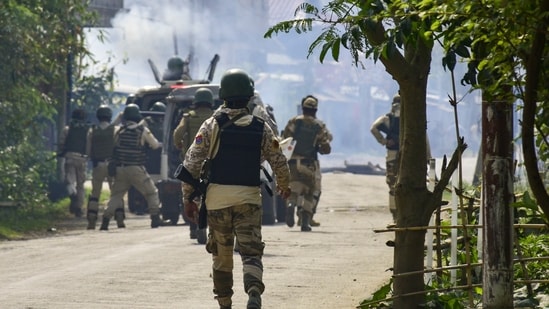
Kukis alleged that heavily armed cadres of NSCN-IM and its proxy outfit ZUF (K) attacked the village.
Three people were killed and seven houses were reduced to ashes in a suspected militant attack on Loibol Khullen village in Manipur’s Kangpokpi district early Friday, according to Kuki Inpi Manipur (KIM), the apex body representing the Kuki-Zo tribes in the state.
In a statement issued on June 5, KIM alleged that heavily armed cadres of NSCN-IM and its proxy outfit ZUF (K) attacked the village at around 4 am. The organisation said the assault killed three civilians, destroyed seven houses and caused extensive damage to civilian properties.
The deceased were identified as Letkhongam Haokip, his wife Tinmary Haokip and Jangminlal Haokip, all residents of Loibol Khullen. According to a separate statement issued by the Kuki Students’ Organisation (KSO), South West Sadar Hills, the victims were aged 34, 30 and 34 respectively.
Police is yet to comment on the incident.
KIM condemns ‘barbaric’ attack
Condemning the incident, KIM described the assault as a “barbaric act of violence” against unarmed civilians and said the deliberate killing of innocent people and destruction of homes constituted a serious violation of human dignity and fundamental human rights.
The organisation extended condolences to the bereaved families and expressed solidarity with residents affected by the violence, saying the attack had caused “immeasurable grief” to the Kuki-Zo community.
Demand for probe and security measures
KIM called on the Government of India and security agencies to launch an immediate investigation into the incident, apprehend those responsible and ensure justice is delivered without delay. It also urged authorities to strengthen security in vulnerable villages to prevent further attacks on civilians.
“The perpetrators of this heinous crime must be held fully accountable,” the organisation said, adding that it would not be responsible for any consequences arising from the attack on the Kuki-Zo community.
Fresh violence amid prolonged ethnic conflict
The incident comes against the backdrop of more than three years of ethnic tensions and violence in Manipur. The conflict began in May 2023 after clashes between the Meitei and Kuki-Zo communities following protests over the Meitei community’s demand for Scheduled Tribe status. The violence quickly spread across the state, leading to widespread killings, arson and displacement.
According to various official and media estimates cited over the course of the conflict, more than 250 people have been killed and around 60,000 displaced since the unrest erupted in May 2023. Large numbers of people from both communities continue to live in relief camps, while several districts remain divided along ethnic lines.
Although the intensity of violence has reduced compared with the early months of the conflict, sporadic gun attacks, ambushes and clashes continue to be reported from parts of Kangpokpi, Imphal East, Churachandpur and other districts.
No response from groups named
Separately, the KSO South West Sadar Hills alleged that militants belonging to VBIG, ZUF-Kamson and NSCN (IM) were involved in the attack and accused Naga insurgent groups of targeting Kuki ancestral areas.
There was no immediate response from NSCN-IM, ZUF (K) or other groups named in the statements.
Loibol Khullen village
Loibol Khullen village is a historic settlement in Manipur, India, known as one of the oldest villages of the Kuki-Chin-Mizo ethnic group, the Thadou community. It holds cultural significance as a site of traditional governance and rituals, with its origins dating back several centuries. The village preserves ancient customs, including the sacred *Loibol* tree, which serves as a symbol of unity and heritage for the local people.
Manipur
Manipur is a state in northeastern India known for its rich cultural heritage and scenic landscapes, often called the “Jewel of India.” Historically, it was an independent kingdom with a distinct identity, marked by the reign of the Meitei rulers and the introduction of Hinduism in the 18th century, before being annexed by the British in 1891 and later merging with India in 1949. The region is famous for its classical dance form, Manipuri dance, and the annual Sangai Festival, which celebrates its unique biodiversity and traditions.
Kangpokpi district
Kangpokpi is a district in the northeastern Indian state of Manipur, known for its scenic hills and diverse tribal communities, including the Thadou and Kuki peoples. Historically, the area was a significant site during the Anglo-Manipur War of 1891 and later became a center for tribal identity and administration. The district was officially created in 2016, carved out of the larger Senapati district to improve local governance and development.
Kuki-Zo community
The Kuki-Zo community is an indigenous ethnic group primarily inhabiting the northeastern states of India (such as Manipur, Nagaland, and Mizoram), as well as parts of Myanmar and Bangladesh. Historically, they are believed to have migrated from Southeast Asia centuries ago, and they share cultural and linguistic ties with other Zo tribes. The community has faced significant challenges, including conflicts over land and identity, and has been involved in political movements for greater autonomy and recognition within India.
Imphal East
Imphal East is a district in the Indian state of Manipur, known for its historical significance and rich cultural heritage. It includes the site of the Battle of Imphal, a key World War II confrontation in 1944 where Allied forces halted the Japanese advance into India. The district also features landmarks like the Kangla Palace and the Ima Keithel (Mother’s Market), reflecting the region’s royal history and vibrant traditions.
Churachandpur
Churachandpur is a major town and district in Manipur, India, known for its vibrant tribal culture and being a key commercial hub. Historically, it was named after Maharaja Churachand Singh, a ruler of Manipur, and served as a significant site during the British colonial era. Today, it is recognized for its diverse ethnic communities and scenic landscapes, including the nearby Thangjing Hills.
Kuki ancestral areas
The Kuki ancestral areas are traditionally located in the mountainous regions of Manipur, Nagaland, and Assam in Northeast India, as well as parts of Myanmar. These lands are historically significant as the original homeland of the Kuki-Zo people, who have inhabited the region for centuries, with their history marked by tribal migrations, clan-based societies, and resistance against colonial rule during the Anglo-Kuki War of 1917–1919. Today, these areas remain culturally vital, preserving the Kuki language, traditions, and identity amid ongoing socio-political discussions about autonomy and recognition.
Naga insurgent groups
The term “Naga insurgent groups” refers to various armed separatist organizations from the Naga ethnic communities in northeastern India, who have fought for greater autonomy or an independent sovereign state since the mid-20th century. The conflict stems from historical grievances following British colonial rule and the region’s integration into India, with the most prominent group being the National Socialist Council of Nagaland (NSCN). Decades of insurgency have led to numerous peace talks, ceasefires, and ongoing negotiations between the Indian government and different Naga factions.