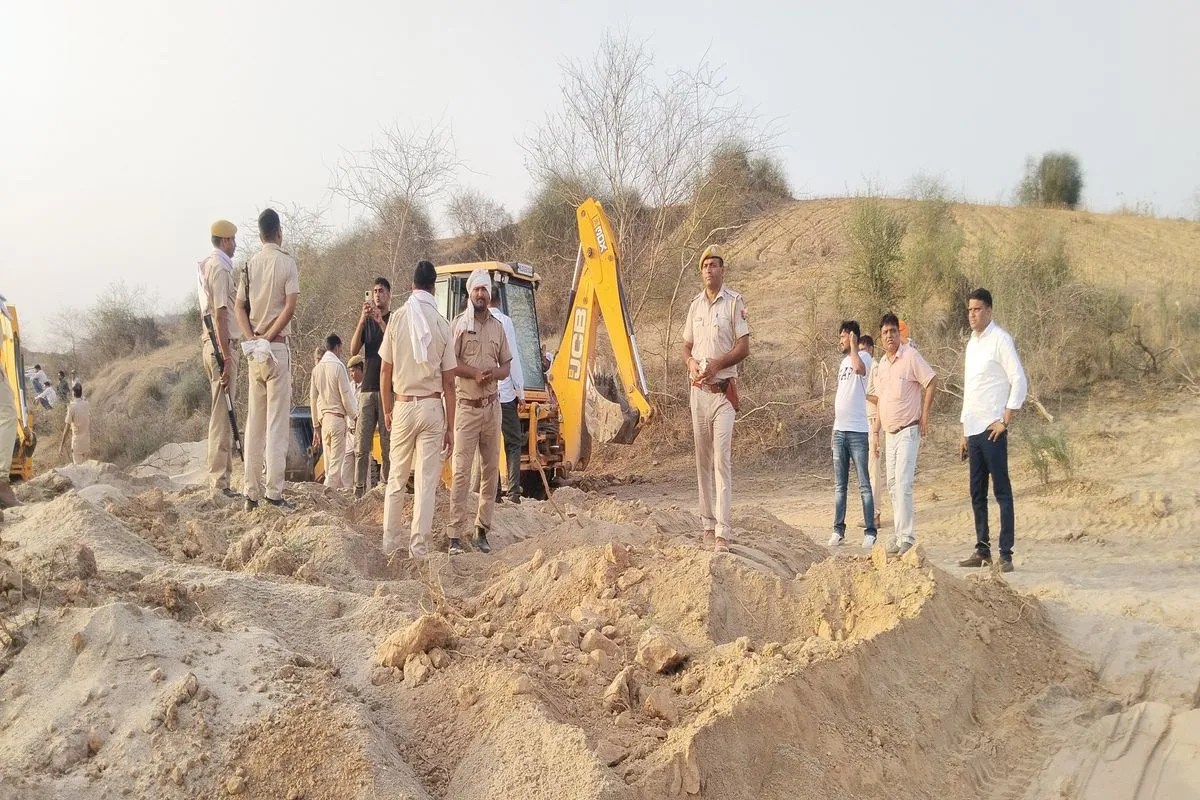
Mandrayal/Karauli. A joint team of police, forest, and mining departments conducted an operation on Sunday against illegal mining in the Chambal Gharial Sanctuary, destroying gravel stocks. The police, forest department, and mineral department jointly raided the Chambal river area along the Rajasthan-Madhya Pradesh border to combat illegal gravel mining and transportation. The team, reaching the prohibited Chambal Gharial area, destroyed several stocks of illegal gravel brought from the Chambal Gharial Sanctuary in Imratpura village, while demolishing routes used for gravel extraction with a JCB machine.
A large number of police personnel and forest staff were present during the operation. Mandrayal police station officer Ramchandra Rawat stated that the campaign against illegal gravel mining and transportation in the Chambal Gharial prohibited area was conducted under the direction of the Inspector General of Police and District Superintendent of Police Lokesh Sonwal, along with the joint team of the forest and mineral departments. During the operation, the team reached Imratpura village, where a large stock of illegally stored gravel was found. Officials destroyed the gravel stocks on the spot using a JCB.
Additionally, action was taken on the routes created for gravel extraction in the Chambal river area. These routes were demolished and leveled with the help of a JCB machine to completely curb illegal mining activities.
During the operation, Mandrayal police station officer Ramchandra Rawat, Ranger Indrajit Singh, Ranger Tinku Singh, along with officials from the police, forest department, and mineral department were present.
Officials stated that the campaign against illegal gravel mining and transportation will continue in the future. Meanwhile, the transport department also took action, issuing challans for 7 tractor-trolleys found empty. District Transport Officer Dhara Singh said action was taken for lacking number plates and registration.
Chambal Gharial Sanctuary
The Chambal Gharial Sanctuary is a protected area in northern India, established in 1978 along the Chambal River to conserve the critically endangered gharial (a fish-eating crocodile) and the Ganges river dolphin. Historically, the region was part of the princely states of Madhya Bharat and Rajasthan, and the river itself has been referenced in ancient Indian texts like the Mahabharata. Today, the sanctuary spans over 600 square kilometers across three states, serving as a crucial habitat for diverse aquatic and bird species.
Chambal river
The Chambal River in central India is known for its unique, rugged landscape of ravines and its relatively pristine ecosystem, hosting rare wildlife like the Ganges river dolphin and gharial crocodiles. Historically, it has been famed as a stronghold for dacoits (bandits) due to its treacherous terrain, which provided natural hideouts. In mythology, it is associated with a curse from the goddess Chambal, said to have made the land barren and its waters inhospitable.
Rajasthan-Madhya Pradesh border
The border region between Rajasthan and Madhya Pradesh in central India is historically significant as a cultural and trade corridor, linking the arid landscapes of Rajasthan with the forested and riverine terrain of Madhya Pradesh. This area was historically part of the Rajput and Maratha empires, and features several medieval forts and temples that reflect the shifting boundaries between kingdoms. Today, it remains a transitional zone with distinct linguistic and architectural influences from both states.
Imratpura village
Imratpura is a historic village in the Bhiwani district of Haryana, India, known for its strong martial heritage and connection to the Jat community. It is particularly famous as the birthplace of the legendary folk hero and freedom fighter, Rao Tula Ram, who played a key role in the Indian Rebellion of 1857 against British rule. The village also features a historic fort and several memorials that commemorate its rich cultural and revolutionary past.
Mandrayal
Mandrayal is a small village located in the Kishtwar district of Jammu and Kashmir, India, known for its scenic beauty and cultural heritage. Historically, the area has been influenced by various regional dynasties and is often associated with traditional crafts and local folklore. While not a major tourist destination, Mandrayal offers a glimpse into the rural life and cultural practices of the Himalayan region.
Karauli
Karauli is a historic city in the Indian state of Rajasthan, founded in 1348 by the Yaduvanshi Rajputs. It is renowned for its ancient temples, particularly the Madan Mohan Temple dedicated to Lord Krishna, and the imposing Karauli Fort. The city also serves as a gateway to the Kailadevi Wildlife Sanctuary, blending cultural heritage with natural beauty.