Highlights:
- An employee was burned alive in a massive fire at the oil mill
- The fire spread rapidly due to rice husk and oil
- Family members have made serious allegations regarding the lack of safety measures
Satna
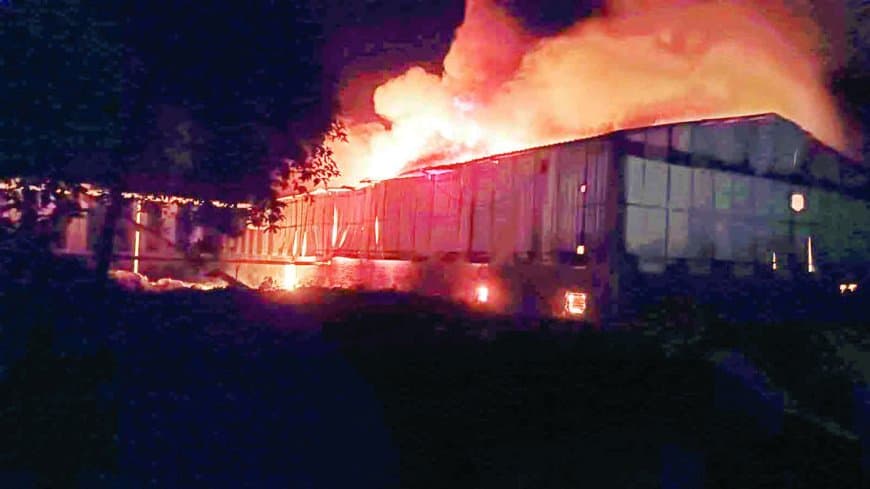
On Monday night, a fire broke out at an oil mill located on the Satna-Amarpatan road. The fire quickly became severe, engulfing the factory in flames. Due to the high flames, residents of a nearby settlement panicked and moved to safer locations outside their homes. One employee of the mill was burned alive in the fire, while another employee was seriously injured. The injured person has been admitted to the district hospital for treatment. The fire was brought under control around 11 PM. The cause of the fire is being investigated.
Oil is produced from rice husk
According to information received, Vidyashree Rice Mill is located on Amarpatan Road, ahead of the Satna River, under the City Kotwali jurisdiction. Oil is produced there from rice husk. It is reported that on Monday night, most employees had gone home after their shift, leaving only a few workers in the mill. Around 7:30 PM, a fire broke out in the mill for unknown reasons. Due to the rice husk and oil, the fire quickly spread throughout the entire factory. The severity of the fire can be gauged from the fact that flames were visible from several kilometers away. Because of the high flames, residents of the nearby settlement left their homes and moved to safe locations.
Officials arrived at the scene
Upon receiving information about the fire at the mill on Amarpatan Road, SDM City Rahul Siladia, SDM Uchehara Somesh Dwivedi, CSP Devendra Pratap Singh Chauhan, TI City Kotwali Raghavendra Dwivedi, along with the municipal fire brigade, arrived at the scene. Firefighters, with the help of police personnel and local residents, began extinguishing the fire. Due to the dry rice husk and oil, firefighters faced significant challenges in putting out the blaze. CSP Chauhan stated that the municipal fire brigade had brought the fire under control by 11 PM. An investigation is underway to determine how the fire started in the mill.
The operator was trapped inside
Police reported that as soon as the fire started in the oil mill, machine operators Dilawar Singh Parihar, a resident of Tighra, and Munnoo Kewat became trapped inside. With the help of local residents and firefighters who arrived after the fire was reported, Munnoo was rescued from the flames, but Dilawar remained trapped inside. Dilawar died from burns sustained in the fire. It is reported that only a skeletal remains of Dilawar’s body were found. Munnoo, who was burned in the fire, was admitted to the district hospital for treatment and, after initial care, has been referred to Rewa.
A businessman from Lucknow was operating the mill
According to information, the Vidyashree Solvent (Vidyashree Rice Mill) on Amarpatan Road is owned by Satna businessman Saurabh Jain. The mill was being operated on lease by Virendra Pradhan, a businessman from Lucknow. Police are questioning the mill operator and other individuals associated with the mill and are examining safety-related information and operational documents.
Family members blocked the road, clashed with SDM
Family members of the operator Dilawar Singh Parihar, a resident of Tighra who was burned alive in the mill, arrived at the scene upon learning of the incident. The deceased’s relatives made serious allegations against the mill operator, claiming that no safety measures were implemented in the mill. The relatives alleged that due to the lack of safety arrangements in the mill, the fire occurred, leading to Dilawar’s death. Angered by the incident, the family members began a protest by blocking the road. It is reported that during talks with the deceased’s relatives to clear the blockade, the situation became heated. A heated argument took place between the deceased’s relatives and the SDM City. CSP, TI Kotwali, TI Civil Lines, and