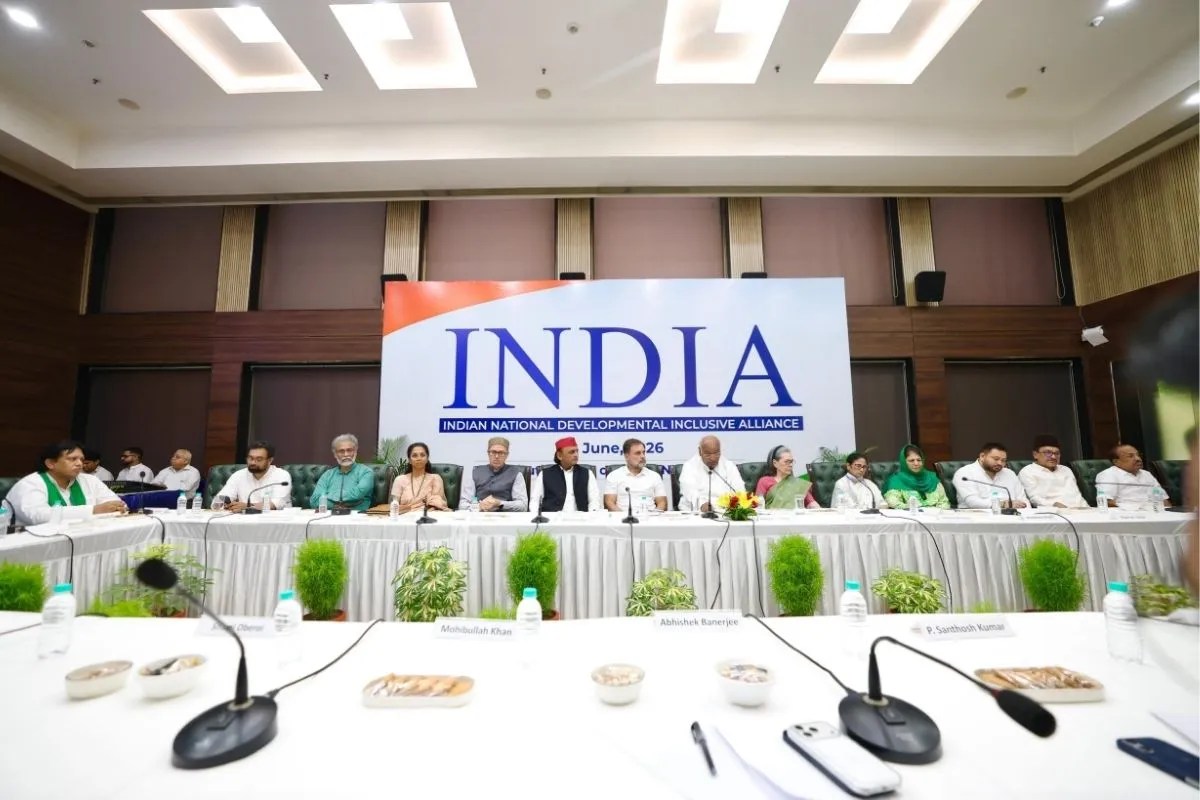
INDIA Block Meeting: The meeting of the INDIA alliance in Delhi has concluded. 23 opposition parties participated in this meeting. After the meeting, the Congress President addressed the media. Along with him, several other leaders were present. Speaking to the media, he stated that agreement has been reached on five points, which all parties will work on. These include the resignation of the Education Minister and sending a letter to the Chief Justice of India on the SIR issue, among other matters.

  • A letter will be written to the CJI on the SIR issue.
  • Demand for the Education Minister’s resignation on the NEET issue.
  • Demand for an all-party meeting on economic conditions, unemployment, inflation, and farmers’ issues.
  • The alliance will meet every two months.
  • During the parliamentary session, there will be a daily meeting chaired by the Leader of the Opposition.

Addressing the meeting, the Chairman launched a sharp attack on the central government. He alleged that the basic spirit of the constitution is being continuously undermined in the country, and investigative agencies are being used to suppress political opponents. He also said that a discriminatory attitude is being adopted towards non-BJP ruled states, while inflation is constantly increasing the difficulties of the common people. Referring to issues related to youth, he said that due to serious disorder in the examination system, the hopes of millions of students and youth have been shattered. He emphasized that opposition parties must work together to tackle the challenges facing the country and strongly raise the issues of the people.

An important meeting of the INDIA alliance was held at the Constitution Club in Delhi, attended by several key opposition leaders. Present at the meeting were several senior leaders. Before the meeting began, a warm meeting between two senior leaders was observed, pictures of which have emerged. Photos of other leaders from the venue have also been shared.

Delhi

Delhi, the capital of India, is a historic city that has been continuously inhabited for over two millennia, serving as the seat of power for numerous empires, including the Mughals and the British Raj. Its rich history is reflected in iconic landmarks like the Red Fort, Qutub Minar, and Humayun’s Tomb, which blend Persian, Islamic, and Indian architectural styles. Today, Delhi is a bustling metropolis that seamlessly intertwines its ancient past with modern urban life.

Constitution Club

The Constitution Club in New Delhi, India, is a historic members-only social and political club founded in 1946, originally established for members of the Constituent Assembly that drafted India’s Constitution. Located near Parliament House, it has served as a key venue for informal political discussions and networking among lawmakers, journalists, and intellectuals. The club remains a symbol of India’s democratic heritage and continues to host events and debates.

Red Fort

The Red Fort is a historic fortification in Delhi, India, built by the Mughal emperor Shah Jahan in the mid-17th century as the palace for his capital, Shahjahanabad. It served as the main residence of Mughal emperors for nearly 200 years and is a UNESCO World Heritage Site, symbolizing India’s rich cultural heritage and struggle for independence.

Constitution Club

The Constitution Club is a historic social and political club in New Delhi, India, established in 1947. It was originally founded as a meeting place for members of the Constituent Assembly, who drafted India’s constitution, and later served as a hub for parliament

Constitution Club

The Constitution Club in New Delhi, India, is a historic members-only social and cultural club established in 1949, originally founded for the members of the Constituent Assembly that drafted India’s Constitution. Located on Rafi Marg, it has since served as a prestigious venue for political, intellectual, and social gatherings, playing a role in India’s post-independence political culture. The club’s name and legacy are directly tied to the birth of the Indian Republic.

Red Fort

The Red Fort is a historic fortification in Delhi, India, built in the mid-17th century by the Mughal emperor Shah Jahan as the seat of Mughal power. Constructed from red sandstone, it served as the main residence of the emperors for nearly 200 years and is now a UNESCO World Heritage site. Today, it stands as a symbol of India’s independence, with the Prime Minister hoisting the national flag there each year on Independence Day.

Qutub Minar

The Qutub Minar is a towering 73-meter-high minaret located in Delhi, India, built in the early 13th century by Qutb-ud-din Aibak, the first ruler of the Delhi Sultanate, and later completed by his successors. It was constructed to celebrate Muslim dominance in Delhi after the defeat of the last Hindu kingdom, and it also served as a victory tower and a minaret for the nearby Quwwat-ul-Islam Mosque. The complex is a UNESCO World Heritage Site, showcasing Indo-Islamic architecture with intricate carvings and inscriptions from the Quran.

Humayun’s Tomb

Humayun’s Tomb is a UNESCO World Heritage Site located in Delhi, India, built in 1572 as the final resting place of the Mughal Emperor Humayun. Commissioned by his widow, Empress Bega Begum, it was the first garden-tomb in the Indian subcontinent and a pioneering example of Mughal architecture, featuring a grand red sandstone structure with a white marble dome. Its design heavily influenced later masterpieces, including the Taj Mahal.

Parliament House

Parliament House in Canberra, Australia, is the meeting place of the nation’s federal government, officially opened in 1988. Its design, featuring a striking flagpole atop a grass-covered roof, symbolizes the country’s democratic values and connection to the land. The building replaced the Provisional Parliament House, which had served since 1927, and now stands as a major architectural and cultural landmark.

Delhi

Delhi, the capital of India, is a historic city that has been continuously inhabited for over two millennia, serving as the seat of power for several ancient and medieval empires, including the Delhi Sultanate and the Mughal Empire. Its rich heritage is reflected in iconic landmarks such as the Red Fort, Qutub Minar, and Humayun’s Tomb, which showcase a blend of Hindu, Islamic, and British colonial influences. Today, Delhi stands as a vibrant metropolis, juxtaposing its ancient past with modern urban life, and remains a cultural and political hub of the nation.