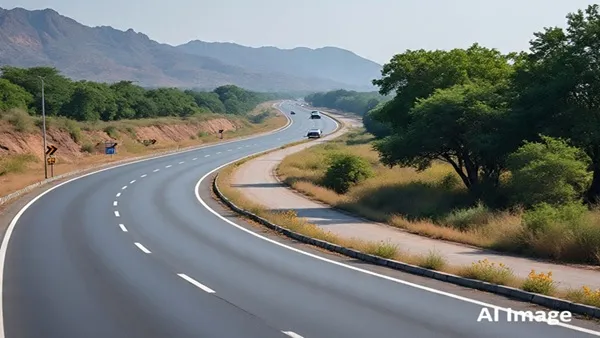
Delhi Chennai Distance Reduction: The Central Road Transport and Highways Minister has announced that the government is working towards reducing the distance between Delhi and Chennai by approximately 320 kilometers. After the construction of the proposed North-South Expressway, the current distance of about 2,200 kilometers will be reduced to around 1,900 kilometers. Currently, traveling by road from Delhi to Chennai takes more than 24 hours.
The goal is to complete this journey in just 12 hours once the new expressway is ready. The Central Minister stated that the government’s priority is to build environmentally friendly roads. In line with this, a pilot project to establish ‘hydrogen fuel filling stations’ on 10 major routes has also been launched. This will promote green mobility and make long-distance travel more sustainable.

Delhi Chennai Distance Reduction: What is the current travel time and cost?
– If a passenger travels by air from Delhi to Chennai, the flight time averages between 2 hours 45 minutes and 3 hours. The fare on normal days ranges from approximately ₹6,000 to ₹10,000.
– During peak season, the airfare from Delhi to Chennai can reach ₹15,000 or more.
– Regarding rail travel, the journey from Delhi to Chennai via the Rajdhani Express takes about 28 to 30 hours. The fare for AC 3-tier is approximately ₹3,000-₹3,500, and for AC 2-tier it can be around ₹4,500-₹5,500.
– The railway also has dynamic fares now, and a different fare applies to tatkal tickets. Additionally, fares are subject to change from time to time.
North South Expressway: An Important Project for Business Purposes Too
The proposed expressway will not only make road travel faster but will also give new momentum to logistics, freight transport, and industrial connectivity. The government believes this project will better connect the northern and southern parts of the country, leading to an increase in economic activities and making the travel experience more convenient. With the journey being shortened by up to 320 km, it will provide a good alternative for the common people to travel from Delhi to South India in less time.