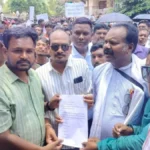
Family Health Card Campaign to Provide Better Health Protection for Rural Families
SMW Steel Private Limited has launched a Family Health Card distribution campaign in the Wardha region under its corporate social responsibility initiative.
The aim of this initiative is to provide better, accessible, and quality healthcare services to rural communities located near the company.
Themed “My Village, Healthy and Prosperous Village,” this campaign was launched on April 14, on the occasion of Dr. Bhimrao Ambedkar Jayanti. The campaign will run until May 1, Labor Day. It will conclude with the distribution of Family Health Cards to company employees and their families.
The formal launch of this initiative took place at a ceremony held in Dewli on April 20. The event was attended by MLA Rajeshji Bakane, former MP Ramdasji Tadas, and senior officials from the health and administrative departments. Director Deepakji Sumad and Vice President Shyamji Mundada also participated in the ceremony on behalf of the company.
The Family Health Cards are being distributed in several villages, including Dewli, Selsura, Padegaon, Chikni, Wadad, and Dighi Bopapur. Families residing near the company’s operational area will particularly benefit from this initiative.
This program is a key part of SMW Steel’s broader rural development efforts. Over the past decade, the company has undertaken several notable initiatives in health, education, sports, and skill development.
In the past year, the company has strengthened its social commitments by running a tree plantation campaign, distributing educational materials to school children, and supporting local sports events.
Additionally, the company has provided essential facilities such as water dispensers, computers, uniforms, and furniture to schools and health centers. The company is also playing a significant role in local job creation and community development.
Wardha
Wardha is a city in the Indian state of Maharashtra, historically significant for its association with Mahatma Gandhi during the Indian independence movement. Gandhi established his ashram, Sevagram, near Wardha in 1936, which served as his base for launching the Quit India Movement and promoting rural development and self-reliance. The city is also home to the Magan Sangrahalaya, a museum dedicated to Gandhi’s principles of sustainable living and khadi (hand-spun cloth).
Dewli
Dewli is a small village in the Indian state of Rajasthan, known for its historic stepwell and temple complex. The site features an intricately carved stepwell dating back to the 8th–9th century, reflecting the region’s advanced water management and architectural heritage. It is also home to a temple dedicated to the Hindu deity Vishnu, showcasing ancient craftsmanship and religious significance.
Selsura
Selsura is a small village in the Czech Republic, known for its well-preserved Baroque Church of Saint Bartholomew, built in the 18th century. Historically, the area was part of the larger agricultural landscape of the Bohemian-Moravian Highlands, with the church serving as a local spiritual and community center. Today, Selsura remains a quiet rural settlement, reflecting the region’s traditional architecture and cultural heritage.
Padegaon
Pade
Sevagram
Sevagram is a village in Maharashtra, India, best known as the residence of Mahatma Gandhi from 1936 to 1942. It was here that Gandhi established his simple ashram and developed many of his key philosophies and strategies for India’s independence movement. The site now serves as a national memorial, preserving his living quarters and offering insight into his life of simplicity and nonviolent resistance.
Magan Sangrahalaya
Magan Sangrahalaya is a museum located in Wardha, Maharashtra, India, established in 1938 to showcase the ideals of Mahatma Gandhi and the principles of rural self-sufficiency. It was originally founded as a center for promoting khadi and village industries, reflecting Gandhi’s vision of economic independence and sustainable living. The museum houses exhibits on traditional crafts, spinning wheels, and models of village development, preserving the legacy of India’s freedom movement and Gandhian philosophy.
Baroque Church of Saint Bartholomew
The Baroque Church of Saint Bartholomew is a historic Catholic church located in the town of Heeze, Netherlands. Built in the 17th century, it features ornate Baroque architecture and serves as a prominent example of the region’s post-Reformation religious revival. The church is dedicated to Saint Bartholomew and remains an active place of worship, known for its richly decorated interior and striking bell tower.
stepwell
A stepwell is a traditional, often elaborate, water storage system found in India, featuring a series of steps descending to a subterranean water source. Historically, these structures served not only as vital water reservoirs in arid regions but also as social and religious gathering places, with many dating back over a thousand years to the early medieval period. They showcase remarkable engineering and architectural artistry, with some, like the Rani ki Vav in Gujarat, being recognized as UNESCO World Heritage Sites.
temple complex
A temple complex is a group of interconnected religious structures, often including multiple shrines, halls, and courtyards, designed for worship and ritual practices. Historically, such complexes were central to ancient civilizations, such as the Angkor Wat complex in Cambodia, built in the 12th century as a Hindu temple before transitioning to a Buddhist site. These complexes served not only as spiritual centers but also as hubs for community gatherings, education, and political activity, reflecting the architectural and cultural achievements of their time.
Vishnu
Vishnu is one of the principal deities of Hinduism, known as the Preserver or Protector within the Hindu trinity (Trimurti), alongside Brahma the Creator and Shiva the Destroyer. His history dates back to the Vedic period (c. 1500–500 BCE), where he was a minor solar deity, but he later rose to prominence in the Puranic and epic traditions, such as the Ramayana and Mahabharata. Vishnu is believed to have incarnated on Earth in ten primary forms (avatars), including Rama and Krishna, to restore cosmic order and dharma.
Wardha
Wardha is a city in the Indian state of Maharashtra, historically significant as a key center of Mahatma Gandhi’s activities during the Indian independence movement. It was in Wardha that Gandhi established the Sevagram Ashram in 1936, which served as his residence and the headquarters for his social and political campaigns. The city is also known for its association with the Wardha Education Scheme, which promoted basic education and rural development.
Dewli
Dewli is a small village in the Indian state of Rajasthan, known for its ancient stepwells and historic temples that reflect the region’s rich architectural heritage. The area is believed to have been an important settlement during the medieval period, with structures that showcase intricate carvings and designs typical of Rajput and Mughal influences. Today, it remains a quiet, culturally significant site that offers a glimpse into the water management and religious practices of past centuries.