It was reported: « Naqvi arrived for an official two-day visit, as part of Pakistan’s ongoing efforts to promote negotiations and enhance regional peace. »
Iran’s Interior Minister Eskandar Momeni welcomed his Pakistani counterpart. It was quoted as saying that border trade was one of the main issues discussed. The two sides agreed to « take measures to shorten procedures and facilitate the exchange of goods, transit, and trade across the border, » while also considering the possibility of opening new border crossings.
Momeni stated that the two countries have « very positive views of each other » and will continue to « expand economic and trade relations, while developing political and friendly ties. »
The visit took place just days after the visit of Pakistan’s Army Chief, General Asim Munir.
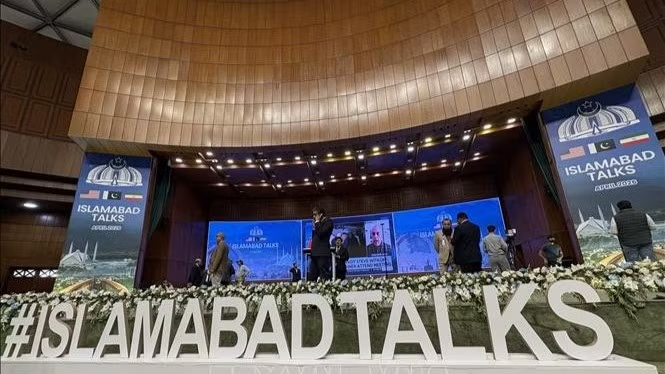
Islamabad has been actively mediating peace negotiations between Iran and the US. Last April, Pakistan hosted an important meeting between delegations from both sides.
* In a related development, Iran announced the reopening of the stock market on May 19, after a period of suspension due to the conflict between Iran and the US and Israel.
Hamid Yari, deputy supervisor at the Securities and Exchange Organization of Iran, emphasized that the suspension of stock market operations since the beginning of the conflict was aimed at protecting shareholders’ assets, preventing panic trading, and allowing for more transparent pricing conditions.
According to Hamid Yari, with the reopening of the stock market, all sectors of the capital market will fully recover.
Islamabad
Islamabad, the capital city of Pakistan, was built in the 1960s to replace Karachi as the national capital, with construction beginning in 1961. Designed by Greek architect Constantinos Apostolou Doxiadis, the city is known for its modern, planned layout and lush greenery. It serves as the political and administrative heart of the country, housing key landmarks like the Faisal Mosque, Pakistan Monument, and the Parliament House.
Pakistan
Pakistan, officially the Islamic Republic of Pakistan, is a South Asian country with a rich history as the cradle of the ancient Indus Valley Civilization. It gained independence from British rule in 1947, becoming a homeland for Muslims of the Indian subcontinent. Today, Pakistan is known for its diverse cultures, languages, and landmarks such as the Badshahi Mosque in Lahore and the northern mountain ranges like the Karakoram.
Islamabad
Islamabad is the capital city of Pakistan, established in the 1960s to replace Karachi as the national capital. Designed as a planned city by Greek architect Constantinos Apostolou Doxiadis, it is known for its modern layout, lush greenery, and iconic landmarks like the Faisal Mosque. The city serves as the political and administrative hub of the country, blending contemporary development with natural beauty.
Faisal Mosque
Faisal Mosque in Islamabad, Pakistan, is one of the largest mosques in the world, named after King Faisal of Saudi Arabia who funded its construction. Designed by Turkish architect Vedat Dalokay, it was completed in 1986 and is known for its unique, modern design featuring eight-sided shell-shaped roofs and four towering minarets. The mosque serves as a major cultural and religious landmark, symbolizing Pakistan’s ties with the Islamic world.
Pakistan Monument
The Pakistan Monument in Islamabad is a national symbol constructed to represent the unity and diversity of the Pakistani people. Built in the shape of a blooming flower, its four main petals represent the four provinces of Pakistan, while three smaller petals stand for the territories. Opened in 2007, the monument commemorates the nation’s independence and heritage, with an adjacent museum detailing the country’s history and the Pakistan Movement.
Parliament House
Parliament House in Canberra, Australia, is the meeting place of the Australian Parliament, officially opened in 1988. Designed by architect Romaldo Giurgola, it is built into Capital Hill, symbolizing the nation’s democratic process and replacing the Provisional Parliament House that had been used since 1927. The building is renowned for its distinctive flagpole and modern architecture, serving as both a working government hub and a major tourist attraction.
Badshahi Mosque
The Badshahi Mosque, located in Lahore, Pakistan, is a stunning example of Mughal architecture built in 1673 by Emperor Aurangzeb. It was the largest mosque in the world at the time and remains one of the most iconic landmarks of the Mughal era. The mosque has witnessed significant historical events, including serving as a stable for Sikh and British forces during periods of occupation.
Karakoram
The Karakoram is a major mountain range spanning the borders of Pakistan, India, and China, known for having some of the world’s highest peaks, including K2, the second tallest mountain on Earth. Its history includes being a crucial part of the ancient Silk Road trade route, with the Karakoram Pass connecting Central and South Asia for centuries. The region’s rugged terrain and glaciers have also made it a significant destination for exploration and mountaineering since the 19th century.



![[Podcast] Tin tức ngày 20-7: Gửi 29 triệu tin nhắn Zalo hướng dẫn ứng phó bão số 3 Wipha](https://asiacity.news/wp-content/uploads/2025/07/media-cdn-v2.laodong.vn-storage-newsportal-2025-7-20-1543395-_bao-so-3-14h-150x150.gif)