Algeria is committed to supporting all initiatives that enhance continental integration.
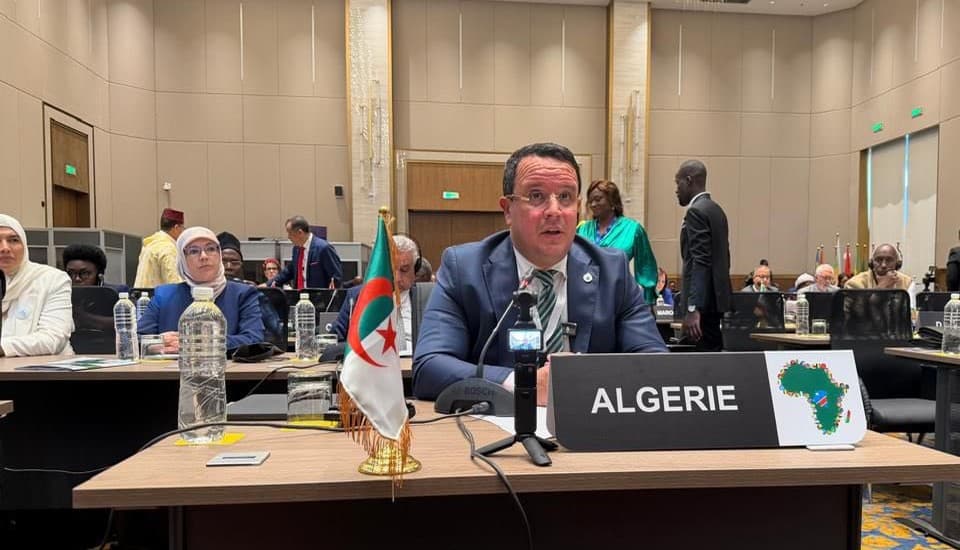
The Vice President of the Algerian National People’s Council, Mondher Boudène, affirmed on Friday from Kinshasa (Democratic Republic of the Congo) Algeria’s commitment, under the leadership of the President of the Republic, to support all initiatives that enhance continental integration and economic cooperation among African countries.
In his speech at the opening of the 47th Conference of Presidents of the African Parliamentary Union, Boudène reaffirmed “Algeria’s steadfast commitment,” under the leadership of the Algerian President, to “support the path of African economic integration and strengthen cooperation and solidarity among the continent’s nations,” adding that “our country, based on its firm conviction of the importance of promoting African integration, continues its effective support for all initiatives aimed at advancing economic cooperation among the continent’s countries.”
He further stated that “Africa’s future is built by the hands of its sons and daughters, and its strength lies in the unity of its countries and their ability to formulate development programs that reflect the priorities of their peoples and ensure a prosperous and sustainable future for them.”
In this regard, Boudène commended the launch by the President of the Republic of “an African fund dedicated to financing startups and young innovators,” considering that investing in the energies of youth constitutes “a fundamental pillar for building an innovative African economy capable of competing globally.”
He also recalled, in the same context, the “great success” achieved by the fourth edition of the Intra-African Trade Fair hosted by Algeria (September 2025) under the high patronage of the Algerian President, which brought together thousands of economic actors from various countries.
On the same occasion, the Vice President of the National People’s Council highlighted the “strategic importance” of the African Continental Free Trade Area project as one of the “pillars of continental economic integration,” saying that the success of this project “requires unified political will and advanced coordination to remove barriers, improve transport and logistics infrastructure, and facilitate the movement of goods and capital.”
In this respect, he noted that Algeria was among the “first countries” to sign the agreement establishing the Area and that it “continues to work on promoting intra-African trade and consolidating South-South cooperation.”
On another note, he addressed the “dual challenges facing the continent in the field of energy transition and strengthening national sovereignty,” calling for “greater African cooperation to develop joint energy projects capable of supporting sustainable development.”
He said that “Algeria has adopted an ambitious energy policy based on renewable energies, green hydrogen, and scientific research,” and that “achieving sustainable development requires full national sovereignty and African countries’ control over their resources and wealth.”
The proceedings of the 47th Conference of Presidents of the African Parliamentary Union commenced on Friday, with the attendance of the President of the Congolese National Assembly, the President of the Congolese Senate, the President of the Executive Committee of the African Parliamentary Union, the Vice-President of the Executive Committee, the Secretary General of the African Parliamentary Union, and the Secretary General of the Inter-Parliamentary Union.
Algerian National People’s Council
The Algerian National People’s Council (APN) is the lower house of Algeria’s bicameral Parliament, established following the country’s independence. It functions as a legislative body whose members are elected by the people, operating within the framework set by the Algerian constitution to represent the populace and pass laws.
African Parliamentary Union
The African Parliamentary Union (APU) is a regional organization established in 1976 in Abidjan, Côte d’Ivoire, to promote cooperation, democracy, and development among the parliaments of African states. It serves as a forum for dialogue, sharing legislative experiences, and advocating for peace, integration, and human rights across the continent. Historically, it has worked to strengthen parliamentary institutions and foster Pan-African solidarity in governance.
African fund dedicated to financing startups and young innovators
The African Innovation Foundation (AIF) is a non-profit organization established in 2009 with a mission to drive innovation-led development across the continent. Its flagship program, the Innovation Prize for Africa (IPA), has become a key platform, providing funding, recognition, and support to a wide range of African entrepreneurs and inventors since its launch in 2011.
Intra-African Trade Fair
The Intra-African Trade Fair (IATF) is a major biennial event launched in 2018 by the African Export-Import Bank (Afreximbank) in collaboration with the African Union. It was established to boost trade and economic integration across the continent by providing a platform for businesses to connect, showcase products, and sign deals. The fair directly supports the goals of the African Continental Free Trade Area (AfCFTA) by helping to unlock Africa’s internal market potential.
African Continental Free Trade Area
The African Continental Free Trade Area (AfCFTA) is a landmark trade agreement that came into force in 2021, aiming to create the world’s largest free trade area by number of participating countries. It seeks to boost intra-African trade by eliminating tariffs and harmonizing regulations across its 54 member states, building on a long-standing vision for pan-African economic integration since the founding of the Organization of African Unity.
Congolese National Assembly
The Congolese National Assembly is the lower house of the Parliament of the Democratic Republic of the Congo, located in the capital, Kinshasa. It was established following independence from Belgium in 1960, though its operation has been repeatedly disrupted by political instability, civil wars, and authoritarian regimes. The current institution functions under the 2006 constitution, which created a bicameral legislature intended to represent the people in the post-conflict era.
Congolese Senate
The Congolese Senate is the upper house of the Parliament of the Democratic Republic of the Congo, established under the 2006 constitution that followed the Second Congo War. It represents the country’s provinces and plays a key role in legislation and oversight, evolving from a history of centralized and often unstable governance structures since independence in 1960.
Inter-Parliamentary Union
The Inter-Parliamentary Union (IPU) is a global organization of national parliaments, founded in 1889 to promote peace and cooperation through parliamentary diplomacy. It is the oldest international political assembly, initially created to encourage dialogue and arbitration as alternatives to war, and today it works to strengthen democratic institutions, human rights, and sustainable development worldwide.