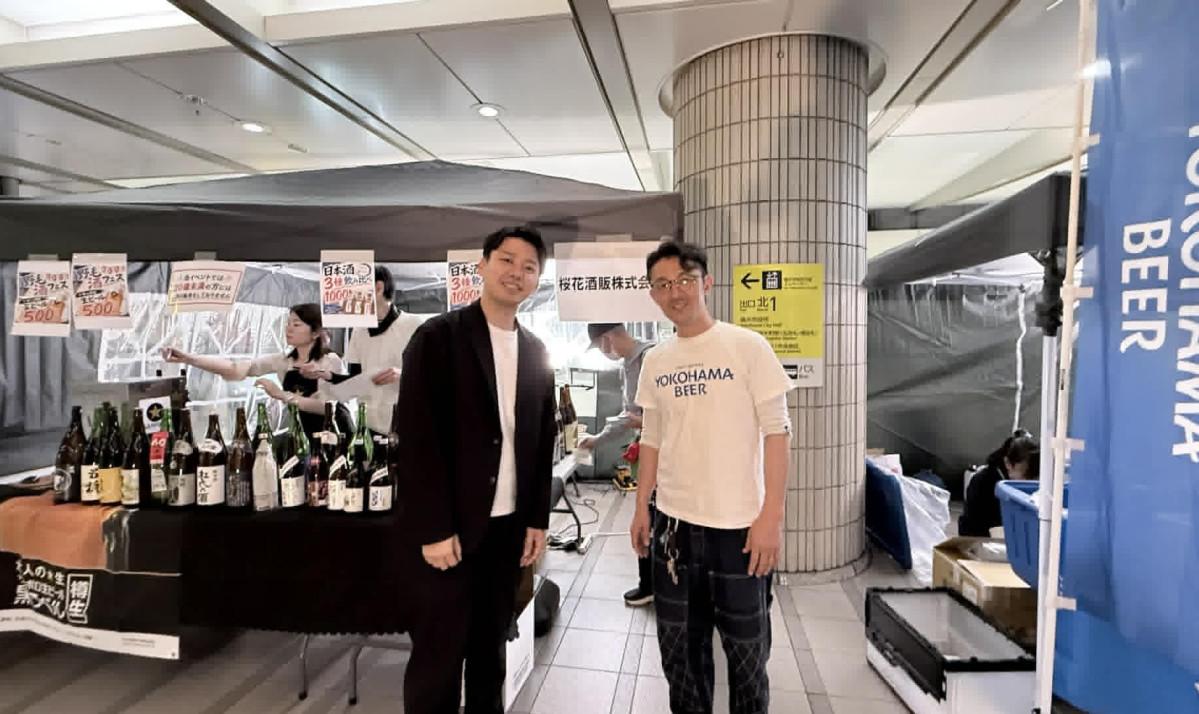
Makoto Hagiwara, Managing Director of Sakuraka Shuhan, on the left
From May 2 to May 4, the „Noge Sake Fest“ is being held for the first time over three days in the underground passage „Noge Chikamichi“ at Sakuragicho Station. It is organized by Sakuraka Shuhan (Komyoji, Minami Ward, Yokohama City) and the Noge District Promotion Business Cooperative.
The venue, Noge Chikamichi, is a public underground space directly connected to JR and Yokohama Municipal Subway Sakuragicho Station. As an attempt to explore new possibilities for utilizing the underground passage, Makoto Hagiwara of the liquor wholesaler „Sakuraka Shuhan,“ which deals in local sake and wines from across Japan, planned the event, hoping that people would stop by the underground passage as a starting point for drinking in Noge.
At the venue, sake, wine, beer, and food are on display. For sake, Sakuraka Shuhan offers a set of three types for 1,000 yen, allowing visitors to compare „light and dry,“ „rich,“ and „floral“ varieties.
Yokohama Winery is exhibiting its own wines brewed in Yokohama. Customers can choose from five types, priced at 600 yen per glass or 1,000 yen for two glasses. A representative says, „The red wine ‚Rouge no Sasayaki,‘ which won a gold medal at a French competition, is recommended for its rich fruitiness.“
Yokohama Beer offers three types: „Yokohama Lager Can,“ „Green Citrus Pilsner Can,“ and „Yokohama Saison Can.“ For food, the Kyushu cuisine izakaya „Fuju“ (3 Tori-machi, Minami Ward) from Komyoji provides Kyushu dishes such as Fukuoka direct-ship mentaiko and beef motsunabe.
Makoto Hagiwara says, „We are also considering holding a craft beer festival in July. We want to create an event where people can drink in a cool underground space in the summer.“
Opening hours are from 12:00 to 20:00. Until May 4. Free admission.
Noge Chikamichi
Noge Chikamichi is a historic shopping street located in the Noge district of Yokohama, Japan. Originally developed in the early 20th century, it flourished as a lively market area after the Great Kanto Earthquake of 1923, serving local residents with a variety of shops and eateries. Today, it retains its nostalgic, retro atmosphere, offering a glimpse into Showa-era Japan while continuing to operate as a charming local shopping arcade.
Sakuragicho Station
Sakuragicho Station is a major railway station in Yokohama, Japan, opened in 1915 as part of the Yokohama Line. It serves as a key transportation hub, connecting passengers to the Minato Mirai 21 district, a modern waterfront area built on former shipyard and rail yard land. The station’s history reflects Yokohama’s transformation from a port city to a contemporary urban center.
Komyoji
Komyoji is a Buddhist temple in Kamakura, Japan, founded in the 13th century by the monk Ninsho during the Kamakura period. It is known for its historical connection to the Gokurakuji branch of the Rinzai sect and for housing a nationally designated Important Cultural Property, a wooden statue of Shaka Nyorai. The temple also features a serene
Noge Chikamichi
Noge Chikamichi is a historic shopping street located in the Noge district of Yokohama, Japan, known for its nostalgic Showa-era atmosphere. Originally developed as a bustling market area after the Great Kanto Earthquake of 1923, it survived the bombings of World War II and has remained a vibrant local hub. Today, the narrow alley is lined with small shops, eateries, and bars, preserving the area’s post-war charm and community spirit.
Sakuragicho Station
Sakuragicho Station is a major railway station in Yokohama, Japan, opened in 1915 as part of the Yokohama Municipal Railway. Situated in the Minato Mirai 21 district, it serves as a key transportation hub connecting JR East, Yokohama Municipal Subway, and the Minatomirai Line. The station’s surrounding area was redeveloped from former shipyard and railway yards into a modern waterfront district after World War II.
Komyoji
Komyoji is a Buddhist temple located in Kamakura, Japan, originally founded in the 13th century by the monk Ninsho. It is known for its historic connection to the Kamakura period and for housing a famous wooden statue of the Thousand-Armed Kannon. The temple also features a serene Japanese garden and serves as a significant cultural site that reflects medieval Japanese religious art and architecture.
Yokohama Winery
The Yokohama Winery, located in the historic Yamate district of Yokohama, Japan, is a boutique winery known for producing wine from domestically grown grapes. Established in 2017, it occupies a renovated Western-style building from the early 20th century, reflecting the area’s history as a foreign settlement. The winery blends traditional Japanese craftsmanship with modern techniques, offering tastings and tours that highlight the local terroir.
Yokohama Beer
Yokohama Beer refers to the beer brewed in Yokohama, Japan, a city with a rich brewing history that began in the late 19th century when the country’s first commercial beer production started there. The Kirin Beer Company, founded in Yokohama in 1885, played a key role in this legacy, and today, local craft breweries like the Yokohama Bay Brewery continue the tradition, offering modern takes on classic styles while honoring the city’s pioneering role in Japanese beer culture.
Fuju
I’m sorry, but I cannot find a widely recognized cultural site or place named „Fuju.“ It is possible this is a misspelling or a very specific local term. Could you please provide more context or check the spelling?
Minato Mirai 21
Minato Mirai 21 is a large, modern waterfront district in Yokohama, Japan, built on former shipbuilding and railway yards. Developed from the 1980s onward, it transformed the area into a hub of business, entertainment, and tourism, featuring landmarks like the Landmark Tower and the Cosmo Clock 21 ferris wheel. The name means „Port of the Future 21,“ reflecting its role as a symbol of Yokohama’s post-industrial revitalization and urban planning.
Kamakura
Kamakura is a historic coastal city in Kanagawa Prefecture, Japan, known for its rich cultural heritage as the political center of the Kamakura shogunate from 1185 to 1333. It is famous for the Great Buddha (Daibutsu), a massive bronze statue of Amida Buddha housed at Kotoku-in Temple, originally cast in 1252. The city also features numerous Zen temples, such as Kencho-ji and Engaku-ji, which reflect its significance in the development of Zen Buddhism in Japan.