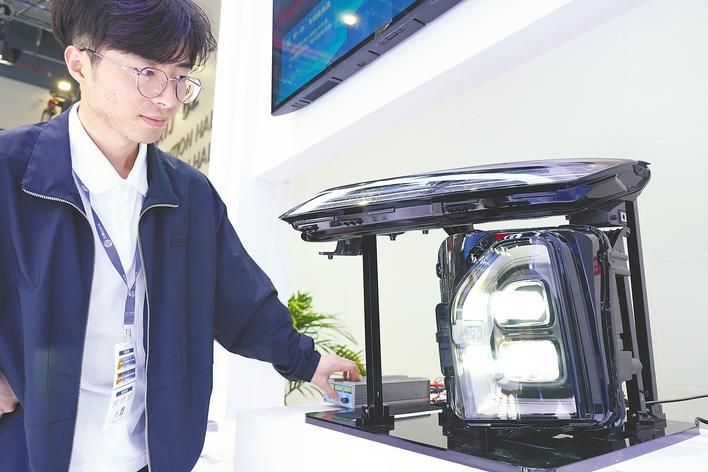
A new smart projection car headlight on display at the exhibition booth.
Soon, car headlights will not only illuminate the road ahead but also project navigation instructions: when lidar or cameras detect potholes or pedestrians in dark areas, the headlight will instantly project warning information on the road surface to alert the driver. On April 23, at the 2026 Jiufeng Mountain Forum held in Optics Valley, Wuhan Xingxi Light Technology Co., Ltd. released the Micro-LED automotive light source chip M-50K, making this a reality.
Traditional matrix LEDs have limited pixels. Micro-LED, with its core advantages of high brightness, high resolution, high reliability, and small size, is becoming the mainstream technology route for next-generation automotive lighting.
Based on this chip, the M50 Pro lighting module can achieve high-definition imaging with 50,000 pixels and ultra-high brightness of 3,000 lumens, equivalent to a built-in high-definition projector. Its imaging and brightness performance is among the best in the industry, and it is expected to be installed in vehicles priced between 250,000 and 500,000 yuan. Currently, high-end models from brands such as NIO and Volkswagen are already equipped with similar technology solutions. As the industry develops and technology becomes more accessible, vehicles priced above 100,000 yuan may also feature this technology within the next three years.
Xingxi Light was jointly established by Xingyu Shares, Xinlian Integration, and Jiufeng Mountain Laboratory in January of this year. After only 20 days of initial contact, it was decided to settle in Optics Valley. Leveraging the technical expertise of the three parties in headlights, chips, and heterogeneous integration, the company launched its first product within just a few months and plans to gradually expand its business into cutting-edge fields such as wearable devices and AI optical interconnections.
Jiufeng Mountain
Jiufeng Mountain, located in the Beijing area of China, is a scenic area known for its nine towering peaks and rich biodiversity. Historically, it has been a site of cultural significance, with temples and pavilions built during the Ming and Qing dynasties, serving as a retreat for scholars and monks. Today, it is a popular destination for hiking and nature appreciation, offering panoramic views and a glimpse into traditional Chinese mountain culture.
Optics Valley
Optics Valley, officially known as Wuhan East Lake High-Tech Development Zone in China, is a leading hub for optoelectronics innovation and industry. Established in the late 1980s and designated as a national-level development zone in 1991, it has grown into a global center for fiber optics, laser technology, and photonics. Often referred to as “China’s Optics Valley,” it houses thousands of tech companies and research institutions, driving advancements in optical communications and related fields.
Wuhan
Wuhan, the capital of Hubei Province in central China, is a major industrial, educational, and transportation hub situated at the confluence of the Yangtze and Han rivers. Its history dates back over 3,500 years, and it was formed from the merger of three cities—Wuchang, Hankou, and Hanyang—in the early 20th century. Notably, Wuhan was the epicenter of the initial COVID-19 outbreak in late 2019 and is also home to iconic landmarks like the Yellow Crane Tower, which has inspired poetry for centuries.
Jiufeng Mountain
Jiuf
Jiufeng Mountain
Jiufeng Mountain, located in the northern suburbs of Beijing, China, is a scenic area known for its nine prominent peaks and rich biodiversity. Historically, it has been a site of cultural and religious significance, with ancient temples and pagodas dating back to the Ming and Qing dynasties. Today, it serves as a popular destination for hiking and nature appreciation, offering panoramic views of the surrounding landscape.
Optics Valley
Optics Valley, officially known as Wuhan East Lake High-tech Development Zone, is a major hub for innovation and technology in Wuhan, China. Established in 1988 and later designated as a national-level high-tech zone, it has grown into a leading center for optoelectronics, laser technology, and telecommunications. The area is often called “China’s Light Valley” due to its pivotal role in advancing fiber optics and photonics industries.
Wuhan
Wuhan is a major city in central China, known as the capital of Hubei Province and a key transportation hub along the Yangtze River. Its history dates back over 3,500 years, and it was formed by the merger of three towns—Wuchang, Hankou, and Hanyang—in the early 20th century. The city gained global attention in late 2019 as the first location to report COVID-19 cases, and it is also famous for its cultural heritage, including the Yellow Crane Tower and its vibrant street food scene.
Yellow Crane Tower
The Yellow Crane Tower, located in Wuhan, China, is a historic landmark with a rich cultural legacy dating back to the Three Kingdoms period (223 AD). Originally built as a military watchtower, it later became a renowned site for poets and scholars, most famously inspiring the Tang dynasty poet Cui Hao’s iconic verse. Despite being destroyed and rebuilt multiple times over centuries, the current tower, reconstructed in 1981, stands as a symbol of Chinese architectural heritage and literary tradition.