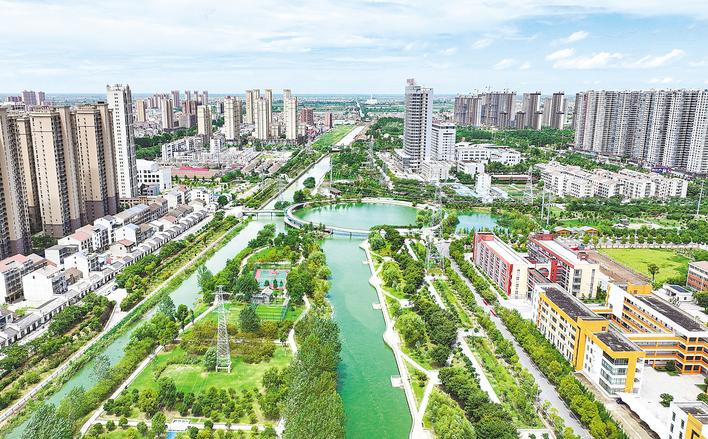
Linchang River is clear with green banks.
The protection of the Yangtze River is reflected not only in its major rivers but also in the details of every city and river.
Jianli is located on the north bank of the middle reaches of the Yangtze River, with a dense network of rivers and interconnected waterways. The Linchang River, which flows through the city, starts from the Hou River in the west and ends at the Drainage River in the east, forming an important part of the Yangtze River tributary system.
Once upon a time, direct sewage discharge, silt accumulation, and foul odors turned this river into a “smelly ditch,” severely affecting the city’s appearance and residents’ lives.
Over the past decade, the Yangtze River protection initiative has deepened. Jianli City moved beyond the single-minded approach of “treating the river in isolation” and integrated inland river management into the overall layout of Yangtze River protection. By coordinating pollution source control, internal pollution treatment, ecological restoration, and long-term maintenance, the once-dull urban water veins have been revitalized.
In the past, sewage was directly discharged, clogging the river.
“When I was a child, the Linchang River was clear. In summer, children would play in the water and catch fish. These are our most precious childhood memories,” said a villager from Zhaoxia Village, Hongcheng Township, Jianli City, while walking along the riverbank on May 19, gazing at the rippling water.
As the core water system of Jianli’s main urban area, the Linchang River connects residential areas and industrial parks, benefiting about 280,000 urban residents. It is truly the “city’s mother river.”
With rapid urbanization and continuous expansion of the city, the conflict between population concentration, industrial development, and ecological carrying capacity became increasingly prominent, and the Linchang River gradually became overwhelmed.
For some time, the construction of sewage pipe networks in Jianli City lagged behind, with widespread issues of combined rainwater and sewage, misconnected pipes, and broken leaks. Residential sewage, wastewater from street shops, and scattered aquaculture tailwater were directly discharged into the river. Combined with heavy sediment accumulation, the water body completely lost its self-purification ability, turning the Linchang River into a mildly black and odorous water body.
“Before the government started treating the Linchang River, the water turned black and smelly in summer. We couldn’t open windows all year round, and we had to cover our noses and hurry past, let alone take a walk or relax,” the villager recalled.
The “illness” of the inland river was not only a pain for the people but also a potential threat to the ecological safety of the Yangtze River.
Previously, only periodic dredging and garbage cleaning were done for the Linchang River, without cutting off pollution at the source or systematically restoring the ecology. Therefore, the river’s chronic problems were never fundamentally solved.
With the comprehensive promotion of Yangtze River protection, the Jianli City government made up its mind to treat the Linchang River, Hou River, and other inland rivers as key livelihood and ecological projects for Yangtze River protection, using the management of one river to protect the waters of the Yangtze.
11 sewage interception gates cut off pollution sources.
Entering the Jianli (Rongcheng) urban sewage treatment plant, the online monitoring screen shows real-time data: total phosphorus 0.19 mg/L, total nitrogen 4.515 mg/L.
Fine screens, biochemical tanks, and other equipment operate orderly. The originally turbid domestic sewage becomes clear and transparent after multiple treatment processes.
“Treating the Linchang River starts from the source on the banks and in the pipe network. After urban sewage is treated, the compliant tailwater is used to replenish the Linchang River nearby, achieving water cycle replenishment and long-term water quality improvement,” said a construction management official.
The key to preventing sewage from entering the river is interception. The culprit that once turned the Linchang River into a “smelly ditch” was the direct discharge of sewage and mixed rainwater and sewage throughout the city.
Moving away from the fragmented approach of “treating the river in isolation,” local authorities used the sewage treatment plant as the terminal node, tracing forward and extending upward. They built a complete chain of interception, pipe connection, dredging