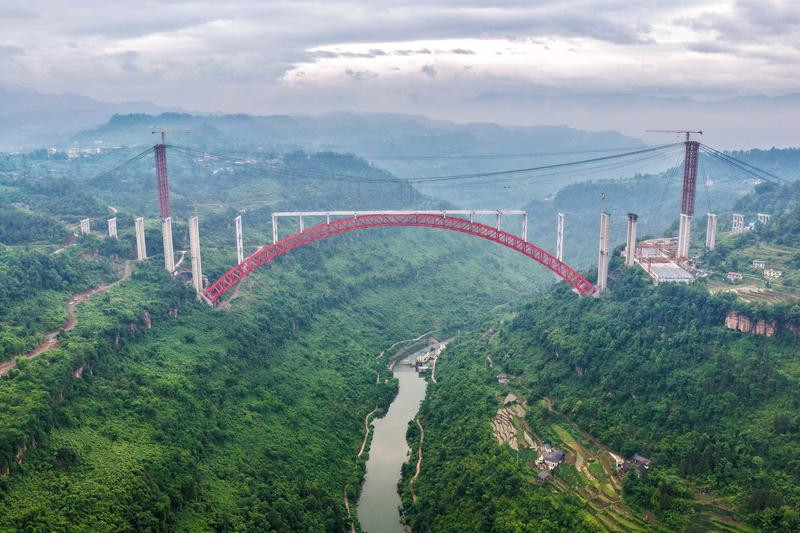
At 18:20 on May 16, the first reinforced concrete deck slab of the Fenglai Daxihe Extra-Large Bridge on the Wulong to Liangjiang New Area Expressway was smoothly placed onto the steel composite beam. This milestone laid the decisive foundation for the full completion of the world’s largest span deck-type steel truss arch bridge. The bridge is scheduled to open to traffic in 2026, reducing the travel time between Wulong and Liangjiang New Area to under one hour.
As the critical control project of the entire Wulong-Liangjiang Expressway, the Fenglai Daxihe Extra-Large Bridge showcases China’s robust engineering capabilities and innovation through multiple world-class indicators. The bridge has a total length of 1,136.7 meters, with a main span of 580 meters, crossing the deep gorge of the Daxihe River, a tributary of the Wujiang River. The maximum height difference between the bridge deck and the river surface exceeds 310 meters, equivalent to the height of a 104-story building. The total steel usage for the entire bridge amounts to 25,800 tons, roughly equivalent to 3.6 times the steel used in the Eiffel Tower. Such scale and volume are rare in large-span bridge construction in mountainous areas, making it a typical example of China’s breakthrough into “ultra-large spans and complex environments.”
The first deck slab hoisted was a reinforced concrete structure measuring 4.6 meters in length, 4 meters in width, and weighing approximately 22 tons. Like a “giant building block,” it was precisely maneuvered by a cable crane.
“A total of 528 such slabs will be installed on this bridge,” explained the project’s chief engineer. As a large-span steel truss arch bridge, it combines the advantages of steel truss and arch structures, featuring outstanding vertical and lateral stiffness and strong load-bearing capacity. This design effectively adapts to the complex geological conditions of the gorge, and its construction techniques provide significant reference for similar bridge projects.
The Wulong-Liangjiang Expressway spans 37.18 kilometers, built to a two-way four-lane standard with a design speed of 100 kilometers per hour. Once completed, it will connect high-quality tourism resources such as Fairy Mountain and Baima Mountain, further improving the highway network layout in southeastern Chongqing.
Fenglai Daxihe Extra-Large Bridge
Fenglai Daxihe Extra-Large Bridge is a major railway bridge in China, part of the high-speed rail network connecting Chongqing and Guiyang. Completed in 2018, it spans the Daxi River valley in Fengjie County, Chongqing, and is notable for its massive scale and engineering complexity, featuring a continuous steel truss arch design. The bridge plays a key role in improving transportation links through the mountainous terrain of southwestern China.
Wulong-Liangjiang Expressway
The Wulong-Liangjiang Expressway is a major expressway in Chongqing, China, connecting Wulong District to the Liangjiang New Area. Opened to traffic in phases, with its final section completed around 2021, it significantly reduces travel time between the mountainous Wulong region and the economic hub of Liangjiang. The expressway enhances regional connectivity, supporting tourism to Wulong’s famous karst landscapes and promoting economic development in the area.
<h3
Fenglai Daxihe Extra-Large Bridge
The Fenglai Daxihe Extra-Large Bridge is a major railway bridge located in Guizhou Province, China, part of the high-speed rail network connecting Chengdu and Guiyang. Spanning the Daxi River valley, it was completed in 2019 and is notable for its massive scale, with a main span of 436 meters and a total length of over 1,100 meters, making it one of the longest arch bridges in the world. Its construction overcame challenging mountainous terrain, showcasing modern Chinese engineering prowess.
Wulong-Liangjiang Expressway
The Wulong-Liangjiang Expressway is a key highway in Chongqing, China, connecting Wulong District to the Liangjiang New Area. Completed in recent years, it was built to improve regional transportation and support economic development in the mountainous terrain of southeastern Chongqing. The expressway enhances access to Wulong’s famous karst landscapes and tourist attractions, boosting local tourism and trade.
Daxihe River
The Daxihe River is a scenic waterway located in the Zhangjiajie area of China’s Hunan Province, known for its crystal-clear waters and lush karst landscape. Historically, it served as an important transportation route for local communities and was part of the region’s rich cultural heritage, often associated with the Tujia ethnic minority. Today, it is a popular destination for rafting and river cruises, offering visitors a peaceful escape into nature.
Wujiang River
The Wujiang River is a major tributary of the Yangtze River in southwest China, flowing through Guizhou and Chongqing. Historically, it served as a vital waterway for trade and transportation in the region, and its dramatic gorges and karst landscapes have made it a notable natural and cultural site. The river also played a role in ancient military campaigns and the spread of local ethnic cultures, particularly among the Miao and Tujia peoples.
Eiffel Tower
The Eiffel Tower is a wrought-iron lattice tower located in Paris, France, built between 1887 and 1889 as the centerpiece of the 1889 World’s Fair. Designed by engineer Gustave Eiffel, it was initially criticized by some of France’s leading artists and intellectuals but has since become a global cultural icon and one of the most recognizable structures in the world. Originally intended to be a temporary structure, it was saved from demolition due to its usefulness as a radio transmission tower.
Fairy Mountain
Fairy Mountain, also known as “Xiannv Shan,” is a scenic area in Chongqing, China, renowned for its misty peaks, lush forests, and alpine meadows. Its name originates from a local legend about a fairy who descended to the mountain, and the site has been a popular destination for centuries. Today, it serves as a national forest park and a major tourist attraction, offering hiking, skiing, and cultural experiences.
Baima Mountain
Baima Mountain, located in Sichuan Province, China, is a scenic area known for its unique karst landscapes and rich biodiversity. Historically, it has been a site of cultural significance for local ethnic groups, including the Tibetan and Qiang peoples, and features ancient temples and relics that reflect its long-standing spiritual importance. Today, it is a popular destination for hiking and nature tourism, offering visitors a blend of natural beauty and cultural heritage.