AI surgical robots, the BeiDou Navigation Satellite System, and many other cutting-edge technological achievements were on display at the Beijing International High-Tech Expo, giving visitors a deep sense of the vitality of the capital’s technological innovation and the dynamic momentum of future industries, creating a feeling that “the future has arrived and is within reach.”
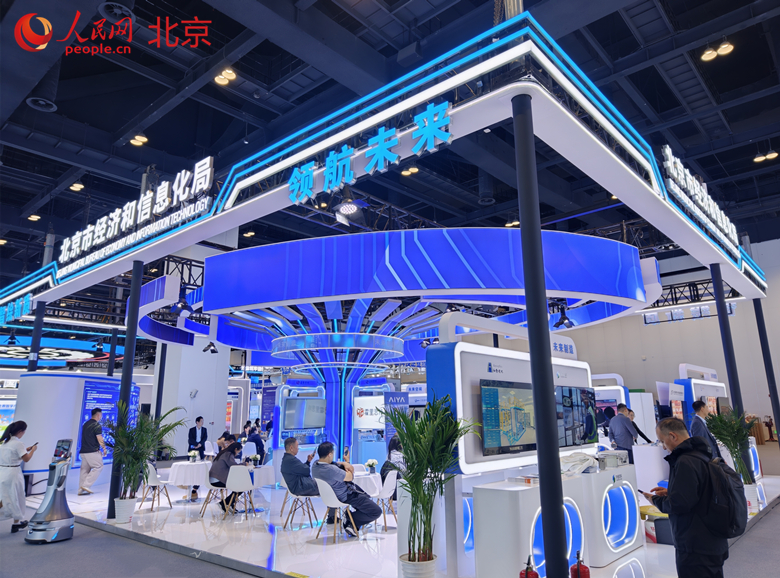
Beijing’s future industry innovation achievements are on display at the expo.
Located in the second phase of the China National Convention Center, the exhibition area focuses on six major future industry directions that Beijing is strategically developing: future information, future health, future manufacturing, future space, future energy, and future materials. Twenty-five innovative companies brought their achievements to the public, showcasing new technologies and products from practical applications.
In the future space sector, Guodian Gaoke demonstrated the Tianqi Constellation satellite IoT system, which supports access for a massive number of IoT terminals. iSpace presented models of the Hyperbola-3 reusable rocket and the Focus-2 liquid oxygen methane engine, which offer advantages such as high payload capacity and intelligent engines. Beidou Tianhui has developed a comprehensive system integration solution for the BeiDou Navigation Satellite System application field. Maiya Technology displayed the “StarBrain” series of space-based AI computing platforms, driving the intelligent development of satellites.
Service robots exhibited in the future manufacturing sector.
In the future manufacturing sector, Orion Star showcased service robots that integrate semantic understanding, autonomous navigation, and multimodal interaction. Ruihong Embodied Intelligence launched the world’s first emotional AI large model digital life partner. Holystar presented intelligent sorting equipment that uses high-precision X-ray detectors and AI recognition algorithms to achieve green and efficient mineral processing. Companies such as Robit, Helong Optimization, Shougang Mechatronics, and Tianheng Anke contributed to a complete map of intelligent manufacturing upgrades, covering dimensions like service robots, process optimization control for industrial production, high-precision manufacturing of aircraft engines and gas turbines, and real-time monitoring and management systems for smart manhole covers and pipe gallery inspection equipment.
In the future information sector, information technology is deeply embedded in urban management and industrial connectivity. Cloudrive Future released an automotive-grade central security gateway that supports next-generation intelligent driving domain control architecture. Yizhuang Science and Technology Innovation showcased a vertical AI large model for intellectual property, helping companies achieve high-quality technological breakthroughs.
In the future materials sector, the Beijing Graphene Technology Research Institute Co., Ltd. exhibited a graphene composite micro-structured current collector that increases battery energy density by 2% and extends lifespan by over 50%, with products widely applicable to power batteries. Aishangjia Technology’s graphene thermal management empowers embodied robots and previously served the Beijing Winter Olympics.
In the future energy sector, Qingchi Technology demonstrated a self-developed proton exchange membrane that breaks reliance on key materials and reduces fuel cell system costs. Yuantai Nengcai introduced high-performance diaphragm materials to support the next generation of hydrogen energy and energy storage products. Lvfan Energy showcased an all-vanadium redox flow long-duration energy storage system. Gecarbon Zhihe focuses on carbon dioxide capture and utilization, actively advancing the industrial application of green carbon innovation technology. BBMG Beishui has developed a full-process technical system in the field of collaborative disposal of hazardous waste in cement kilns, covering pretreatment, blending, feeding, and end-treatment.
In the future health sector, Lianlian Zhichuang displayed a neurovascular AI surgical robot that assists doctors in performing intelligent aneurysm neurointerventional surgeries, improving surgical safety and effectiveness. Shiyou Technology exhibited brain-computer interface brain function assessment devices used for evaluating anxiety, sleep, fatigue, depression, and cognition. Anlong Bio focuses on gene therapy drug development, while Huawai Hengyuan showcased human immune privilege cell technology.
Currently, Beijing is accelerating the cultivation and expansion of future industries. According to a relevant official from the Beijing Municipal Bureau of Economy and Information Technology, over the past year, Beijing has produced 21 globally first-of-their-kind new technologies and products, including the open-source 6G communication, sensing, computing, and intelligence fusion experimental device. It has approved 11 AI Class III medical devices for market, ranking first nationwide, and 10 innovative medical devices and 6 innovative drugs, ranking among the top in the country. It was the first to release action plans such as “AI Empowering Scientific Research,” and as of now, the number of registered large models has reached 218, accounting for about 30% of the national total.
In the 2025 Future Industry Development Index, Beijing ranked second globally. This year,
<div class