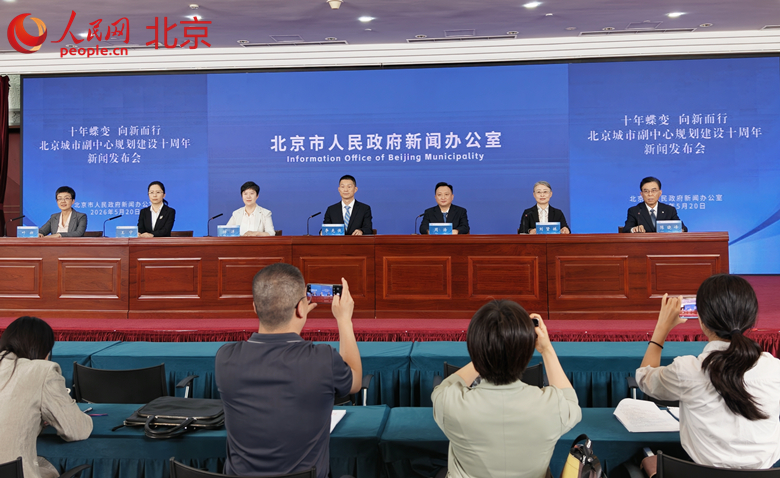
A press conference was held on the 10th anniversary of the planning and construction of Beijing’s Municipal Administrative Center.
On May 20, a press conference marking the 10th anniversary of the planning and construction of Beijing’s Municipal Administrative Center announced that over the past decade, the center has focused on high-quality development, striving to become a new growth pole for the capital. The economic output has doubled, with the gross regional product rising from 65 billion yuan in 2016 to 163.88 billion yuan in 2025, an average annual growth rate of over 6%. In 2025, the growth rate reached 10.8%, ranking first in the city.
An official from the center introduced that since construction began in 2016, the center has closely followed the goal of relieving Beijing of functions non-essential to its role as the capital. It has firmly grasped the strategic positioning as one of the “two wings of Beijing” and accelerated the creation of a demonstration zone for coordinated development in the Beijing-Tianjin-Hebei region.
The center and the central urban area have worked together, with over 80 municipal departments already relocated. The relocation of municipal-level agencies is largely complete, marking a historic and major adjustment in the capital’s urban structure.
The center and the Xiong’an New Area in Hebei Province have taken on different roles and cooperated to address Beijing’s “urban challenges.” A total of 374 subsidiaries of central and state-owned enterprises have been established. Among 14 relocated municipal state-owned enterprise headquarters, three are already operational, three will be completed by the end of this year, and five have started construction. Seven medical institutions, including the Tongzhou branch of Beijing Friendship Hospital and the Tongzhou branch of Beijing Anzhen Hospital, have been established, effectively relieving pressure on central urban medical services. Four universities have been positioned in the area, with the Tongzhou campuses of Renmin University and Beijing Institute of Fashion Technology already open, hosting over 6,400 students and faculty. During the “15th Five-Year Plan” period, the number of students and faculty is expected to grow to 25,000.
The center has integrated and developed in coordination with the three northern counties of Langfang in Hebei Province. Beijing Tongzhou Station has officially opened, the Beijing-Tangshan intercity railway is fully operational, and the cross-regional rail transit Line 22 will be ready for operation by the end of this year. The factory road has been fully opened, continuously improving commuting efficiency into Beijing.
“From ‘minute-level’ commuting to jointly creating an ecological picture of the Chaobai River National Forest Park, from industrial chain coordination to the ‘regional handling’ of over 27,000 government service items, from the extension of high-quality education and medical resources to cross-regional elderly care for over 6,000 people, the results of coordination have deeply integrated into the production and daily lives of regional residents,” the official stated.
Over the past decade, the number and quality of market entities in the center have improved. The total number of enterprises has reached 207,000, ranking third in the city, a 150% increase from 2016, with an average annual increase of 12,500 enterprises. There are 17 listed companies, 14 more than in 2016, and 1,484 high-tech enterprises, 2.6 times the number in 2016. There are 177 innovation platforms at the municipal level or above, nurturing 47 national “little giant” enterprises and 751 municipal-level “specialized and new” enterprises.
Key industries have been upgraded. Advanced manufacturing, represented by smart connected vehicles, biomedicine, and integrated circuits, has shown strong growth. The output value of industries above designated size has exceeded 100 billion yuan, moving from 9th to 5th in the city. The financial sector has continued to grow, with its share of added value and tax revenue increasing from 5% to about 10%. Cultural tourism has emerged as a pillar industry, with the added value of the cultural, sports, and entertainment sectors growing 10.7 times over the decade.
The capacity of key functional areas has been elevated. The Canal Business District has completed over 5 million square meters of construction, gathering over 7% of the district’s enterprises in less than 1% of its area and contributing over 22% of tax revenue. The total revenue of key enterprises in Zhongguancun Tongzhou Park has exceeded 100 billion yuan. The Tai-Ma collaborative area has gathered leading enterprises such as Xiaomi Auto and Zhongxin Beijing, accounting for nearly 40% of the district’s