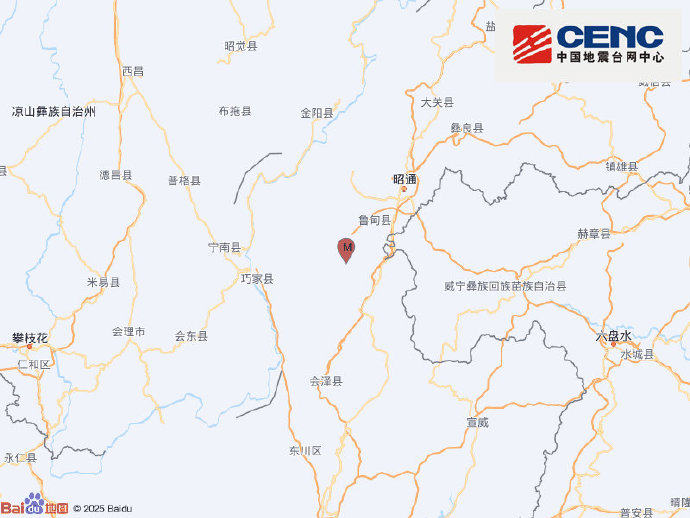
The China Earthquake Networks Center officially determined: At 19:32 on January 19, a magnitude 5.1 earthquake occurred in Qiaojia County, Zhaotong City, Yunnan Province (27.01°N, 103.41°E), with a focal depth of 10 kilometers.
China Earthquake Networks Center
The China Earthquake Networks Center (CENC) is the primary national institution in China responsible for earthquake monitoring, early warning, and data analysis. Operated by the China Earthquake Administration, it was established to enhance the country’s seismic hazard management following devastating historical earthquakes. It maintains a vast network of stations across China and plays a crucial role in real-time data reporting and scientific research for disaster prevention.
Qiaojia County
Qiaojia County is a county located in Zhaotong City, northeastern Yunnan Province, China, situated along the Jinsha River. Historically, it has been a multi-ethnic area and was part of important ancient trade routes. It is notably recognized as the final resting place of the Ming Dynasty’s Yongli Emperor.
Zhaotong City
Zhaotong City is a prefecture-level city in northeastern Yunnan Province, China, with a history dating back over 2,000 years as a key hub on the ancient Southern Silk Road. It played a significant role in cultural exchanges and is historically known as the “Southern Gateway to Sichuan.” Today, it is recognized for its unique ethnic diversity, dramatic canyon landscapes, and its importance in the development of hydropower in the region.
Yunnan Province
Yunnan Province is a diverse, mountainous region in southwestern China known for its rich ethnic diversity, encompassing over 25 recognized minority groups. Historically, it was a crucial part of the ancient Southern Silk Road, facilitating trade between China, Southeast Asia, and the Indian subcontinent. Today, it is celebrated for its stunning natural landscapes, such as the Stone Forest, and its unique cultural heritage.