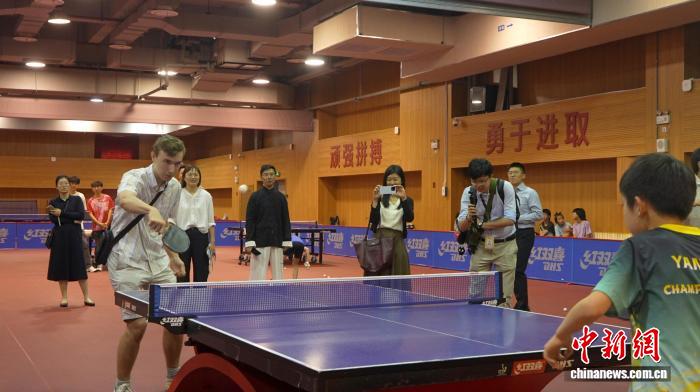
On June 8, a themed exchange event titled “Sports Connect the World” was held in Shanghai, featuring a delegation from Columbia University in the United States.
On June 8, the “Sports Connect the World” themed exchange event with the Columbia University delegation took place in Shanghai.
The 20-member Columbia University delegation represented over 10 countries, including the United States, Australia, Brazil, Germany, Colombia, South Korea, Canada, the Czech Republic, India, Indonesia, and France. The delegation visited China from May 28 to June 10, with their stay in Shanghai from June 7 to 10.
The trip was packed with activities, as the delegation visited four cities: Beijing, Chongqing, Nanjing, and Shanghai. Many members were first-time visitors to China, and they remarked, “This has been an eye-opening journey.” They learned about Chinese history they had not known before and saw impressive infrastructure they had only heard about. They expressed intentions to return to China and recommended that friends come as well, adding, “We also want to try all kinds of Chinese cuisine.”
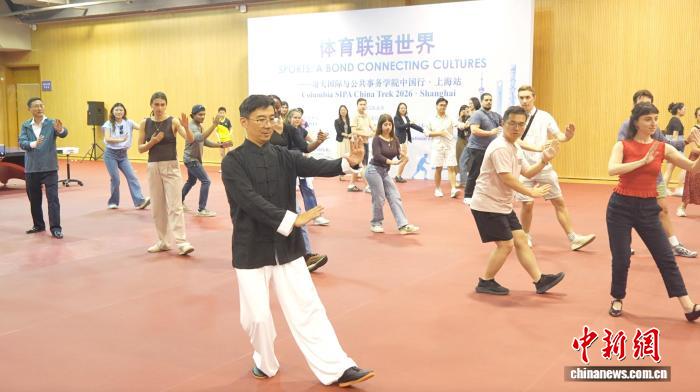
On June 8, the “Sports Connect the World” themed exchange event with the Columbia University delegation took place in Shanghai.
During the event held at Shanghai University of Sport on June 8, delegation members had an immersive experience with table tennis and martial arts. They played matches with young students and practiced against a table tennis robot, and also learned a few simple Tai Chi moves.
The Chair of the Shanghai University of Sport Committee noted that the university has a special connection with Columbia University, as its first president studied there. As the first higher education institution for sports in New China, the university has always been a positive force in international exchanges. In April of this year, young people from China and the U.S. gathered there for a series of events commemorating the 55th anniversary of ping-pong diplomacy, where they built understanding and friendship through friendly competition. Currently, interactions between Chinese and American youth are becoming more frequent, and there is hope to join hands with more American youth to use the power of sports to connect people and the world, injecting continuous youthful energy into friendly exchanges between the two countries.
The Executive Vice President of the Shanghai NGO International Exchange Association reflected on history, noting that from ping-pong diplomacy—where “small ball turned the big ball”—to ongoing sports and cultural exchange projects in Shanghai, including table tennis, basketball, baseball, softball, and Chinese martial arts, sports have consistently strengthened grassroots mutual trust amid the ups and downs of U.S.-China relations. The association will continue to promote local organizations to use sports as a medium and friendship as a bridge, allowing seeds of goodwill to take root in the hearts of young people from both countries.
During a story-sharing session, a table tennis Olympic champion and vice president of the China Table Tennis College at Shanghai University of Sport shared three moments from his career to highlight how sports can foster positive U.S.-China grassroots exchanges. A short track speed skating Olympic champion and vice president of the China NGO Network for International Exchanges also shared her experiences in promoting international sports exchanges and fostering understanding and trust among people from different cultural backgrounds. Sports, they agreed, are the common answer.
“Don’t be afraid of language barriers; be brave and come to China or other countries to see,” said a U.S. student studying at Shanghai University of Sport. About to graduate as a senior majoring in martial arts, he speaks fluent Mandarin. The Taoist concept of yin and yang in martial arts has inspired him. “Everything in life has two sides. Seeing both sides is what matters most,” he said. He encouraged the Columbia University friends present: “Don’t be scared by language barriers. Come to China often to visit and have fun. As long as you have the will to overcome difficulties, you’ll be fine.” When asked about his plans after graduation, he firmly stated, “I’m not going back. I’ll stay in China for graduate studies. I hope martial arts can be included in the Olympic Games as soon as possible.”
The delegation also watched a video commemorating the 55th anniversary of ping-pong diplomacy and