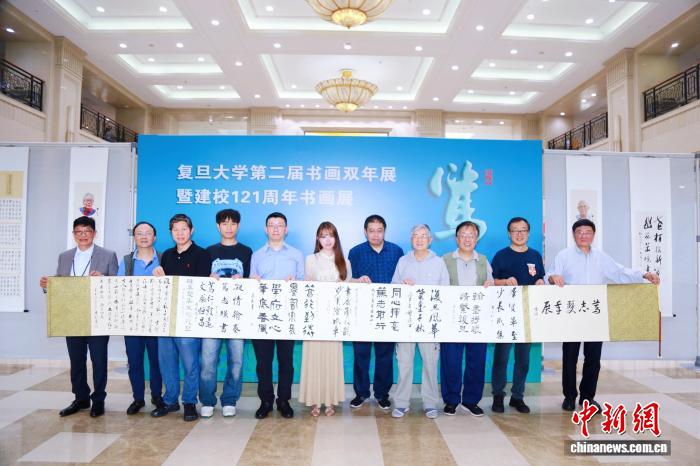
On May 26, the second calligraphy and painting biennial and the 121st anniversary exhibition of Fudan University officially opened. Over 180 works of calligraphy, painting, and seal carving were gathered from faculty, students, retired staff, and alumni both at home and abroad.
Visitors encountered touching moments left by former Fudan University President Su Buqing at the exhibition.
According to a recollection by academician Li Daqian of the Chinese Academy of Sciences, in the winter of 1978, the wind was biting cold at Beihai Park in Beijing. Su Buqing accompanied Li Daqian, who was about to go to France for further studies, up to the White Pagoda. That evening, Li Daqian presented a seven-character poem for advice. The next day, Su Buqing personally wrote back a poem titled “Accompanying Li Daqian on a Visit to Beihai Park, Written as a Farewell Gift.” The line “In future years, you will gallop far and wide, awaiting your return” was carried by Li Daqian to a foreign land, becoming a spiritual guide that brought him back to his homeland, to repay Fudan University, and to contribute to the motherland.
Starting in 1955, Jiang Peiyu worked in the President’s Office and served as Su Buqing’s secretary for the next 26 years, helping organize his schedule, gather materials, and compile “Selected Works of Su Buqing.” Su Buqing, grateful for her hard work, composed and wrote a poem titled “New Ode to a Chaste Woman” based on the original rhyme of Zhang Ji’s Tang Dynasty poem “Ode to a Chaste Woman,” and also copied Zhang Ji’s original poem for comparison. This work, created when Su Buqing was 86, represents the mature period of his calligraphy and is the most solemn recognition of a quietly dedicated colleague.
In the autumn of 1987, 85-year-old Su Buqing visited the new home of mathematics teacher Hua Xuanji at Fudan University’s 10th Dormitory to celebrate his move, presenting a personally written seven-character self-encouraging poem.
Workers repairing pipes, photographers and videographers making documentaries, and administrative logistics staff working silently behind the scenes—Su Buqing regarded them all as members of the “Fudan family.” Su Buqing would write calligraphy pieces on newspaper, yet these small ink treasures condensed the greatness of a master.
In 1993, when the sewer pipe in Su Buqing’s home was blocked, Zhu Rongyu, head of the Property Management Section, quickly brought people to fix it. A few days later, Zhu Rongyu received a calligraphy piece from Su Buqing with a poem from the Tang Dynasty temple Tōshōdai-ji, inscribed with the dedication “To adorn the wall of your humble abode.” The Fudan University Audio-Visual Education Center filmed a special documentary about Su Buqing titled “The Evergreen Tree in the Kingdom of Mathematics,” and three staff members, including Xie Yuejin, each received a personally inscribed poem as a gift.
“A whiff of ink fragrance, warmth filling the room”—this is the softer, more enduring legacy Su Buqing left for Fudan University and for his era.