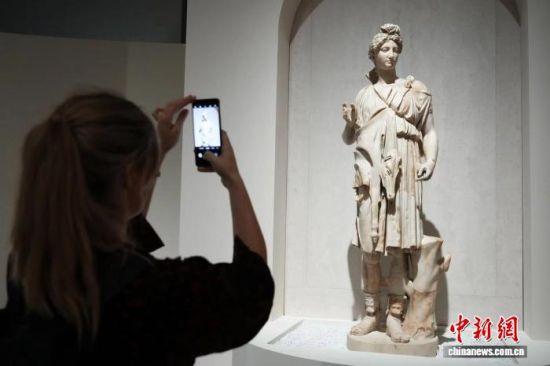
The “Rome Rome: From Olympus to the Capitol” Ancient Roman Art Exhibition officially opened at the Shanghai World Expo Museum on November 10th, presenting a panoramic view of the evolution of ancient Roman civilization through 131 precious artifacts from the National Museums Liverpool.
This cultural feast, jointly created by the World Expo Museum and National Museums Liverpool, showcases the mythological origins, imperial rise and fall, and secular life of ancient Rome through three thematic chapters: “Legends of the Gods,” “Glory of the Empire,” and “Feast of Life.” The exhibition features diverse categories including sculptures, pottery, glassware, gems, and sarcophagus reliefs, with the vast majority making their debut in Shanghai.
In the exhibition hall, nearly 20 large deity statues including the statue of Zeus (Jupiter) and the head of Poseidon (Neptune) reveal the ancient Romans’ “creative transformation” of Greek mythology. One particular statue of Artemis (Diana), the hunting goddess, has been identified by conservators as consisting of 127 different marble fragments, reflecting the exceptional craftsmanship of its creators.
The concentrated display of 26 Roman emperor and noble busts outlines the historical process of ancient Rome’s rise from a city-state to an empire, featuring figures such as Augustus (originally named Gaius Octavius), the first Roman emperor; Hadrian, the first bearded Roman emperor; and Marcus Aurelius, one of Rome’s “Five Good Emperors” who authored “Meditations.”
The Deputy Director of Shanghai Municipal Administration of Culture and Tourism stated that as another major ancient civilization exhibition following the ancient Egyptian and Greek civilization exhibitions to land in Shanghai, this exhibition will open a window for citizens and tourists to explore ancient Roman history and culture, offering an immersive experience of civilizational dialogue. “In recent years, a large number of highly popular, high-quality, and phenomenal exhibitions have made ‘visiting museums and viewing art exhibitions’ a beautiful hallmark of Shanghai, witnessing the city’s cultural exchange and mutual learning among civilizations with countries around the world.”
Olympus
Mount Olympus is the highest mountain in Greece, located between the regions of Thessaly and Macedonia. In Greek mythology, it was revered as the home of the twelve Olympian gods, led by Zeus, who were believed to reside in its cloud-covered peaks. Today, it is both a UNESCO Biosphere Reserve and a popular destination for hikers and mythology enthusiasts.
Capitol
The United States Capitol in Washington, D.C. is the meeting place of the U.S. Congress and a symbol of American democracy. Its construction began in 1793, and although it has been built, burnt, rebuilt, and expanded, the iconic white dome was completed during the Civil War. It stands as a monument to the nation’s history and legislative branch of government.
Shanghai World Expo Museum
The Shanghai World Expo Museum is a museum dedicated to the legacy of the 2010 Shanghai World Expo and the history of world expositions in general. It was officially opened in 2017 and is the only permanent museum in the world officially recognized by the Bureau International des Expositions (BIE). The museum’s design is inspired by the theme of the expo, “Better City, Better Life,” and it houses a collection of artifacts and exhibits that document the past, present, and future of these global events.
National Museums Liverpool
National Museums Liverpool is a group of eight museums and galleries located across the city, including the renowned Museum of Liverpool, World Museum, and the International Slavery Museum. Its origins date back to 1851 with the establishment of the William Brown Library and Museum, and the group has since evolved to preserve and interpret the region’s rich social, historical, and cultural heritage. The museums collectively explore themes from global history and science to Liverpool’s pivotal role as a major port, including its connection to the transatlantic slave trade.
Zeus (Jupiter)
Zeus, known as Jupiter in Roman mythology, was the king of the gods in ancient Greek religion. He ruled from Mount Olympus and was the god of the sky, lightning, and thunder, often depicted wielding a lightning bolt. His primary cult center was the sanctuary of Olympia, home to the famous Statue of Zeus, one of the Seven Wonders of the Ancient World.
Poseidon (Neptune)
Poseidon, known as Neptune in Roman mythology, was the ancient Greek god of the sea, storms, earthquakes, and horses. He was one of the twelve Olympian deities and the brother of Zeus and Hades, famously depicted wielding a trident. His primary cult centers were often located along coastlines, such as the Temple of Poseidon at Sounion, where he was worshipped by sailors and seafarers seeking safe passage.
Artemis (Diana)
Artemis, known as Diana in Roman mythology, was the ancient Greek goddess of the hunt, wilderness, wild animals, and the moon. She was the daughter of Zeus and Leto and the twin sister of Apollo, often depicted as a virgin huntress carrying a bow and arrows. A major center of her worship was the Temple of Artemis at Ephesus, one of the Seven Wonders of the Ancient World.
Augustus
Augustus refers to Gaius Octavius, also known as Augustus Caesar, the first emperor of Rome who founded the Roman Principate in 27 BC. His reign initiated an era of relative peace and stability known as the Pax Romana, which allowed for significant architectural and cultural development across the empire. While not a single site, his legacy is physically embodied in monuments like the Mausoleum of Augustus in Rome and the Ara Pacis, an altar celebrating the peace he established.