|
|
|
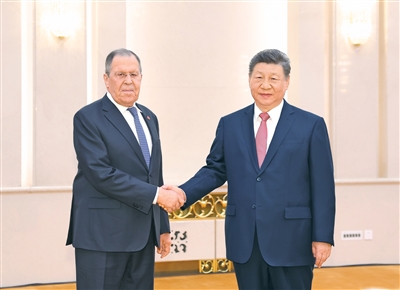
On the morning of April 15, President Xi Jinping met with Russian Foreign Minister Sergey Lavrov at the Great Hall of the People in Beijing.
|
On the morning of April 15, President Xi Jinping met with Russian Foreign Minister Sergey Lavrov at the Great Hall of the People in Beijing.
President Xi asked Lavrov to convey his sincere greetings to President Vladimir Putin. Xi Jinping pointed out that this year marks the 30th anniversary of the establishment of the China-Russia strategic partnership of coordination and the 25th anniversary of the signing of the China-Russia Treaty of Good-Neighborliness and Friendly Cooperation. The comprehensive strategic partnership of coordination between the two countries has maintained a high level of development, yielding fruitful results in various fields of cooperation. In the face of an international situation marked by intertwined changes and turbulence, the stability and certainty of China-Russia relations are particularly valuable, and the strong vitality and exemplary significance of the China-Russia Treaty of Good-Neighborliness and Friendly Cooperation have become even more prominent. The two sides should make every effort to implement the important consensus reached by President Putin and myself, strengthen strategic communication, enhance diplomatic coordination, and ensure that the China-Russia comprehensive strategic partnership of coordination stands taller, moves forward more steadily, and goes further.
Xi Jinping emphasized that in the face of profound changes unseen in a century, China and Russia should engage in closer and more effective strategic coordination to firmly defend the legitimate interests of both countries, safeguard the unity of the Global South, and demonstrate the responsibility of major countries and permanent members of the United Nations Security Council. The two sides should maintain strategic resolve, trust and support each other, pursue common development, and focus on managing their own affairs well. They should fully leverage their geographical proximity and complementary advantages to deepen all-round cooperation and enhance their respective development resilience. It is essential to strengthen multilateral coordination, firmly uphold and practice multilateralism, work together to revitalize the authority and vitality of the United Nations, maintain close coordination and cooperation within frameworks such as the Shanghai Cooperation Organization and BRICS, and promote the development of the international order in a more just and reasonable direction.
Lavrov conveyed President Putin’s sincere greetings and best wishes to President Xi Jinping. He stated that under the strategic guidance of the two heads of state, Russia-China relations have demonstrated high resilience amid a complex external environment, with robust momentum in trade and investment cooperation, increasingly close people-to-people exchanges, and close coordination on multilateral platforms such as the United Nations, the Shanghai Cooperation Organization, BRICS, and APEC. In the face of a severe and complex international situation, Russia is willing to work with China to earnestly implement the important consensus reached by the two heads of state, maintain high-level exchanges, strengthen practical cooperation, promote cultural and people-to-people exchanges, uphold international fairness and justice, advance greater development in Russia-China relations, and make greater contributions to world peace and stability.
The meeting was attended by Wang Yi.
Great Hall of the People
The Great Hall of the People is a monumental state building located on the western edge of Tiananmen Square in Beijing, China. Completed in 1959 as one of the “Ten Great Buildings” constructed for the 10th anniversary of the People’s Republic, it serves as the primary meeting place for China’s national legislature (the National People’s Congress) and hosts major political and diplomatic events.
China-Russia Treaty of Good-Neighborliness and Friendly Cooperation
The China-Russia Treaty of Good-Neighborliness and Friendly Cooperation is a major bilateral agreement signed in 2001, establishing a strategic partnership between the two nations. It formalizes a long-term commitment to peaceful coexistence, mutual non-aggression, and extensive cooperation in political, economic, and military affairs. The treaty, which was renewed for another five years in 2021, is rooted in the modern post-Cold War context but also draws upon the complex history of Sino-Russian relations over centuries.
United Nations
The United Nations (UN) is an international organization founded in 1945 after World War II to promote peace, security, and cooperation among nations. Headquartered in New York City, it replaced the ineffective League of Nations and now has 193 member states working on global issues like human rights, development, and humanitarian aid.
United Nations Security Council
The United Nations Security Council (UNSC) is the primary body within the United Nations responsible for maintaining international peace and security. Established in 1945 following World War II, its founding is outlined in the UN Charter, granting it the power to authorize sanctions, peacekeeping missions, and military action. It consists of 15 members, including five permanent members (China, France, Russia, the United Kingdom, and the United States) with veto power.
Shanghai Cooperation Organization
The Shanghai Cooperation Organization (SCO) is a major Eurasian political, economic, and security alliance founded in 2001 by China, Russia, and four Central Asian states, evolving from earlier border agreements in the 1990s. Its primary goals are to promote regional stability, combat terrorism, and enhance economic cooperation among member states. Today, it has expanded to include several full members and observer states, serving as a significant platform for dialogue and joint initiatives across the region.
BRICS
BRICS is not a specific place or cultural site, but an acronym for an association of five major emerging national economies: Brazil, Russia, India, China, and South Africa (added in 2010). It originated as an economic grouping from a 2001 investment bank report, with the first formal summit held in 2009 to promote cooperation, trade, and influence in global affairs among its members.
APEC
APEC, or the Asia-Pacific Economic Cooperation, is an intergovernmental forum established in 1989 to promote free trade, economic cooperation, and sustainable growth across the Asia-Pacific region. It is not a single physical site but a cooperative organization whose 21 member economies, including the United States, China, and Japan, hold annual summits in rotating host locations. Its history is defined by efforts to reduce trade barriers and address shared economic challenges since the late Cold War era.
Global South
The term “Global South” is not a specific geographic place but a socio-economic and political concept referring broadly to countries in Africa, Latin America, Asia, and Oceania that have historically been marginalized in the global political economy, often as former colonies. It emerged during the Cold War, gaining prominence through movements like the Non-Aligned Movement, to describe nations with shared experiences of development challenges and a common interest in advocating for a more equitable international order. Today, it represents a collective identity focused on addressing issues like poverty, inequality, and climate justice from a shared perspective.