Xi Jinping holds talks with Mozambican President Chapo
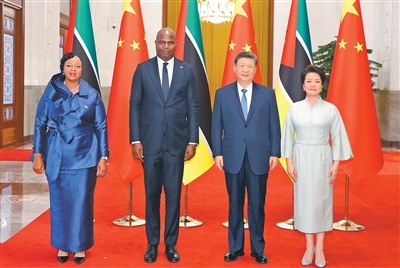
On the afternoon of April 21, President Xi Jinping held talks with Mozambican President Filipe Nyusi, who was on a state visit to China, at the Great Hall of the People in Beijing. This is a group photo of Xi Jinping and his wife Peng Liyuan with Nyusi and his wife Guita before the talks.
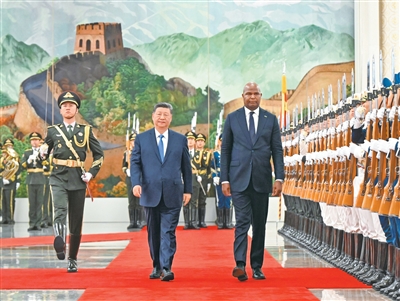
On the afternoon of April 21, President Xi Jinping held talks with Mozambican President Filipe Nyusi, who was on a state visit to China, at the Great Hall of the People in Beijing. This is the welcome ceremony for Nyusi held by Xi Jinping in the North Hall of the Great Hall of the People before the talks.
On the afternoon of April 21, President Xi Jinping held talks with Mozambican President Filipe Nyusi, who was on a state visit to China, at the Great Hall of the People in Beijing. The two heads of state agreed to elevate bilateral relations to a China-Mozambique community with a shared future in the new era.
Xi Jinping pointed out that the traditional friendship between China and Mozambique transcends history and spans mountains and seas. Since the establishment of diplomatic ties, China and Mozambique have trusted each other and supported each other, becoming a model of China-Africa friendship and South-South cooperation. Under the new circumstances, continuously deepening China-Mozambique friendly cooperation meets the common expectations of the peoples of both countries and aligns with the trend of the times for the Global South to strengthen solidarity and cooperation and jointly address challenges. China is willing to work with Mozambique to take the implementation of the outcomes of the Beijing Summit of the Forum on China-Africa Cooperation and the 2026 “China-Africa Year of People-to-People Exchanges” as opportunities to jointly pursue the dream of modernization.
Xi Jinping emphasized that friendship and mutual trust are the prominent features and political advantages of China-Mozambique relations. The two sides should carry forward the fine traditions, continue to firmly support each other on issues concerning core interests and major concerns, maintain close exchanges between governments, political parties, legislative bodies, local governments, and other fields and levels, and strengthen exchanges of experience in governance and party building. China and Mozambique have strong economic complementarity and broad prospects for cooperation. This year marks the beginning of China’s “15th Five-Year Plan.” China is willing to work with Mozambique to strengthen the alignment of development strategies, innovate cooperation models, explore new paths for comprehensive development cooperation in infrastructure, energy, and minerals, and actively cultivate new growth points for cooperation in agriculture, new energy, digital economy, artificial intelligence, etc., to promote high-quality and sustainable development of practical cooperation between the two countries. Facing the complex and changing international situation, the two sides should continue to strengthen coordination and cooperation within the United Nations and other institutions, work together in solidarity, jointly advocate an equal and orderly multipolar world and a universally beneficial and inclusive economic globalization, and jointly defend international fairness and justice.
Xi Jinping pointed out that in the 70 years since the establishment of diplomatic relations between China and Africa, no matter how the international situation changes, the two sides have always stood together through thick and thin. The Global South
人民大会堂
The Great Hall of the People (人民大会堂) is a significant political and cultural landmark located on the western side of Tiananmen Square in Beijing. Completed in just 10 months in 1959, it was built as one of the “Ten Great Buildings” to commemorate the 10th anniversary of the founding of the People’s Republic of China. The hall serves as the primary venue for the National People’s Congress and other major state events, symbolizing China’s political power and architectural ambition.
人民大会堂北大厅
The North Hall of the Great Hall of the People in Beijing serves as the main entrance and a key ceremonial venue within this iconic political building. Constructed in 1959 as part of the “Ten Great Buildings” to commemorate the 10th anniversary of the People’s Republic of China, it is famously known as the site where Chinese leaders greet foreign dignitaries and host state welcoming ceremonies. The hall features grand marble columns and a distinctive red carpet, symbolizing national dignity and hospitality.
北京
Beijing, the capital of China, is a city with a history spanning over 3,000 years, serving as the nation’s political and cultural center for centuries. It is home to iconic landmarks such as the Forbidden City, the Great Wall, and the Temple of Heaven, reflecting its imperial past under the Ming and Qing dynasties. Today, Beijing blends ancient heritage with modern development, hosting major events like the 2008 Summer Olympics and serving as a global hub for innovation and diplomacy.
联合国
The term “联合国” refers to the United Nations (UN), an international organization founded in 1945 after World War II to promote peace, security, and cooperation among nations. Its headquarters is located in New York City, and it was established with the signing of the UN Charter by 51 original member countries. Today, the UN plays a key role in addressing global issues such as conflict resolution, human rights, and sustainable development.
中非合作论坛北京峰会
The Forum on China-Africa Cooperation (FOCAC) Beijing Summit is a major diplomatic event that brings together leaders from China and African nations to strengthen economic, political, and cultural ties. First established in 2000, the summit has been held every three years, with the Beijing Summit serving as a key platform for discussing development cooperation, trade, and infrastructure projects. The 2024 summit continues this tradition, reflecting the growing partnership and mutual interests between China and Africa.
2026年中非人文交流年
“2026年中非人文交流年” (China-Africa Year of People-to-People Exchanges in 2026) is a designated year aimed at strengthening cultural, educational, and social ties between China and African nations. Building on the long-standing diplomatic and economic cooperation between the two sides, this initiative highlights a mutual commitment to deepen mutual understanding and friendship through various exchange programs. The year serves as a platform to showcase shared heritage and foster closer people-to-people connections, reflecting the evolving partnership between China and Africa.
中国
China, officially known as the People’s Republic of China, is a vast country in East Asia with one of the world’s oldest continuous civilizations, dating back over 4,000 years. It is home to iconic cultural sites such as the Great Wall, the Forbidden City, and the Terracotta Army, reflecting its rich imperial history from dynasties like the Qin, Ming, and Qing. Today, China blends its ancient heritage with rapid modernization, serving as a global economic powerhouse while preserving traditions like calligraphy, tea ceremonies, and festivals such as the Lunar New Year.
莫桑比克
Mozambique is a southeastern African country with a rich history shaped by Swahili trade networks, Portuguese colonization, and a long civil war following its independence in 1975. Its cultural heritage blends African, Portuguese, and Arab influences, evident in the architecture of Maputo and the cuisine. Today, Mozambique is known for its stunning Indian Ocean coastline and growing tourism industry.