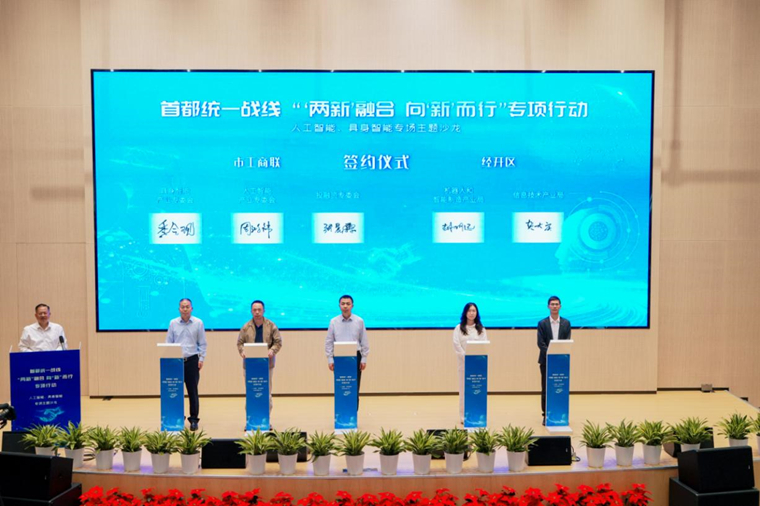
A special action program titled “Integration of New Forces, Moving Towards Innovation” was launched in Beijing, aiming to accelerate the integration of technological and industrial innovation in the capital.
The initiative seeks to leverage Beijing’s strengths in education, science, and talent to create a platform for entrepreneurs and scientists to collaborate and contribute to the development of new productive forces.
Officials emphasized the importance of breaking down barriers between technological and industrial innovation, transforming Beijing’s top-tier educational resources, active market entities, and vast application scenarios into industrial momentum. This will provide a continuous source of vitality for building world-class industrial clusters in the Beijing-Tianjin-Hebei region. A service system to promote the integration of new forces will be established, featuring regular matchmaking platforms to align industry demands with technological supply and accelerate the transition of scientific achievements into industrial practice. The focus will be on results, making the transformation of scientific and technological achievements a top priority by improving project tracking mechanisms and turning Beijing’s innovation advantages into strong drivers for high-quality development.
The action plan, along with lists of entrepreneurs’ technical needs and scientists’ technological achievements, was released. Policy briefings were given by several municipal departments and the Beijing Economic-Technological Development Area, while professional service institutions introduced products for transforming scientific and technological achievements.
During the event, relevant departments and institutions in the Beijing Economic-Technological Development Area signed cooperation agreements. Three parallel matchmaking sessions for scientists and entrepreneurs were also held, focusing on vertical large models, embodied intelligence, and integrated circuits.
Beijing
Beijing, the capital of China, is a sprawling metropolis with a history spanning over three millennia, serving as the nation’s political and cultural center for centuries. It was the imperial seat of the Ming and Qing dynasties, leaving landmarks like the Forbidden City and the Great Wall nearby. Today, it blends ancient traditions with modern development, hosting major events like the 2008 Summer Olympics.
Beijing-Tianjin-Hebei region
The Beijing-Tianjin-Hebei region, also known as Jing-Jin-Ji, is a major economic and cultural hub in northern China centered around the capital Beijing and the port city of Tianjin. Historically, this area was the heart of imperial China, with Beijing serving as the capital for the Ming and Qing dynasties, while Tianjin developed as a key trading port in the 19th century. Today, the region is a focus of national integration efforts to coordinate development, reduce pollution, and improve transportation links.
Beijing Economic-Technological Development Area
The Beijing Economic-Technological Development Area (BDA), also known as Yizhuang, is a major industrial and technology hub located in the southeast of Beijing. Established in 1994 with approval from the State Council, it was designed to attract high-tech industries, foreign investment, and advanced manufacturing. Over the past decades, the BDA has grown into a key driver of Beijing’s economic modernization, hosting numerous multinational corporations and innovation centers.
Beijing
Beijing, the capital of China, is a city with a rich history spanning over 3,000 years, serving as the nation’s political and cultural center for centuries. It is home to iconic landmarks such as the Forbidden City, the Great Wall, and Tiananmen Square, which reflect its imperial past and modern significance. Today, Beijing blends ancient traditions with rapid modernization, making it a vibrant global metropolis.
Beijing-Tianjin-Hebei region
The Beijing-Tianjin-Hebei region, often called Jing-Jin-Ji, is a major economic and cultural hub in northern China centered around the capital city of Beijing. Historically, this area has been politically significant for centuries, serving as the imperial heartland during the Ming and Qing dynasties. Today, it is a key focus of national integration efforts, aimed at coordinating development, reducing pollution, and improving transportation links to create a world-class urban cluster.
Beijing Economic-Technological Development Area
The Beijing Economic-Technological Development Area (BDA), also known as Yizhuang, is a major industrial and technological hub located in the southeast of Beijing. Established in 1994 with approval from the State Council, it was designed to attract high-tech industries, foreign investment, and innovation-driven enterprises. Over the years, the BDA has grown into a key driver of Beijing’s modern economy, hosting numerous Fortune 500 companies and focusing on sectors such as information technology, biomedicine, and advanced manufacturing.