Finally, after three months of war and stalemate, the biggest diplomatic breakthrough between the United States and Iran is about to happen—or rather, the two sides are heading for a “win-win.”
But first, it must be said that reports from American media are definitely one-sided.
All media narratives are essentially extensions of positions, not the full picture of reality.
Because I first saw the U.S. news site Axios report that the U.S. and Iran had basically reached an agreement on a “memorandum of understanding” on the 26th, with Iran having approved it, now awaiting final approval from Trump.
Iran soon “clarified”: This does not match the facts, the relevant document has “not been finalized”; if it is finalized, Iran will formally notify Pakistan and announce it publicly.
So the question is: Has it been finalized or not?
This is entirely my personal judgment—it is likely still in the final stages of extreme tug-of-war.
The endgame of major power games is never a smooth compromise, but a fierce struggle over every inch of ground.
Roughly speaking:
1. The recent U.S.-Iran talks in Qatar definitely produced a “memorandum of understanding,” which was basically agreed upon. Trump hinted at this earlier.
2. The key is the next step: approval. U.S. media said it awaits Trump’s final approval, as if Trump is the ultimate decision-maker. This certainly does not match the facts.
3. According to convention, the text must be approved by the highest decision-making levels of both sides—meaning it needs Trump’s approval and also the approval of Iran’s Supreme Leader, Mojtaba.
4. From the negotiation process, Iran’s negotiation of the “memorandum of understanding” must have been authorized by the highest decision-making level, so Mojtaba’s final signature should not be a big problem.
6. Trump’s delay in signing may indeed be due to dissatisfaction with the agreement. His previously touted “major victory” seems unimpressive? He needs time to digest, weigh options, and deal with media and domestic pressure.
7. Of course, he is also continuing to seek breakthroughs. For example, a few days ago, he threatened Saudi Arabia, Qatar, and other countries that they must sign the Abraham Accords, otherwise he would not sign the agreement with Iran. This was subtly criticized by Western media as blackmailing Gulf states.
8. At the same time, the U.S. has redefined the concepts of “self-defense” and “ceasefire.” While declaring adherence to a ceasefire, it launched “self-defense attacks” on Iran, aiming to continue maximum pressure on Iran.
9. Iran is certainly watching. If Trump does not sign, Mojtaba will not rashly sign either. Otherwise, Trump would surely boast, “See, Iran is eager to sign the agreement.”
10. This is the most exhausting part of negotiating with the U.S. right now: even if the agreement is basically reached, the U.S. will still create various complications, Trump delays signing, and it cannot be ruled out that he might suddenly tear it up.
In the game of power, promises are merely bargaining chips.
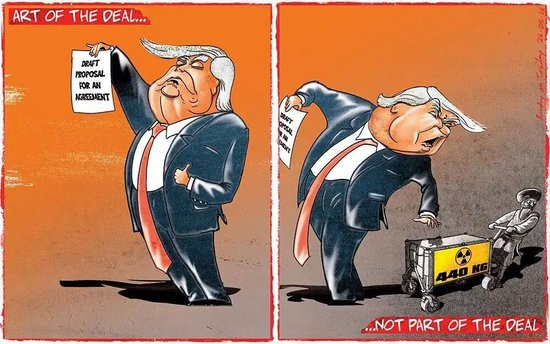
Trump revels in this. During his time as a real estate developer, he wrote the book “The Art of the Deal.” I’ve seen people summarize his so-called deals as generally involving four steps:
First, propose a shocking goal, set conditions far beyond expectations, and throw the opponent into panic.
Second, then engage in massive publicity, using various media campaigns to strengthen one’s deterrence.
Third, decisions then fluctuate repeatedly, creating various uncertainties in negotiations, giving the opponent room to negotiate but not easily agreeing, leaving them anxious.
Fourth, finally force the opponent to compromise, and they are even relieved not to have gotten the worst outcome.
According to Trump’s explanation, the so-called art of negotiation is setting a condition far higher than expected to leave the opponent at a loss, using erratic changes to pressure them, and offering a suboptimal option for them to accept, achieving the originally desired result.
We saw similar scenes in the previous tariff negotiations and
<div