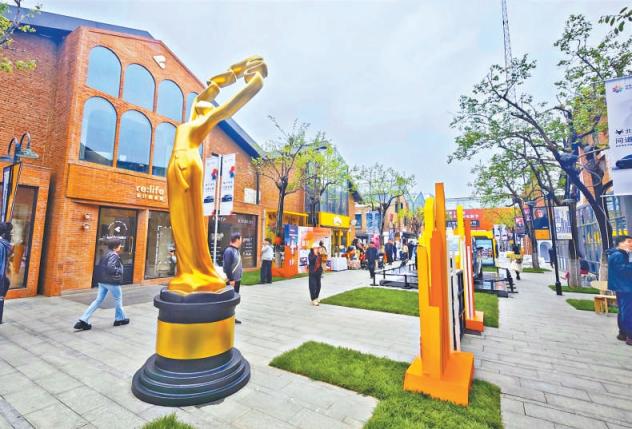
A statue of the “Tiantan Award” at the Beijing International Film Festival market scene.
Ten days of cinema, joy across the entire city. The 16th Beijing International Film Festival concluded successfully by Yanqi Lake. Whether you are a devoted film fan rushing to theaters for great movies, or an ordinary citizen wanting to soak up the spring atmosphere; whether you are a new director just starting your film journey, or an international buyer seeking cooperation in the Chinese market, everyone can reap rewards from this grand event.
Having run for 16 editions, the Beijing International Film Festival is not just a film event, but a heartfelt dialogue between the city and cinema, a contemporary resonance between Chinese cinema and world civilization.
Boosting Consumption
Film Art Truly Achieves Universal Sharing
The diverse “Beijing Film Exhibition,” 5 million yuan in public welfare subsidies, and the “Film Lifestyle Festival” series of activities have worked in concert to quietly stimulate urban consumption, allowing film art to truly achieve universal sharing and empathy.
260 outstanding films from around the world brought approximately 800 screenings in theaters across the Beijing-Tianjin-Hebei region. Competition section entries, open-air screenings, VR films, and other special features combine artistic depth with contemporary spirit. This year’s “Beijing Film Exhibition” lineup was diverse, allowing film fans to find their own moving spark.
At the same time, special funds from the Beijing Cultural Consumption Promotion Action launched a “Spring Public Welfare Film Viewing Activity,” investing 5 million yuan in subsidies for consumption in areas such as film viewing, increasing subsidies for Beijing Film Exhibition tickets.
If the exciting film lineup and public welfare subsidies are the primary driving force attracting audiences to theaters, then the “Film Lifestyle Festival” has created a cross-dimensional experiential matrix covering food, tourism, markets, reading, and more. When a movie ticket stub is no longer just proof of viewing but becomes a “passport” to enjoy consumption across the city, the boundaries of the film festival have been redefined. With a small ticket stub, audiences can enjoy exclusive discounts at over 600 merchants in more than 50 commercial districts across the city, experiencing immersive consumption like “Follow the Film to Taste Food,” “Follow the Film to Explore Markets,” and “Follow the Film to Travel.”
Taking the “Frame-Burning Youth Gathering Place Film Life Art” themed market at Langyuan Station Park as an example, this market gathered around 200 stalls, creating a new cinematic life scene that can be viewed, experienced, and consumed, blending film merchandise, movie-themed accessories, independent illustration works, and film-themed creative snacks and specialty coffee.
A market stall from Tianjin called “Vintage Dream House” was filled with figurines from well-known IPs like Disney, treasures that the owner had sourced from around the world. From April 16th to 25th, her stall was constantly surrounded by a steady stream of customers, including celebrities attending the festival. “We are grateful to the Beijing International Film Festival for this opportunity. The planning and support for the entire market were excellent,” the owner revealed. Their sales at the festival market far exceeded expectations, and they even received invitations from several other market organizers.
The activities of the Beijing International Film Festival are actively stepping out of traditional cinema spaces and embedding themselves into various city neighborhoods. This edition also created a “Live Site” for the first time, broadcasting or screening festival-related activities live on public high-definition large screens at over 20 open locations across the city. A consumer ecosystem network composed of festival organizers, cinemas, and catering, cultural tourism, and retail merchants is taking shape.
Nurturing Talent
Extending from Scriptwriting to Film Promotion
As a core barometer of the domestic film industry and a key incubation hub for new works, this year’s festival consistently focused on integrating resources across the entire chain, building a complete industrial ecosystem covering creative incubation, industry transactions, talent supply, industry seminars, and public accessibility.
On April 21st, the Project Pitch Awards Ceremony was held as scheduled. “Yerlan and Nurlan” received the Jury’s Special Recommendation, “The Street Cleaners on the Path of Life” won the Most Commercially Valuable Project, and “Borrowing Life’s Float” won the Best Original Screenplay Project
<div class="my-4 p-4 rounded-lg shadow-md bg-blue-50 border-l-4 border-blue-