On November 21, the 2025 International Garden City Competition global finals concluded in Istanbul, Turkey. Beijing Wenyu River Park received the “Gold Award for Environmental Sustainable Development Project” for its outstanding practices in ecological construction and sustainable development.
This year’s competition focused on the theme “Culture and Urban Sustainable Development,” with 38 projects from 30 cities across 35 countries reaching the finals, making the competition intense. The evaluation covered six core dimensions: landscape improvement, cultural heritage management, environmental response, and others. Beijing Wenyu River Park achieved the highest overall score in the project category for environment, climate response, and green economy, earning the “Special Award” as the only project to receive this distinction, making it a standout in this year’s competition.
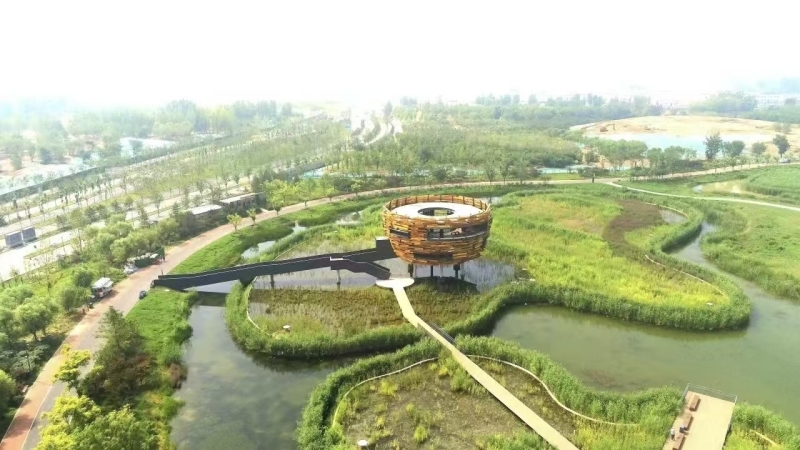
The Chaoyang section of Beijing Wenyu River Park covers approximately 17.7 square kilometers and serves as a flagship example of the capital’s ecological civilization construction. Since 2022, the first phase of the Chaoyang section has been open to the public, featuring five themed areas from south to north: natural education, cultural integration demonstration, all-ages forest sports, ecological culture experience, and flood storage and ecological conservation. These areas provide urban residents with light outdoor activities, micro-vacations, slow living, and positive leisure spaces, allowing better connection with nature.
In September 2025, the second phase of the Chaoyang section officially opened. The park continues to focus on its core themes of “education, camping, sports, and trendy activities,” with emphasis on developing specialized facilities such as a tennis center and the Beijing Equestrian Association’s competition center. These new spaces further strengthen the park’s positioning as an “urban micro-vacation destination,” creating a new ecological leisure destination for capital residents and visitors.
With ongoing ecological management, the biodiversity of Wenyu River Park’s ecosystem has steadily improved, with over 200 new species establishing habitats in the area. Currently, the total number of plant and animal species has reached 880.
Since 2020, Wenyu River Park has followed the development goal of “initial launch in one year, demonstration in two years, formation in five years, conservation in ten years, and scenic maturity over many years.” The park implements ecological methods including ecological priority, combination of refinement and wilderness, low disturbance, and wilderness management to systematically build the regional ecological foundation. The park employs a four-level ecological zoning management system covering wilderness reserves, ecological priority areas, ecological experience areas, and ecological recreation areas, with differentiated planning, landscape design, and visitor guidance. A 9-square kilometer natural zone has been designated for wilderness management.
Currently, the main water quality indicators of Wenyu River Park remain stable at Class IV standards, with some locations reaching Class III standards, contributing to improved water quality in downstream areas. Through the two ecological corridors of Wenyu River and Qing River, biological resources are effectively distributed, enhancing biodiversity particularly for aquatic plants and animals in downstream regions.
While protecting the ecological environment, Beijing Wenyu River Park has also actively developed themed IPs including education, camping, sports, and trendy activities. Since opening, the park has established various high-quality sports facilities, developed diverse outdoor sports programs, and hosted events of different scales and formats, achieving an organic combination of green space and sports functions to become a sports park embedded within nature. Additionally, the park creates seasonal landscape features and corresponding recreational facilities.
Looking forward, the Chaoyang district will continue working to create a new vision of “city and nature coexistence,” contributing to the capital’s garden city development.