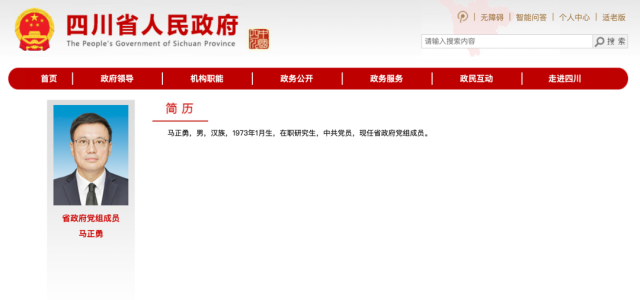
The official website of the Sichuan Provincial Government recently updated its “Government Leadership” section, showing that Ma Zhengyong has been appointed as a member of the Sichuan Provincial Government Party Leadership Group.
Previously, Ma Zhengyong served as Vice Governor of Guangdong Province and a member of its Government Party Leadership Group, as well as Secretary of the Meizhou Municipal Party Committee.
Public information shows that Ma Zhengyong, male, Han ethnicity, was born in January 1973 in Guyuan, Ningxia. He joined the Communist Party of China in December 1994 and began working in July 1994, holding a postgraduate degree from in-service study.
He previously served as Secretary of the Party Leadership Group and Director of the Guangzhou Municipal Science and Technology Innovation Committee, and as Secretary of the Haizhu District Committee in Guangzhou. In May 2020, he became Deputy Secretary of the Qingyuan Municipal Committee and Mayor, in August 2021 Deputy Secretary of the Meizhou Municipal Committee and Mayor, and in October 2021 Secretary of the Meizhou Municipal Committee.
In April 2025, Ma Zhengyong was promoted to Vice Governor of Guangdong Province and a member of its Government Party Leadership Group, while continuing to serve as Secretary of the Meizhou Municipal Committee.
Sichuan Provincial Government
The Sichuan Provincial Government is the administrative authority for Sichuan Province, China, historically rooted in the region’s governance structures that date back to the Qin dynasty. Its modern form was established after the founding of the People’s Republic of China in 1949, overseeing the province’s development from its capital, Chengdu. The government manages local policy, economy, and culture, reflecting Sichuan’s role as a key hub in southwestern China.
Guangdong Province
Guangdong Province, located on the southern coast of China, has a rich history as a major center for trade and cultural exchange, particularly through the historic port city of Guangzhou (Canton). It played a pivotal role in ancient maritime Silk Road commerce and was a key site for early foreign contact, including European trade in the 16th century. Today, Guangdong is known for its vibrant Cantonese culture, economic dynamism, and as the birthplace of many overseas Chinese communities.
Meizhou
Meizhou is a city in eastern Guangdong Province, China, known as the cultural heartland of the Hakka people. Its history dates back over a thousand years, and it is famous for preserving traditional Hakka architecture, such as the circular tulou buildings, as well as the Meixian dialect of Hakka Chinese. The city is also the birthplace of notable figures like Marshal Ye Jianying and is a key destination for exploring Hakka customs, cuisine, and ancestral heritage.
Guyuan
Guyuan is a city in the Ningxia Hui Autonomous Region of China, with a history stretching back over 2,000 years as a key strategic outpost along the ancient Silk Road. Historically known as a frontier garrison town, it was a vital crossroads for trade and cultural exchange between China and Central Asia. Today, the area is notable for its well-preserved tombs from the Northern Wei and Tang dynasties, as well as the scenic Liupan Mountains.
Ningxia
Ningxia is an autonomous region in northwestern China known for its rich history along the Silk Road and its distinctive Hui Muslim culture. Historically, it was part of the Western Xia dynasty (1038–1227), whose imperial tombs near Yinchuan remain a major archaeological site. Today, Ningxia is famous for its desert landscapes, the Helan Mountains, and its production of goji berries and wine.
Guangzhou
Guangzhou, the capital of Guangdong Province in southern China, is a major port and cultural hub with a history spanning over 2,200 years. As a key starting point of the ancient Maritime Silk Road, it has long been a center for trade and foreign exchange, blending traditional Lingnan culture with modern influences. Today, it is known for its vibrant Cantonese heritage, iconic landmarks like the Canton Tower, and its role as a global manufacturing and commercial powerhouse.
Haizhu District
Haizhu District is a central urban district of Guangzhou, China, located on the south bank of the Pearl River. Historically, it was an important port and commercial area during the Qing Dynasty, with the iconic Canton Fair originating there in 1957. Today, it is known for its mix of modern development, cultural heritage sites like the Pazhou Pagoda, and the Canton Fair Complex, making it a key hub for trade and tourism.
Qingyuan
Qingyuan, located in Guangdong Province, China, is a prefecture-level city known for its natural beauty and hot springs. Historically, it was part of the ancient Baiyue region and developed as a key area during the Ming and Qing dynasties due to its strategic location along the Bei River. Today, Qingyuan is famous for attractions like the Feixia Scenic Area and the Qingxin Hot Springs, blending cultural heritage with modern tourism.