Convenience stores, a retail format spread across city streets and close to daily consumption, delivered a leading performance in the first quarter of 2026.
According to the latest data from the National Bureau of Statistics, among retail units above the designated size in the first quarter of this year, retail sales of convenience stores, supermarkets, and specialty stores increased by 8.3%, 5.1%, and 0.5% year-on-year, respectively, while department stores and brand stores fell by 0.1% and 4.2%. Convenience stores maintained the fastest growth rate, ranking first.
However, behind the impressive data, the industry is under significant pressure. The “2025 China Convenience Store Development Report” jointly released by the China Chain Store & Franchise Association and KPMG pointed out that although the convenience store industry is experiencing positive growth in scale, it is generally facing dual pressures of declining customer traffic and lower average spending per customer. At the same time, convenience store brands are increasing their presence in instant retail, comprehensively restructuring industry patterns, competition methods, and profit models.
Stable Scale, New Players Enter
Looking at the overall operation of the format, the convenience store industry is still expanding steadily, but the pace of expansion has clearly slowed, entering a new phase where stock competition and structural optimization go hand in hand.
Data from the “2026 China Top 100 Convenience Stores” released by the China Chain Store & Franchise Association at the end of April this year shows that in 2025, the total number of stores of the top 100 convenience store enterprises nationwide reached 208,000, a net increase of 11,000 year-on-year, with a growth rate of 5.6%, which is lower than the previous high-speed growth stage. The industry is gradually shifting from “rapid expansion” to improving quality and efficiency. The concentration of leading brands continues to increase, and the market structure is becoming more stable.
According to the “2026 China Top 100 Convenience Stores,” there are 38 enterprises with a store count of over 1,000, the same as in 2024. Among the top 10 enterprises with the most stores, the top three are still Meiyijia, Sinopec Easy Joy, and PetroChina Kunlun Haoke, with a total of 88,650 stores. Meiyijia leads with 40,147 stores, ranking first; Easy Joy and Kunlun Haoke, relying on exclusive gas station scenarios, together have over 48,000 stores.
In addition, new players have quickly entered the market. In 2025, Suqian Jingdong Derui, Chongqing Yuhejia, Hebei Zanjia, Shenyang Sendi, and Shifen Bianli newly entered the list. Shanghai Guangming Commercial Supply Chain Co., Ltd. entered the list after the integration of original Shanghai Haode Kedi Bianli and Liangyou Jinban Bianli.
However, behind the stabilizing industry scale, profitability pressure has become a common challenge. The daily revenue per convenience store is declining, and the profit margin per store is being continuously compressed. At the same time, new formats such as bulk snack stores, discount stores, and instant retail lightning warehouses are rapidly emerging, diverting customer traffic from multiple dimensions such as price, channel, and scenario. Traditional convenience stores face multiple pressures including intensified homogeneous competition, narrowing gross margins, and sluggish customer traffic growth.
In this regard, it is believed that against the backdrop of increasing economic uncertainty and the industry entering a deeper stage of transformation, enterprises are facing unprecedented challenges. Model disruption, industry involution, and profit squeeze are putting tremendous pressure on traditional business operations, demanding higher strategic focus, adaptability, and learning capabilities from enterprises.
Intense Competition, Scenario-Based Breakthrough
As one of the cities with a high degree of marketization and intense competition in the convenience store sector, Shenzhen is a typical sample for observing industry transformation.
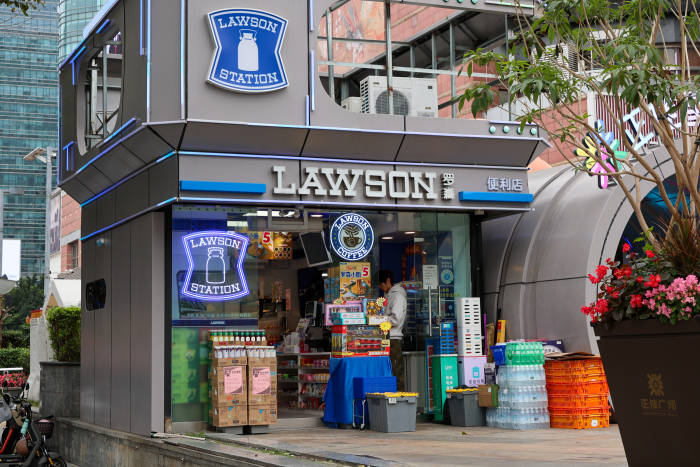
Currently, the convenience store market in Shenzhen presents a structure dominated by domestic local brands, with foreign brands deeply entrenched, differentiated competition, and high saturation. Domestic chain brands such as Meiyijia, Yizhan, and Zhongye Aimin, relying on mature franchise systems and cost-effective strategies, widely cover scenarios like communities, urban villages, and industrial parks. Foreign brands like Lawson, 7-Eleven, and FamilyMart focus on high-quality locations such as office buildings, subway hubs, and high-end communities, occupying the high