The trend of “city-hopping tourism” has arrived—how can Sichuan and Chongqing seize the opportunity?
The “New Charm Chongqing” drone light show attracted many tourists. (File photo)
After watching a Sichuan opera performance featuring rolling lanterns and face-changing at Kuanzhai Alley in Chengdu, two hours later, visitors wait for the lights to illuminate the night in the evening breeze at Hongyadong in Chongqing; in the morning, they marvel at the grandeur of the Three Gorges, exclaiming “a light boat has passed through ten thousand mountains,” and by afternoon, their phone albums are filled with the adorable antics of “Huahua” at the Chengdu Panda Base.
During the just-concluded “May Day” holiday, the Sichuan-Chongqing “CP” once again joined hands to impress the world: Sichuan Province received 36.0223 million tourists, a year-on-year increase of 6.19%, with 5A-level scenic spots hosting a total of 3.4689 million tourists and achieving ticket revenue of 108 million yuan; 130 key monitored scenic spots in Chongqing received 8.15 million tourists, up 3.8% year-on-year.
Whether it’s “enter through Chongqing and exit through Chengdu” or “enter through Chengdu and exit through Chongqing,” a multi-stop single itinerary meets the new demand for “city-hopping travel,” maximizing indicators such as cost-effectiveness, time density, and experience saturation.
How did the Sichuan-Chongqing CP master this new demand, and what explorations have the two regions jointly undertaken?
1
What Does “Hopping” Mean?
Multiple Gains from a Single Trip
During the “May Day” holiday, entering the Baidicheng·Qutang Gorge scenic area in Fengjie, ancient relics and the majestic river scenery complement each other. Many primary and secondary school students and their parents matched poems from textbooks with the real scenery before their eyes.
“West of the Ten Thousand Li Bridge lies a thatched cottage, and the water of Hundred Flower Pool is like the Canglang River,” “The wind is swift, the sky high, apes howl in sorrow; the islet clear, the sand white, birds fly back and forth”… At an innovative national-style NPC interactive event launched by the scenic area, Liu Qi, a sixth-grade student from Xiangtan, Hunan, won a telescope in a poetry matching session, dancing with joy.
Her father, Liu Jingzhou, said that using the “spring break + May Day” opportunity, he planned a “Du Fu tour” route: first visiting Du Fu’s Thatched Cottage in Chengdu for a day, then following the footsteps of the “Poet Sage” through Jiazhou (now Leshan), Yuzhou (now Chongqing), to Kuizhou (now Fengjie), allowing his daughter to travel and learn.
Read ten thousand books and travel ten thousand miles. This year’s “May
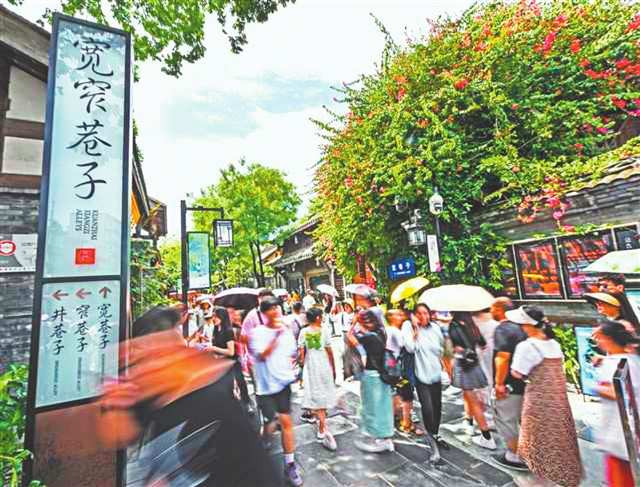
Kuanzhai Alley
Kuanzhai Alley, or Kuanzhai Xiangzi, is a historic district in Chengdu, China, consisting of three parallel alleys—Kuan (Wide), Zhai (Narrow), and Jing (Well) Alleys. Originally built during the Qing Dynasty (1644–1912) as a residential area for Manchu soldiers, it has been preserved and restored to showcase traditional Sichuan architecture and culture. Today, it is a popular tourist destination, offering a blend of ancient teahouses, local crafts, and modern shops that reflect Chengdu’s leisurely lifestyle.
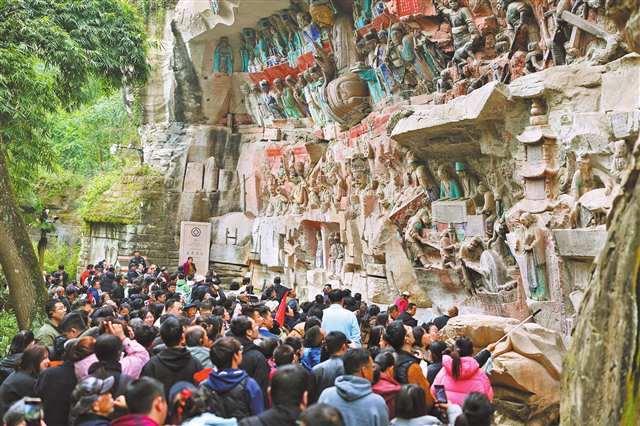
Baodingshan Rock Carving
The Baodingshan Rock Carving is a UNESCO World Heritage site located in Chongqing, China, renowned for its extensive and intricate Buddhist sculptures carved into cliffs during the Southern Song Dynasty (12th–13th centuries). Created under the direction of the monk Zhao Zhifeng, the carvings depict vivid scenes of Buddhist teachings, daily life, and moral lessons, forming a complete narrative of Buddhist philosophy. It is considered a masterpiece of Chinese rock art, blending religious devotion with exceptional artistic craftsmanship.
Hongyadong
Hongyadong is a historic stilted-house complex in Chongqing, China, built along the cliffs of the Jialing River. Originally constructed during the Ming Dynasty, it was later expanded in the early 2000s to recreate traditional Bayu-style architecture. Today, it is a popular cultural and tourist destination, known for its vibrant night views and bustling shops and restaurants.
Three Gorges
The Three Gorges, located along the Yangtze River in China, is a stunning 193-mile-long stretch of dramatic cliffs and narrow gorges, renowned for its natural beauty and cultural significance. Historically, it has been a vital transportation route and a source of inspiration for poets and artists for centuries, with ancient temples and relics lining its banks. The area is also home to the massive Three Gorges Dam, the world’s largest hydroelectric project, which was completed in 2012 to control flooding and generate power.
Chengdu Panda Base
The Chengdu Panda Base, officially known as the Chengdu Research Base of Giant Panda Breeding, is a renowned conservation and research facility located near Chengdu, China. Established in 1987, it was created to protect and breed giant pandas, starting with just six rescued individuals, and has since grown into a world-leading center for panda conservation. Today, it serves as both a successful breeding hub and a popular tourist destination, where visitors can observe pandas in a naturalistic habitat and learn about ongoing efforts to save this endangered species.
Baidicheng·Qutang Gorge
Baidicheng (White Emperor City) is a historic site perched on a hill at the entrance of Qutang Gorge, the shortest but most dramatic of the Three Gorges on the Yangtze River. It was named after a self-proclaimed emperor during the late Western Han dynasty and later became a strategic military stronghold, famously associated with the Three Kingdoms era. Today, it is a popular cultural attraction known for its ancient temples, poetry inscriptions, and stunning views of the gorge.
Du Fu’s Thatched Cottage
Du Fu’s Thatched Cottage, located in Chengdu, China, is a memorial site dedicated to the revered Tang Dynasty poet Du Fu, who lived there from 759 to 762. Originally a simple thatched hut where Du Fu composed over 240 poems during a period of personal and national turmoil, it has been rebuilt and expanded over the centuries into a serene park and museum. Today, it stands as a cultural landmark honoring his literary legacy and offering insight into his life and work.
Jiazhou (Leshan)
Jiazhou, now known as Leshan, is a historic city in Sichuan, China, renowned for the Leshan Giant Buddha—a 71-meter-tall stone statue carved into a cliff face during the Tang Dynasty (713–803 AD). This UNESCO World Heritage site was built to calm turbulent waters at the confluence of three rivers, reflecting the region’s deep Buddhist heritage. The city itself has a rich history dating back over 2,000 years, serving as a cultural and trade hub along the ancient Southern Silk Road.