At under 16 years old, Xi Jinping went to work in the countryside, setting a personal motto: start with self-cultivation. “Not knowing a single thing is a deep shame, so he thirsted for knowledge.” In an era of material scarcity, books became the pillar of his spiritual world, planting the seeds of thought for a future leader to understand China and the world.
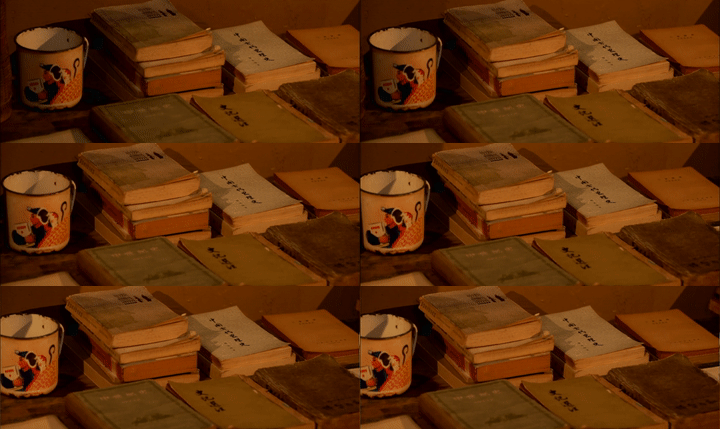
In flea-infested cave dwellings, late at night after intense daily labor… Xi Jinping engaged with the “Communist Manifesto” and “Das Kapital,” seeking truth in classics, and accompanied by “A Concise History of China” and “Selected Records of the Grand Historian,” he cultivated his mind through literature and history.
Books have always accompanied and inspired Xi Jinping. In Zhengding, Hebei, he studied economic works to find a path for county development; in Ningde, Fujian, he read local chronicles to understand regional history and resources, guiding the development of a marine economy; in Zhejiang, he required leading cadres in Shaoxing to recite “Preface to the Orchid Pavilion Collection” and “Phoenix Hairpin” to deepen their understanding of local history and culture… Each term of service was accompanied by targeted, in-depth reading.
From the arduous study under the kerosene lamp in Liangjiahe to applying knowledge in various positions, and to leading the entire Party in fostering a culture of learning, General Secretary Xi Jinping vividly demonstrates through practice: reading keeps one’s thinking vibrant, provides wisdom and inspiration, and nurtures a noble spirit.
Communist Manifesto
The *Communist Manifesto*, written by Karl Marx and Friedrich Engels in 1848, is a foundational political text that outlines the principles of communism and critiques capitalism. It famously begins with “A spectre is haunting Europe—the spectre of communism” and calls for the working class to unite and overthrow bourgeois society. The document has since become one of the most influential political manuscripts in history, inspiring revolutionary movements worldwide.
Das Kapital
“Das Kapital” is not a physical place or cultural site, but a seminal three-volume work of political economy and critique of capitalism written by German philosopher Karl Marx. First published in 1867, the book analyzes the capitalist mode of production, exploring concepts like commodity fetishism, surplus value, and class struggle. It has profoundly influenced economic thought, social movements, and political ideologies worldwide.
A Concise History of China
“A Concise History of China” is a comprehensive overview of China’s vast and complex history, tracing its development from ancient dynasties to the modern era. It covers key events, cultural shifts, and political changes, including the rise and fall of imperial rule, the impact of foreign interactions, and the establishment of the People’s Republic. The book provides readers with a clear and accessible understanding of how China’s past has shaped its present identity and global role.
Selected Records of the Grand Historian
“Selected Records of the Grand Historian” is a monumental work of Chinese history written by Sima Qian in the 1st century BCE. It covers over 2,000 years of Chinese history, from the mythical Yellow Emperor to the reign of Emperor Wu of Han. As a foundational text of Chinese historiography, it combines historical narrative, biography, and commentary, establishing a model for later official histories.
Zhengding
Zhengding is an ancient county in Hebei Province, China, known for its rich history dating back over 2,000 years. It served as a key cultural and religious center during the Sui and Tang dynasties, and is home to numerous well-preserved Buddhist temples and pagodas, including the famous Linji Temple and the 1,400-year-old Longxing Temple. Today, Zhengding is recognized for its architectural heritage and significance in Chinese Buddhist history.
Ningde
Ningde is a coastal city in Fujian Province, China, known for its scenic beauty and rich cultural heritage. Historically, it developed as an important fishing and trading port, with roots dating back to the Tang Dynasty. Today, it is famous for attractions like the Taimu Mountain and the ancient fishing village of Xiapu, drawing visitors with its natural landscapes and traditional culture.
Shaoxing
Shaoxing is a historic city in Zhejiang Province, China, known for its rich cultural heritage and scenic waterways. It was the birthplace of the famous writer Lu Xun and has a history dating back over 2,500 years, serving as an important center of Yue culture. The city is also renowned for its traditional architecture, ancient bridges, and as a major producer of Shaoxing rice wine.
Liangjiahe
Liangjiahe is a small village in Shaanxi Province, China, known for its significance in the early life of Chinese leader Xi Jinping, who lived and worked there as a “sent-down youth” from 1969 to 1975. During this period, he experienced rural life firsthand, engaging in farm labor and community development, which deeply influenced his political views. Today, the site is preserved as a cultural and educational base, symbolizing the spirit of hard work and connection to the people.