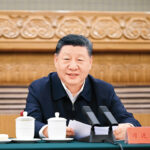
On the afternoon of May 20, President Xi Jinping and Russian President Vladimir Putin jointly attended the opening ceremony of the “China-Russia Education Year” at the Great Hall of the People in Beijing.
Xi Jinping delivered a speech first. Xi noted that education serves as an important bridge connecting people’s hearts and passing on friendship between nations, and it is a noble cause that benefits the present and future generations. Taking the “China-Russia Education Year” as an opportunity, both sides should further consolidate cooperation consensus, expand cooperation areas, and enhance cooperation levels. A country prospers when its education thrives, and a country grows strong when its education is robust. He expressed confidence that with joint efforts, the “China-Russia Education Year” will achieve great success.
Putin said, “I fully agree with the remarks of my friend, respected President Xi Jinping. We jointly launch the ‘Russia-China Education Year,’ a joint initiative that is undoubtedly of landmark significance. Of course, we deeply value our Chinese friends. The number of Russians learning Chinese is increasing year by year, now exceeding 100,000, and 20,000 Russian citizens are studying Chinese in China through various educational programs. I sincerely wish each of you outstanding success on the path you have chosen!”