Chengdu Weather Set to Shift! Sunny and Rainy Conditions to Alternate During Holiday Period, Beware of Temperature Drop and Rainfall.
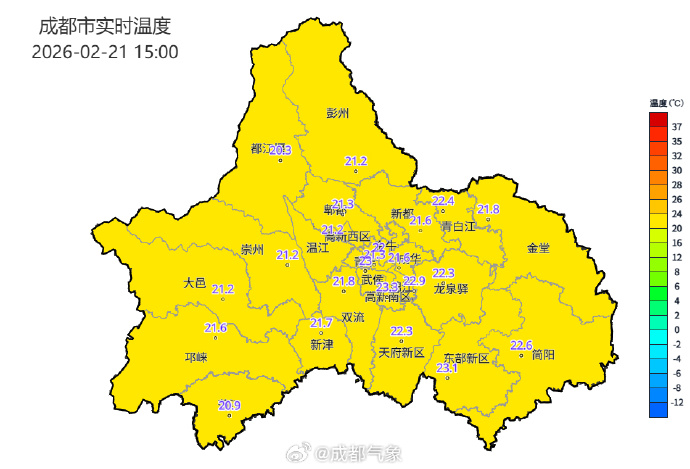
The fifth day of the Lunar New Year, and Chengdu is still blessed with sunny weather. Did you go out to enjoy the sunshine? As of 3 PM today, temperatures across the city were around 22°C, with many people remarking that they were sweating just from basking in the sun!
However, it’s important to note that a weather shift is coming! Over the next three days, the weather is expected to alternate between sunny and rainy. Scattered light rain is forecast for the eastern areas on the afternoon of the 22nd. The daytime of the 23rd will be overcast with scattered light rain, accompanied by northerly winds of force 3-5, with some eastern areas potentially experiencing force 6 or higher. Scattered light rain is expected in the western areas on the night of the 23rd. The highest temperatures over these three days will be 23°C, 19°C, and 22°C respectively, with the lowest being 8°C, 9°C, and 7°C. A period of weak cooling and rainfall is expected towards the end of the holiday. The public is reminded to guard against the wind, add layers, carry rain gear when going out, and be cautious of catching a cold.
Detailed weather forecast for the coming week:
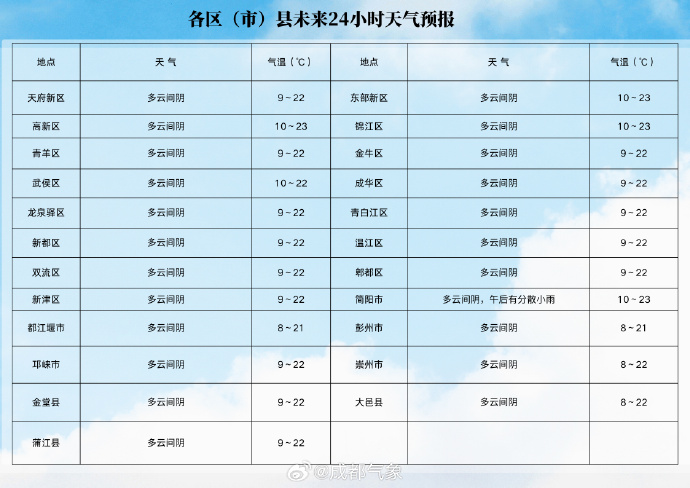
Night of the 21st to daytime of the 22nd: Cloudy to overcast, with scattered light rain in eastern areas in the afternoon. Temperatures 8~23°C; Central urban area: Cloudy to overcast, temperatures 9~23°C.
Night of the 22nd to daytime of the 23rd: Overcast with scattered light rain. Northerly winds force 3~5, with some eastern areas potentially reaching force 6 or higher. Temperatures 9~19°C; Central urban area: Overcast with scattered light rain. Northerly winds force 3~5, with isolated eastern areas potentially reaching force 6 or higher. Temperatures 10~19°C.
Night of the 23rd to daytime of the 24th: Cloudy to overcast, with scattered light rain in western areas at night. Temperatures 7~22°C; Central urban area: Cloudy to overcast, temperatures 8~21°C.
Night of the 24th to daytime of the 25th: Cloudy to overcast. Temperatures 5~21°C; Central urban area: Cloudy to overcast, temperatures 6~20°C.
Night of the 25th to daytime of the 26th: Overcast to cloudy, with scattered light rain at night. Temperatures 8~21°C; Central urban area: Overcast to cloudy, with scattered light rain at night. Temperatures 9~21°C.
Night of the 26th to daytime of the 27th: Cloudy to overcast. Temperatures 7~22°C; Central urban area: Cloudy to overcast, temperatures 8~22°C.
Transboundary Sand and Dust to Enter Sichuan Tonight
Air Quality to Improve with Precipitation Starting the 22nd
A sand and dust air mass originating from Inner Mongolia and Qinghai has been gradually moving southward under the influence of a cold air mass. So far, severe PM10 pollution has been observed in Gansu, Inner Mongolia, and Ningxia, with the dust front reaching Pingliang, Gansu. The overall path is偏向东, and the intensity of the dust upstream is relatively strong. It is expected to enter Sichuan with the cold air starting tonight.
There is no significant precipitation forecast for the Sichuan Basin from tonight into early tomorrow morning. The dust is expected to enter Sichuan via a偏东 path through Dazhou and Bazhong starting tonight. Cities in the northern and eastern parts of the basin are at risk of being affected by dust transport, with PM10 concentrations
Lunar New Year
Lunar New Year is a major cultural festival celebrated across East and Southeast Asia, marking the beginning of a new year on the traditional lunisolar calendar. Its history dates back over 3,000 years to the Shang Dynasty in China, rooted in rituals to honor deities and ancestors at the end of the winter harvest. Today, it is characterized by family reunions, feasts, the giving of red envelopes, and vibrant festivities intended to bring good luck and ward off evil spirits for the coming year.
Chengdu
Chengdu is the capital of Sichuan province in southwestern China, historically serving as a major political and cultural center since its founding over 2,300 years ago during the Shu Kingdom. It is globally famous as the home of the Chengdu Research Base of Giant Panda Breeding and for its profound culinary culture, notably Sichuan cuisine. The city also boasts significant historical sites like the Jinli Ancient Street and the Wuhou Shrine, which commemorate the Three Kingdoms period.
Sichuan
Sichuan is a southwestern province of China renowned for its distinctively spicy cuisine, lush landscapes, and giant panda sanctuaries. Historically, it was the heart of the ancient Shu and Ba kingdoms and later became a vital agricultural and cultural center, famously protected by its surrounding mountains. Its capital, Chengdu, has been a major economic and political hub for over two millennia.
Inner Mongolia
Inner Mongolia is an autonomous region of northern China, historically inhabited by nomadic Mongol tribes and forming part of the Mongol Empire under Genghis Khan in the 13th century. Today, it is known for its vast grasslands (steppes), traditional Mongolian culture—including the Naadam Festival—and a modern economy balancing animal husbandry with mining and industry.
Qinghai
Qinghai is a vast, high-altitude province in northwestern China named after its immense Qinghai Lake, the country’s largest inland saltwater lake. Historically, it has been a crossroads for Tibetan, Mongol, and Han Chinese cultures, forming part of the traditional Tibetan region of Amdo and a key corridor of the ancient Silk Road. Today, it is known for its stark natural beauty, unique Tibetan Buddhist monasteries, and its role as the source of China’s major rivers, the Yangtze, Yellow, and Mekong.
Gansu
Gansu is a province in northwest China historically significant as a crucial corridor of the ancient Silk Road, connecting Central Asia with the heart of China. Its long, narrow shape is home to major cultural treasures like the Mogao Caves, a UNESCO World Heritage site containing a millennium of Buddhist art. The region’s history is marked by diverse ethnic interactions and its strategic role in trade and cultural exchange.
Ningxia
Ningxia, officially the Ningxia Hui Autonomous Region, is a provincial-level region in north-central China, situated along the upper reaches of the Yellow River. Historically, it was a crucial frontier zone and part of the ancient Silk Road, later becoming a center for the Hui Muslim ethnic group, which gives the region its distinctive cultural character today. Its landscape is marked by the Helan Mountains, the Yellow River irrigation plains, and the southern Loess Plateau.
Sichuan Basin
The Sichuan Basin is a fertile lowland region in southwestern China, historically known as the “Country of Heaven” for its agricultural abundance. It has been a major cultural and economic center for millennia, serving as the heartland of the ancient Shu and Ba states and later becoming a crucial province of imperial China. Its relative isolation, protected by surrounding mountains, helped develop a distinct culture, most famously known today for its bold and spicy Sichuan cuisine.