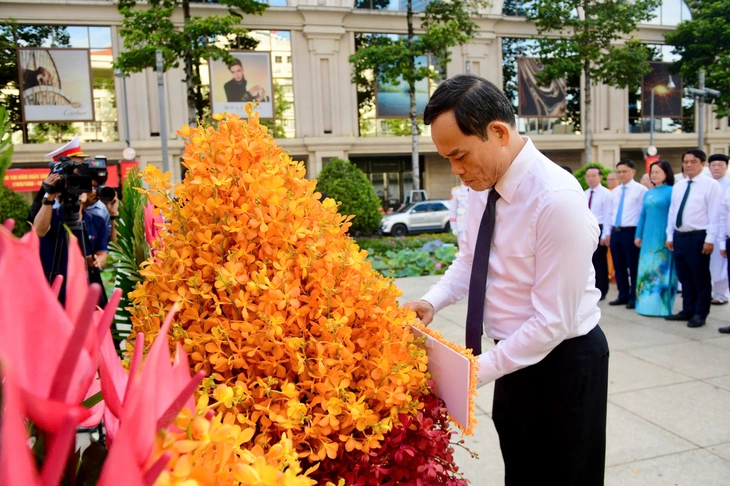
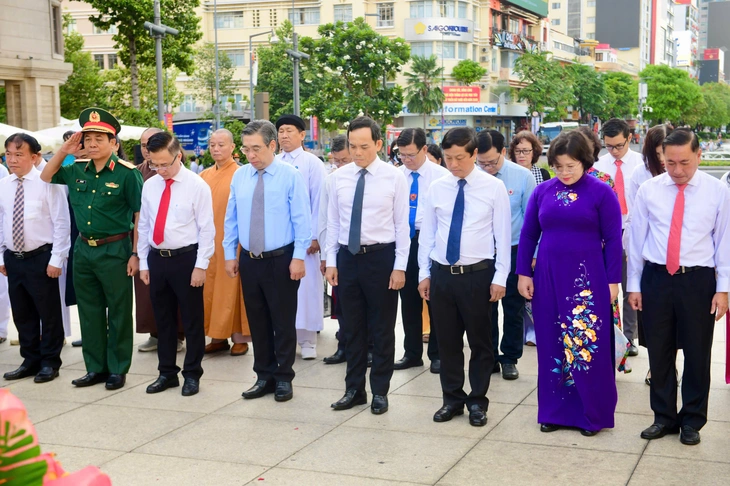
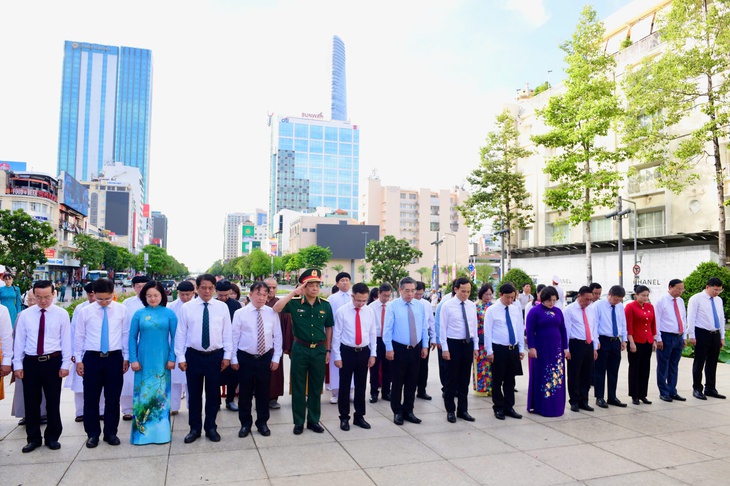
Secretary Tran Luu Quang and the Ho Chi Minh City delegation offered flowers in remembrance of President Ho Chi Minh.
Secretary of the Ho Chi Minh City Party Committee Tran Luu Quang, along with a delegation of Ho Chi Minh City representatives, offered incense to President Ho Chi Minh on the occasion of the 136th anniversary of his birth.
On the morning of May 19, on the occasion of the 136th anniversary (May 19, 1890 — May 19, 2026), a delegation of Ho Chi Minh City representatives led by Secretary of the Ho Chi Minh City Party Committee Tran Luu Quang laid flowers in tribute to President Ho Chi Minh at the President Ho Chi Minh statue park on Nguyen Hue Street, Sai Gon Ward (Ho Chi Minh City).
Also attending the delegation were Deputy Secretary of the City Party Committee and Chairman of the City People’s Council Vo Van Minh, Deputy Secretary of the City Party Committee and Chairman of the Vietnam Fatherland Front Committee of Ho Chi Minh City Nguyen Phuoc Loc, two Deputy Secretaries of the City Party Committee Van Thi Bach Tuyet and Dang Minh Thong, along with members of the Standing Committee of the City Party Committee, leaders of various departments, agencies, and people of Ho Chi Minh City.
The delegation laid flowers and observed a minute of silence in memory of President Ho Chi Minh. He is the most noble symbol of Vietnamese patriotism and revolutionary heroism, a radiant embodiment of the morality, wisdom, spirit, and conscience of the nation and the era.
Also on this morning, a ceremony was held to commend and reward collectives and individuals with outstanding achievements in studying and following Ho Chi Minh’s ideology, morality, and style in 2026.
The ceremony was organized to mark the 136th anniversary of President Ho Chi Minh’s birth, the 115th anniversary of Uncle Ho’s journey to find a way to save the country, and the 50th anniversary of Sai Gon — Gia Dinh city officially being honored to bear the name President Ho Chi Minh.
Through this, it honors exemplary collectives and individuals, spreading good models, creative and effective ways of studying and following Uncle Ho’s example throughout the city.
The flower-laying ceremony was held on the occasion of the 136th anniversary of President Ho Chi Minh’s birth, the 115th anniversary of Uncle Ho’s journey to find a way to save the country, and the 50th anniversary of Sai Gon — Gia Dinh city officially
President Ho Chi Minh statue park
The President Ho Chi Minh statue park is a memorial site dedicated to Vietnam’s revolutionary leader, featuring a prominent bronze statue of Ho Chi Minh. Located in various cities across Vietnam, including Hanoi and Ho Chi Minh City, these parks serve as spaces for reflection and patriotism. They commemorate Ho Chi Minh’s pivotal role in Vietnam’s independence movement and his enduring legacy as the father of the nation.
Nguyen Hue Street
Nguyen Hue Street is a iconic pedestrian boulevard in the heart of Ho Chi Minh City, Vietnam, originally built during the French colonial era as a canal before being filled in to become a major thoroughfare. It has since evolved into a vibrant cultural and commercial hub, famous for its annual flower displays during the Tet holiday and as a gathering place for festivals and public events. The street is also home to historic landmarks like the City Hall and the statue of Ho Chi Minh, reflecting the city’s blend of colonial and modern Vietnamese heritage.
Sai Gon Ward
Sai Gon Ward is a historic area in Ho Chi Minh City (formerly Saigon), Vietnam, known for its role in the city’s development during the French colonial period. It features a mix of architectural styles, including colonial-era buildings and modern structures, reflecting its transformation from a small fishing village into a bustling urban center. Today, it remains a vibrant cultural and commercial hub, preserving key landmarks that tell the story of Vietnam’s past.
Ho Chi Minh City
Ho Chi Minh City, formerly known as Saigon, is Vietnam’s largest city and economic hub. It was the capital of French Indochina and later the capital of South Vietnam, playing a central role in the Vietnam War until its fall in 1975. Today, the city blends historic French colonial architecture with modern skyscrapers, and sites like the War Remnants Museum and the Notre-Dame Cathedral Basilica reflect its complex history.
Sai Gon — Gia Dinh city
Saigon — Gia Dinh is the historical name for the area that now forms the core of modern-day Ho Chi Minh City in southern Vietnam. Originally a small fishing village and later a major trading port under the Nguyen dynasty, it was formally known as Gia Dinh before being renamed Saigon. The city played a central role in Vietnamese history, serving as the capital of French Cochinchina and later the Republic of Vietnam, before being officially renamed Ho Chi Minh City after the war in 1976.
President Ho Chi Minh
President Ho Chi Minh was the founding father of the Democratic Republic of Vietnam and a key revolutionary leader who fought for Vietnam’s independence from French colonial rule. He served as the country’s first President from 1945 until his death in 1969, and is revered as a national hero for his role in unifying the nation. His legacy is preserved at sites like the Ho Chi Minh Mausoleum in Hanoi, where his embalmed body is displayed.
Изображение, на котором якобы изображена казнь ира...
Мы используем файлы cookie, чтобы обеспечить удобство работы с сайтом и анализировать трафик. Продолжая использовать сайт, вы соглашаетесь с нашей
[Политикой cookie]. 🍪