12,000 observations recorded on roads, with Riyadh leading.
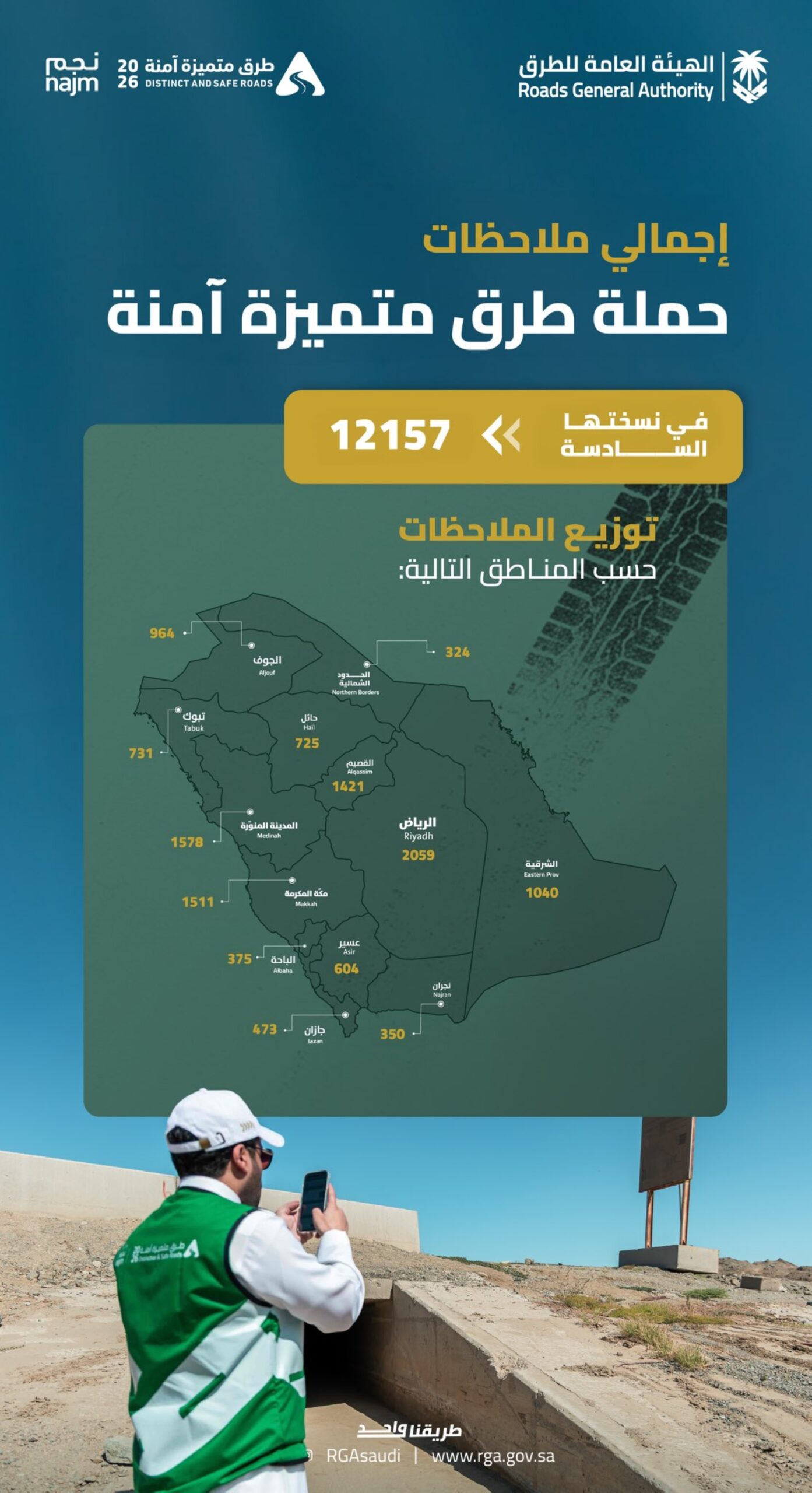
The General Authority for Roads monitored 12,157 observations on the Kingdom’s roads over a 5-day period for the ‘Safe, Distinguished Roads’ campaign, now in its sixth consecutive year. The campaign aims to survey the road network outside urban areas to contribute to raising the level of safety and maintenance on the Kingdom’s road networks.
The Authority revealed the results of the survey work, with more than 620 members participating in the campaign. They represented the Ministry of Transport and Logistics, university students, personnel from the Special Forces for Road Security, as well as representatives from the Ministry of Communications and Information Technology. They were distributed across 61 teams in various regions of the Kingdom.
The campaign’s overall statistics showed that the Riyadh region recorded 2,059 observations, followed by the Medina region with 1,578 observations. The participating teams monitored approximately 1,511 observations in the Makkah region, 1,421 observations in the Qassim region, 604 observations in the Asir region, and 964 observations in the Al-Jawf region.
It was clarified that 731 observations were monitored in the Tabuk region, the teams recorded 1,040 observations in the Eastern Province, 473 observations in the Jazan region, 725 observations on Hail’s roads, and 375 observations on Al-Baha’s roads.
The Riyadh region recorded 2059 observations,
Riyadh region
The Riyadh region is the historic heart of Saudi Arabia, centered on the capital city of Riyadh. It was the seat of the First and Second Saudi States and, after its capture in 1902 by King Abdulaziz Al Saud, became the focal point for the unification of the modern Kingdom. Today, it is a rapidly modernizing political and financial hub, while also preserving historic sites like Diriyah, the original home of the Saudi royal family.
Medina region
The Medina region, located in western Saudi Arabia, is home to the city of Medina (Al-Madinah), the second holiest city in Islam. It is most famous as the site of the Prophet’s Mosque (Al-Masjid an-Nabawi), which was established by the Prophet Muhammad after his migration (Hijrah) from Mecca in 622 CE, marking the beginning of the Islamic calendar. The city served as the capital of the early Islamic Caliphate and remains a central destination for millions of pilgrims performing the Hajj and Umrah.
Makkah region
The Makkah region, located in western Saudi Arabia, is the spiritual heart of Islam and home to the holy city of **Makkah (Mecca)**. Its history is defined by the birth of the Prophet Muhammad in 570 CE and the subsequent revelation of the Quran, which established the Kaaba within the Grand Mosque (Masjid al-Haram) as the holiest site in Islam and the focal point for the annual Hajj pilgrimage. For over 1,400 years, it has served as the eternal and sacred direction of prayer for Muslims worldwide.
Qassim region
The Qassim region, located in the heart of Saudi Arabia, is a historically significant agricultural heartland known for its vast date palm groves. Its capital, Buraydah, hosts the world’s largest date festival, reflecting the area’s deep-rooted farming heritage that dates back centuries. Historically, it was a crucial crossroads for ancient trade routes and a center for the Najdi cultural and scholarly tradition.
Asir region
The Asir region is a mountainous area in southwestern Saudi Arabia, historically known for its distinct culture and tribal heritage, with ancient settlements dating back thousands of years. It is famed for its terraced agriculture, colorful traditional architecture, and the historic city of Abha, which served as a key trade and cultural crossroads. Today, it is a recognized UNESCO Creative City for its folk arts and crafts, preserving a unique identity within the Kingdom.
Al-Jawf region
The Al-Jawf region, located in northwestern Saudi Arabia, is one of the country’s oldest continuously inhabited areas, with a history dating back to ancient civilizations like the Nabateans and the kingdoms of Dadan and Lihyan. It is renowned for its significant archaeological sites, most notably the ancient city of Dumat al-Jandal, which features the iconic Marid Fort and the Umar ibn al-Khattab Mosque, believed to be one of the oldest in the region. Today, the area is also a key modern agricultural center, known for its olive groves and date palm cultivation.
Tabuk region
The Tabuk region in northwestern Saudi Arabia is a historically significant area known for its ancient trade routes and archaeological sites, including the Hejaz Railway and the rock art of Jabal Al-Lawz. It is traditionally associated with the biblical story of Moses and the Exodus. Today, it is a key modern development area, featuring the ambitious NEOM project and serving as a gateway for Red Sea tourism.
Eastern Province
The Eastern Province is a key administrative region of Saudi Arabia, located along the Persian Gulf. It is historically significant as the heart of the kingdom’s oil industry, with the first commercial oil field discovered at Dammam in 1938, transforming the nation’s economy and global energy landscape. The area is also home to a rich cultural heritage, including the ancient Dilmun civilization and the modern, cosmopolitan city of Dhahran.