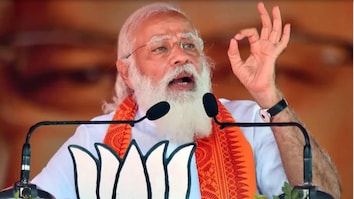
Narendra Damodardas Modi is the 14th Prime Minister of India. After the BJP’s victories in the 2014, 2019, and 2024 Lok Sabha elections, Narendra Modi became Prime Minister for the third consecutive time. Following the Bharatiya Janata Party’s win in the 2014 Lok Sabha elections, Narendra Modi assumed the office of Prime Minister for the first time on May 26. Elected as a Member of Parliament from the Varanasi Lok Sabha constituency in Uttar Pradesh, Narendra Modi’s leadership marked the first time since 1984 that a single political party secured an outright majority in the Lok Sabha.
He is the first Indian Prime Minister born after the country’s independence in 1947. After the NDA’s victory in the 2019 Lok Sabha elections, Modi began his second term as Prime Minister in 2019. Following the win in the 2024 Lok Sabha elections, the Modi government achieved a hat-trick.
Before becoming Prime Minister, Narendra Modi served as the Chief Minister of Gujarat for over a decade. Narendra Modi was born on September 17, 1950, in Vadnagar, Mehsana district, Gujarat. His parents were Hiraba and Damodardas Modi. Although Narendra Modi was first introduced to the Rashtriya Swayamsevak Sangh at the age of eight, he became a full-time RSS worker in the 1970s. He joined the Bharatiya Janata Party in the late 1980s.
In 2001, he took office as the Chief Minister of Gujarat, a position he held until 2014. After the Bharatiya Janata Party’s victory in 2019, Narendra Modi began his second term as Prime Minister. He is the second politician, apart from the Indian National Congress, to become Prime Minister of India by winning two consecutive terms.
Varanasi
Varanasi, one of the world’s oldest continually inhabited cities, is a major spiritual hub in India located on the banks of the Ganges River. For millennia, it has been a center of Hindu pilgrimage, learning, and culture, revered as the city of Lord Shiva where the cycle of life and death is believed to be broken. Its ghats, temples, and the practice of cremation along the river have made it a profound symbol of both life and liberation in Hindu tradition.
Uttar Pradesh
Uttar Pradesh is a culturally and historically rich state in northern India, often considered the heartland of ancient Indian civilization. It encompasses the sacred cities of Varanasi and Ayodhya, and was home to the powerful kingdoms of the Maurya and Gupta empires. The state also played a pivotal role in the Mughal era and the Indian independence movement, with cities like Agra and Lucknow showcasing iconic landmarks such as the Taj Mahal and Bara Imambara.
Gujarat
Gujarat, located in western India, is a state rich in history and culture, known as the birthplace of Mahatma Gandhi and the location of the ancient Indus Valley Civilization city of Lothal. Its history includes being a major center for trade and commerce under various empires, including the Mauryas, Solankis, and Mughals, and it was a key site for the Indian independence movement. Today, Gujarat is celebrated for its vibrant festivals, distinct cuisine, and architectural marvels like the Sun Temple at Modhera and the Rani ki Vav stepwell.
<h3 class="text-lg font-semibold mb-2 text-blue
Varanasi
Varanasi, one of the world’s oldest continuously inhabited cities, is a sacred Hindu pilgrimage site located on the banks of the Ganges River in India. Its history dates back over 3,000 years, serving as a major cultural and religious center where pilgrims perform ritual baths and cremation ceremonies, believing it brings salvation. The city is also known for its ancient temples, narrow winding lanes, and vibrant ghats that have drawn seekers and scholars for millennia.
Ganges River
The Ganges River, originating in the Himalayas and flowing through India and Bangladesh, is one of the most sacred rivers in Hinduism, worshipped as the goddess Ganga. Its history spans millennia, serving as the cradle of ancient civilizations and a vital source of water for agriculture, while also being central to religious rituals, including cremation ceremonies and purification baths. Today, despite severe pollution challenges, the river remains a lifeline for over 400 million people and a symbol of spiritual continuity.
Ayodhya
Ayodhya is an ancient city in northern India, regarded as the birthplace of Lord Rama, a major deity in Hinduism. Historically, it was the capital of the Kosala Kingdom and holds significance in Hindu scriptures like the Ramayana. The site gained international attention in the 20th century due to a long-standing religious and legal dispute over the Babri Masjid mosque, which was resolved by a 2019 Supreme Court verdict allowing the construction of a Hindu temple.
Agra
Agra is a historic city in northern India, best known as the home of the iconic Taj Mahal, a white marble mausoleum built by Mughal emperor Shah Jahan in the 17th century in memory of his wife Mumtaz Mahal. It served as the capital of the Mughal Empire during the reigns of Akbar, Jahangir, and Shah Jahan, and is also home to other UNESCO World Heritage sites like the Agra Fort and Fatehpur Sikri. Today, Agra is a major tourist destination, drawing millions of visitors to its rich Mughal-era architecture and cultural heritage.
Taj Mahal
The Taj Mahal is a white marble mausoleum located in Agra, India, built between 1632 and 1653 by Mughal Emperor Shah Jahan in memory of his beloved wife, Mumtaz Mahal. It is widely recognized as a masterpiece of Mughal architecture, combining elements of Islamic, Persian, and Indian styles. Today, it is a UNESCO World Heritage Site and one of the most iconic symbols of love in the world.
Bara Imambara
Bara Imambara is a historic architectural complex located in Lucknow, India, built in 1784 by Asaf-ud-Daula, the Nawab of Awadh, as a relief project during a severe famine. The complex is renowned for its massive central hall, one of the largest arched structures in the world without supporting beams, and its intricate labyrinth known as the Bhool Bhulaiya. It remains a significant cultural and religious site, reflecting the opulence and ingenuity of the Nawabi era.
Sun Temple at Modhera
The Sun Temple at Modhera, located in Gujarat, India, was built in 1026–27 CE by King Bhima I of the Solanki dynasty. Dedicated to the Hindu sun god Surya, the temple is renowned for its intricate architecture, including a stepped tank (the Surya Kund) and a pillared hall designed to align with the sun’s rays during equinoxes. It stands as a masterpiece of Maru-Gurjara architecture, reflecting both religious devotion and advanced astronomical knowledge of its time.
Rani ki Vav
Rani ki Vav, or the Queen’s Stepwell, is a magnificent subterranean stepwell located in Patan, Gujarat, India. It was built in the 11th century during the Chalukya dynasty by Queen Udayamati in memory of her husband, King Bhima I. Renowned for its intricate architecture and over 500 principal sculptures, it was rediscovered and restored after being buried by silt for centuries, and is now a UNESCO World Heritage Site.