According to the assessment of the Hanoi Party Committee, after one year of operating the model, the city has reduced the number of commune-level administrative units by 76%. The current 126 communes and wards directly manage over 5,463 hamlets and residential groups, serving nearly 8.9 million residents.
The reorganization of commune-level administrative units is tied to the restructuring of development space and the reconfiguration of the city’s governance model.
Despite having to handle many urgent and complex tasks simultaneously, the city has maintained political stability, unity, and consensus throughout the entire system, without disrupting leadership, direction, administration, or public services.
The political system’s apparatus from the city to the grassroots level operates smoothly along “four axes”: the Party, the People’s Council, the People’s Committee, and the Fatherland Front. The administrative mindset has shifted from “management by administrative levels” to “territorial governance, serving the people and businesses,” emphasizing the responsibility of leaders. The effectiveness and efficiency of state management have gradually improved, and the activities of commune and ward governments have seen clear changes toward being closer to the people, more responsive, and providing better public service.
The city has implemented decentralization, delegation, and demarcation of authority in a synchronized and decisive manner. The motto “localities decide, localities act, localities take responsibility” has helped shorten processing times and enhance the ability to meet the demands of citizens and businesses.
In less than a year, communes and wards have received and processed over 2.26 million documents related to tasks previously delegated from the district and city levels.
The city has made 100% of administrative procedures under the jurisdiction of all government levels publicly available. It has implemented 2,077 administrative procedures, of which 1,118 are eligible for full online public service provision. It has completed the restructuring of 1,172 administrative procedures and standardized over 2,000 internal processes and electronic workflows.
In 2025, the city received over 3.5 million new administrative documents, including more than 2.1 million online submissions. It processed over 619,000 documents regardless of administrative boundaries, reducing travel time, lowering the cost of procedures, and facilitating access to public services for citizens and businesses anywhere in the area.
The results achieved in the first year of operation have helped maintain political stability, social order, and safety, while creating a favorable environment for socio-economic development.
In 2025, the city’s GRDP grew by 8.16%. Total state budget revenue exceeded 711 trillion VND, an increase of 38.4%. Registered FDI reached 4.4 billion USD, up 169%, and 32,400 new businesses were established.
In the first quarter of 2026, GRDP continued to grow by 7.87%. Total budget revenue reached 255 trillion VND, and total development investment capital reached 102.3 trillion VND, up 10.1% compared to the same period in 2025.
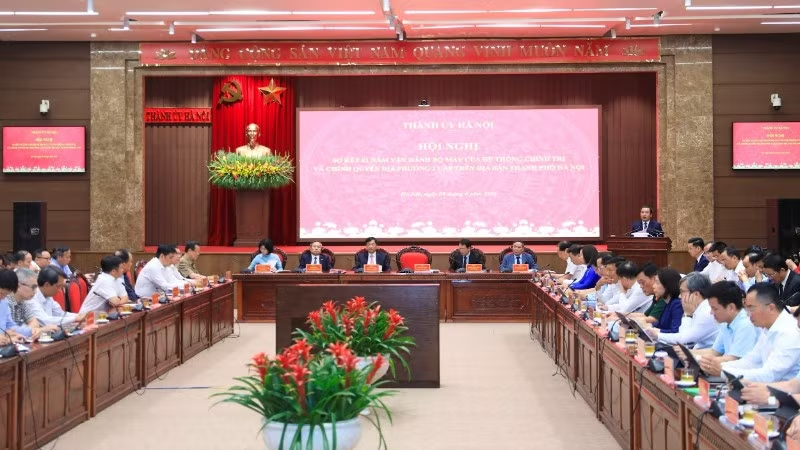
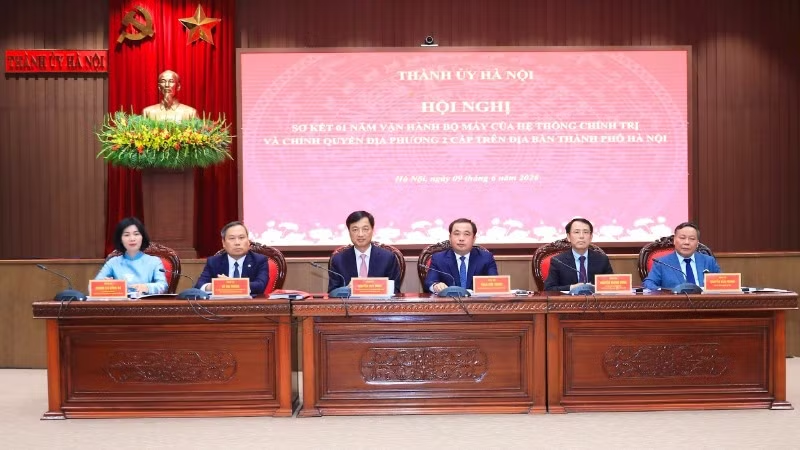
Speaking at the conference, Tran Duc Thang emphasized that the results over the past year confirm that the two-tier local political system and government model in the city is a correct policy, suitable to reality. Initially, the city has formed a new, more effective governance approach that is closer to the people and grassroots. The city’s political system is gradually shifting its leadership and management methods from administrative management to modern governance, from a managing government to a serving government, from administrative direction to data-driven direction, and from coordination through multiple layers to direct coordination from the city down to communes and wards.
The goal of being close to the people and grassroots, transitioning from management to governance, has achieved positive results.
<div class