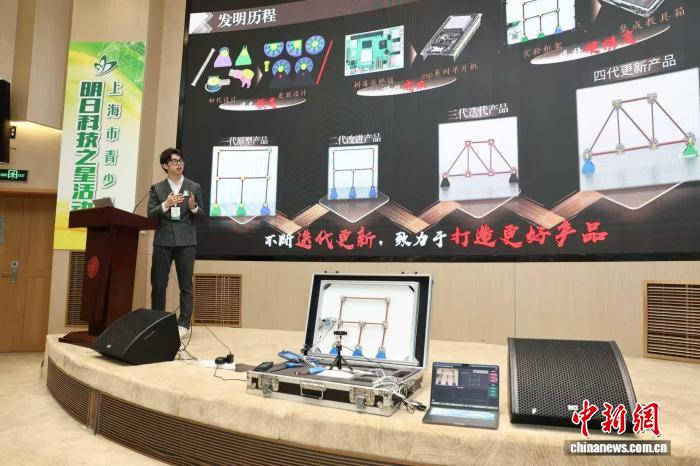
On June 7, the 24th Shanghai Youth “Tomorrow’s Star of Science and Technology” event held its university student group final showcase. The 13 teams that advanced to the final presented projects covering precision manufacturing, biomedicine, artificial intelligence, humanities and social sciences, energy conservation, and environmental protection. These young researchers addressed industrial challenges and real-world needs, demonstrating solid scientific foundations and innovative thinking. Judges provided targeted feedback to guide future research directions.
Launched in 2003, the Shanghai Youth “Tomorrow’s Star of Science and Technology” event has been nurturing scientific talent in Shanghai for 24 years, with the university group held biennially. In recent years, the event has focused on cutting-edge basic sciences and interdisciplinary fields, continuously identifying top innovative talents to support Shanghai’s international science and technology innovation center.
This edition was jointly organized by the Shanghai Municipal Education Commission, the Shanghai Science and Technology Commission, and the Shanghai Science Education Development Foundation. A total of 453 student projects from 34 universities underwent multiple rounds of rigorous evaluation. After expert defense sessions grouped by discipline and academic level, 112 projects advanced, with 13 outstanding projects reaching the municipal final.
The Shanghai Youth “Tomorrow’s Star of Science and Technology” event has witnessed the growth of many young science enthusiasts. One typical example is Guo Jiaye from ShanghaiTech University. His experience illustrates the event’s comprehensive educational impact. In 2020, as a middle school student, Guo Jiaye participated in the 18th edition and earned the “Tomorrow’s Star of Science and Technology” title. After visiting ShanghaiTech University, he developed a deep passion for research. During high school, he continued his scientific exploration and appeared as a representative at the 2023 Shanghai Science and Technology Festival. In 2026, he joined the university group as a ShanghaiTech student.
Gan Zhenliang from Fudan University is another outstanding representative who grew through the event. Facing security challenges from AIGC technology, Gan led his team in original research and technical breakthroughs to make AI-generated content “identifiable, traceable, and explainable.” He has since won the first prize in innovation and entrepreneurship at the Fudan University Alumni IT Youth Association and received a 1.5 million yuan seed investment from the Pudong Venture Capital AI Training Camp. Gan stated he is working to advance AI development along safe, trustworthy, and ethical paths.
During the final showcase, 30 groups of middle school students, families, teachers, and university representatives observed the defense sessions. The Shanghai Municipal Education Commission noted that this initiative aims to bridge scientific exchange between universities, middle schools, and primary schools, giving more young people the opportunity to learn about cutting-edge research projects and spark their interest in scientific exploration.