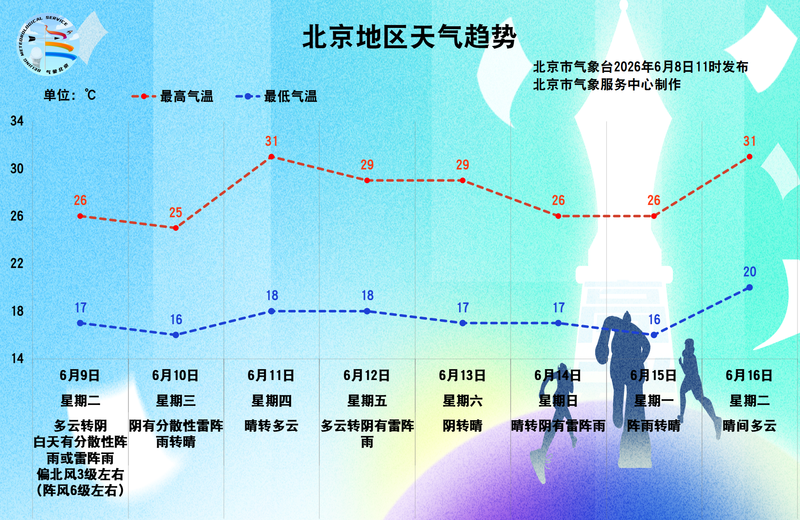
Beijing will see a sunny start today, with clouds gradually thickening in the afternoon. Thunderstorms are expected from the afternoon to the early night, accompanied by short-term strong winds of around level 8 and hail in some areas, affecting the urban area around evening. Please take precautions when going out and seek shelter promptly if severe weather occurs. The thunderstorms may impact the end of college entrance exams and evening rush hour traffic, so bring rain gear and drive safely.
Showers or thunderstorms are still expected over the next two days, coinciding with the college entrance exam period. Students and parents should be mindful of wind, rain, and lightning when traveling. Temperatures will drop, especially in the morning, so sensitive individuals should adjust their clothing to avoid catching a cold.
From the 11th to the 16th, the weather will be mostly cloudy with fluctuating temperatures. Around the 12th and 14th, there will be two rounds of thunderstorms. Stay updated with the latest forecasts and take precautions in advance.
Beijing
Beijing, the capital of China, is a historic city with over 3,000 years of history, serving as the nation’s political and cultural center for centuries. It is home to iconic landmarks such as the Forbidden City, the Great Wall, and Tiananmen Square, reflecting its imperial past and modern significance. Today, Beijing blends ancient traditions with rapid modernization, hosting major events like the 2008 Summer Olympics and 2022 Winter Olympics.
Forbidden City
The Forbidden City, located in the heart of Beijing, China, was the imperial palace from the Ming Dynasty to the end of the Qing Dynasty (1420–1912). It served as the political and ceremonial center of Chinese government for nearly 500 years, housing emperors and their households. Today, it is a UNESCO World Heritage site and houses the Palace Museum, showcasing vast collections of Chinese art and artifacts.
Great Wall
The Great Wall of China is a series of fortifications built across northern China, with construction starting as early as the 7th century BC and major sections built during the Ming Dynasty (1368–1644). It was designed to protect Chinese states and empires from invasions by nomadic groups from the north. Stretching over 13,000 miles, it is one of the most iconic symbols of China and a UNESCO World Heritage site.
Tiananmen Square
Tiananmen Square, located in the heart of Beijing, is one of the world’s largest public squares and a significant symbol of China’s national identity. Originally built in the 15th century as a gate for the Imperial City, it was expanded in the 20th century and has since been the site of major historical events, including the founding of the People’s Republic of China in 1949. Today, it is surrounded by landmarks such as the Great Hall of the People, the National Museum of China, and the Mausoleum of Mao Zedong.