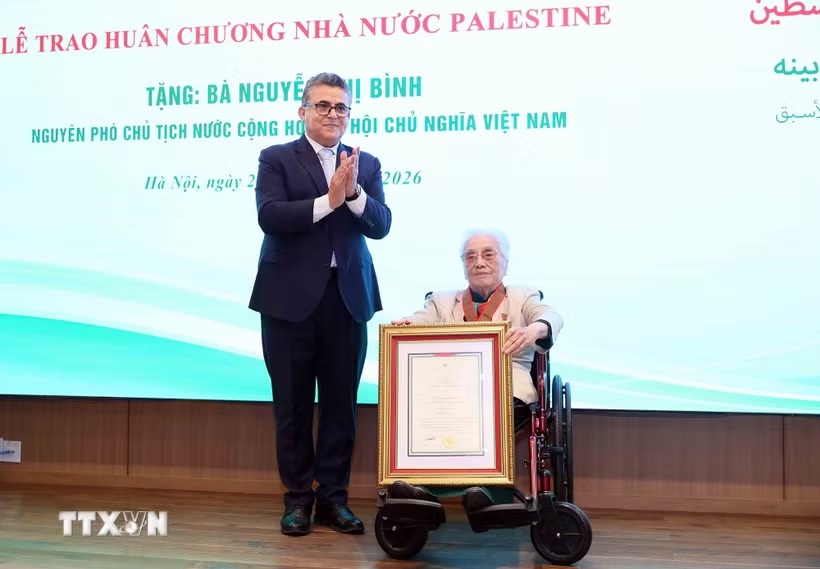
Former Vice President Nguyen Thi Binh, widely known as Madame Binh, has received the Star of Merit Order from the State of Palestine in recognition of her contributions to peace, justice and the longstanding friendship between Vietnam and Palestine.
The award ceremony was jointly held in Hanoi on May 22 by the Presidential Office, the Ministry of Foreign Affairs and the Palestinian Embassy in Vietnam.
Speaking at the ceremony, Palestinian Ambassador to Vietnam Saadi Salama said he was honored to represent President Mahmoud Abbas in presenting the Star of Merit Medal to former Vietnamese Vice President Nguyen Thi Binh, whom he described as an outstanding Vietnamese leader, a symbol of the resilience and diplomatic wisdom of Vietnam’s revolutionary diplomacy, and a loyal friend of the Palestinian people.
He said the award not only recognized Nguyen Thi Binh’s longstanding contributions to the struggle for national independence, peace and justice, but also reflected the deep gratitude of the Palestinian state and people toward a friend who has consistently shown sincere support for Palestine over many decades.
Two para athletes overcome hardship to win national medals
The story of two young men with disabilities raised at Tam Binh Child Protection Center in Ho Chi Minh City has inspired many people, as their perseverance in training led them to national medals and a new sense of purpose.
Luong Hoang Thong, 20, and Nguyen Tung Giang, 21, were both abandoned as children before being taken in by the center. Growing up together there, they gradually discovered a passion for sports.
Despite his small build, Hoang Thong showed strong upper-body strength and was encouraged to pursue para powerlifting. After years of disciplined training under coach Le Quang Thai, he won two silver medals in the 49-kilogram category at the 2026 National Championships for Para Athletics and Powerlifting in Thai Nguyen Province.
Meanwhile, Tung Giang found confidence through athletics despite severe visual impairment. Specializing in middle-distance running, he overcame demanding training sessions to claim a silver medal in the 800-meter race and a bronze medal in the 1,500-meter event at the same championships.
“The children faced hardships from a very young age, so seeing them grow up, work hard and build clear goals for the future makes us very happy,” Dinh Huu Tuyen, director of the center, said.
Vietnam performs first awake brain surgery on child patient
The University Medical Center Ho Chi Minh City said on May 19 that its doctors successfully performed Vietnam’s first awake brain surgery on a child, advancing the country’s neurosurgical capabilities and offering new hope for children with high-risk brain tumors.
The 12-year-old boy was admitted to the hospital after experiencing prolonged headaches, temporary numbness and weakness on one side of his body, and one brief loss of consciousness. After examinations, doctors discovered a large brain tumor located in a critical area directly linked to the patient’s movement and speech functions.
The tumor was located close to critical functional areas of the brain, an especially sensitive position where any intervention carried the risk of long-term complications affecting the patient’s movement, communication, and quality of life. Doctors chose awake craniotomy, an advanced neurosurgical technique commonly used for brain lesions located near critical functional areas, instead of conventional general anesthesia.
Because the patient was just 12 years old, gaining the child’s trust and cooperation throughout the procedure was crucial to the surgery’s success.
After the surgery, the boy remained alert, recovered well and showed no new focal neurological symptoms. Postoperative imaging showed that nearly the entire tumor had been removed, and doctors are continuing close monitoring while preparing further treatment plans to support his full recovery.
Craftsman transforms bamboo roots into works of art
A Vietnamese artisan has gained attention from domestic and foreign tourists for transforming discarded bamboo roots into expressive sculptures, using skills developed over more than three decades.

Huynh Phuong Do, 53, known locally as the “toothless artisan” because of his distinctive smile, works from a small workshop near Hoi An ancient town, where visitors regularly gather to watch him carve smiling faces, animals and Buddhist figures from naturally shaped bamboo roots.
Visitors entering Do’s small house